Packaging Machine Alternate Names and Common Synonyms
Many packaging machines are sold under more than one name. A case erector may be listed as a carton erector, box erector or case former. A flow wrapper may appear as a horizontal form-fill-seal machine or a pillow pack machine. A labeler may be called a labelling machine, a label applicator or a pressure-sensitive labeler.
Some of these names are true synonyms. Others only sound alike and describe a different machine, a different part of a machine, or a narrower or wider scope of supply. Mixing them up can lead to wrong searches, mismatched quotes, and equipment that does not do the job you expected.
This page lists common alternate names by machine family and points out the look-alike names that cause the most confusion. It focuses on machine names. For operating and line terms such as changeover, throughput and accumulation, see packaging machine terms explained.
Naming is not standardized across manufacturers, industries or regions. The lists below reflect common usage, not official definitions. Always confirm what a specific supplier means by a name.
Why the Same Machine Has Several Names
A few patterns explain most of the variation.
- Regional spelling and wording. British and Commonwealth English often use “labelling,” “palletiser” and “packing machine.” American English more often uses “labeling,” “palletizer” and “packaging machine.”
- Package vocabulary. “Case,” “carton” and “box” can all mean a corrugated shipping container. In other contexts, “carton” means a folding paperboard carton for retail. The machine name follows whichever word the supplier or industry uses.
- Naming by principle or by job. A machine can be named for how it works (piston filler, induction sealer) or for what it produces (pouch machine, bagger). Both names may describe the same equipment.
- Supplier branding. Manufacturers often use their own product-line names. These are trade names, not machine categories.
- Integration. When several functions share one frame, the combined machine may get a new name, such as a monoblock or an erect-load-seal system. The same functions may also be sold as separate machines.
Industry directories do not always draw lines in the same place either. PMMI’s ProSource directory, for example, groups case and tray erectors together with formers in one category. It describes a flow wrapper as a specialized horizontal form/fill/seal machine.
A Reliable Way to Identify Any Machine
When a name is unclear, describe the machine by three things:
- What it receives: for example, empty bottles, flat corrugated blanks, a roll of film, or loose product.
- What operation it performs: fills, closes, seals, forms, wraps, labels, codes, inspects, loads or stacks.
- What it discharges: for example, capped bottles, open cases ready for loading, sealed pouches, or a wrapped pallet.
Two machines with different names but the same input, operation and output are usually the same type of equipment. Two machines with the same name but different inputs or outputs are not.
Alternate Names by Machine Family
The tables below are grouped the way Pack Machinery Lab organizes machine types. The third column lists names that are easy to confuse with the machine but usually mean something else.
Filling and dosing
| Common name | Also called | Easily confused with |
|---|---|---|
| Filling machine | Filler, dosing machine, doser | Filling line (the filler plus capping, labeling and other stations) |
| Piston filler | Volumetric piston filler, piston dosing machine | Pump filler (also volumetric, but uses a pump instead of a cylinder) |
| Overflow filler | Level filler, fill-to-level filler | Gravity filler (fills by time or volume, not to a visual level) |
| Auger filler | Powder filler, screw filler | Screw conveyor or screw feeder (moves product, does not meter a fill) |
| Cup filler | Volumetric cup filler, cup dosing machine | Cup sealer (closes filled cups, see Sealing) |
| Weigh filler | Net weight filler, gravimetric filler | Checkweigher (verifies weight after packing, does not fill) |
| Multihead weigher | Combination weigher, combination scale | Checkweigher; multihead weighers dose product into a bagger or other packer |
The difference between dosing by volume and dosing by weight is covered in filling machine vs weighing machine. For the wider family, see filling machines.
Capping and closing
| Common name | Also called | Easily confused with |
|---|---|---|
| Capper | Capping machine, closure applicator | Cap sorter or cap feeder (only orients and supplies caps) |
| Screw capper | Screw-on capper; spindle and chuck cappers are common subtypes named for the tightening method | Retorquer (tightens caps already in place) |
| Press-on capper | Snap capper | Plug inserter (inserts an inner plug or fitment, not a cap) |
| Crimper | Crimp capper, vial crimping machine | Capper; crimping deforms a metal seal or cap rather than screwing on a closure |
| Can seamer | Can closing machine, double seamer | Lidder or lid applicator (places a lid that may be sealed elsewhere) |
| Monoblock | Filler-capper, combined filling and capping machine | A filler followed by a separate capper; the functions are similar but the equipment and integration differ |
A “triblock” or similar name usually signals that a third function, such as rinsing, is integrated on the same frame. What is included varies by supplier, so confirm it from the scope of supply.
Sealing
| Common name | Also called | Easily confused with |
|---|---|---|
| Heat sealer | Bag sealer, film sealer | Carton sealer or case sealer (closes corrugated cases with tape or glue, not heat) |
| Impulse sealer | Pulse sealer | Constant heat sealer (sealing jaws stay heated) |
| Band sealer | Continuous sealer, continuous band sealer | Banding machine (puts a paper or film band around products) |
| Induction sealer | Cap sealer, foil liner sealer | Heat sealer; induction sealing bonds a foil liner inside a closed cap without contact |
| Tray sealer | Tray sealing machine, lidding machine | Tray former (builds trays from blanks, see end-of-line) |
| Cup sealer | Cup filling and sealing machine (when filling is integrated) | Cup filler |
More background is on the sealing machines hub.
Form-fill-seal, bagging and pouching
| Common name | Also called | Easily confused with |
|---|---|---|
| Vertical form-fill-seal (VFFS) machine | Vertical bagger, VFFS bagger, vertical packaging machine | Premade pouch machine (fills pouches made elsewhere, does not form them) |
| Horizontal form-fill-seal (HFFS) machine | Horizontal FFS machine, horizontal pouch machine | Flow wrapper (one type of HFFS, but not every HFFS machine is a flow wrapper) |
| Flow wrapper | Flow pack machine, pillow pack machine, horizontal flow wrapper | Overwrapper (folds film or paper around a box) |
| Premade pouch machine | Pouch filling and sealing machine, fill-seal pouch machine, rotary pouch machine | VFFS or HFFS; premade pouch machines do not make the pouch |
| Thermoform-fill-seal machine | Thermoforming packaging machine, thermoformer | Thermoforming machine for producing empty trays or containers off-line |
| Blister packaging machine | Blister machine, blister packer | Card sealer (seals a premade blister to a card) |
| Bagger | Bagging machine | Open-mouth bag filler for bulk sacks; “bagger” is used for both, so confirm the bag type |
Whether the long seam on a flow wrap sits under or over the product depends on the machine design. Inverted flow wrappers, which feed film from below, exist for some products.
Wrapping and bundling
| Common name | Also called | Easily confused with |
|---|---|---|
| Shrink wrapper | Shrink wrap machine, shrink packaging machine | Shrink tunnel (only the heat-shrinking stage of a shrink system) |
| L-bar sealer | L-sealer, L-bar shrink sealer | Side sealer (continuous side seal instead of an L-shaped seal) |
| Sleeve wrapper | Shrink bundler, sleeve sealer, bundling machine | Shrink sleeve labeler (applies printed sleeve labels, see Labeling) |
| Stretch wrapper | Pallet wrapper, stretch wrap machine, pallet wrapping machine | Stretch hooder (pulls a stretch film hood over the load instead of winding film) |
| Turntable stretch wrapper | Rotary table wrapper | Rotary arm or rotary ring wrapper (the film moves around a stationary load) |
| Orbital stretch wrapper | Orbital wrapper | Standard stretch wrapper; orbital machines wrap through the load horizontally, often for long products |
| Overwrapper | Overwrapping machine, fold wrapper, envelope wrapper | Shrink wrapper; overwrapping usually folds and heat-seals film or paper without shrinking it |
| Banding machine | Bander, paper or film bander | Strapping machine; “bander” is also used for strappers, so check the band material |
| Strapping machine | Strapper | Banding machine (lighter band, often for bundling and presentation) |
For the trade-offs between the two most common wrapping methods, see shrink wrap machine vs stretch wrapping machine and the wrapping machines hub.
Labeling
| Common name | Also called | Easily confused with |
|---|---|---|
| Labeling machine | Labeler, labelling machine, labeller | Label printer (prints labels but may not apply them) |
| Label applicator | Labeling head, applicator head | Complete labeling machine; some suppliers use “applicator” for the head only, without the conveyor or handling |
| Pressure-sensitive labeler | Self-adhesive labeler | Wet glue labeler |
| Wet glue labeler | Cold glue labeler, glue labeler | Hot melt labeler (common for roll-fed wrap-around labels) |
| Wrap-around labeler | Wrap labeler | Front-and-back labeler |
| Shrink sleeve labeler | Sleeve applicator, sleeve labeling machine | Sleeve wrapper or shrink bundler (bundles products in film) |
| Print-and-apply labeler | Label printer applicator, print-apply system | Coding machine (prints directly on the pack, not on a label) |
Coding and marking
| Common name | Also called | Easily confused with |
|---|---|---|
| Coding machine | Coder, date coder, batch coder, marking system, product printer | Labeling machine |
| Continuous inkjet (CIJ) printer | CIJ coder, small-character inkjet | Thermal inkjet (TIJ), which uses a disposable cartridge printhead |
| Thermal transfer overprinter (TTO) | Thermal transfer coder | Stand-alone thermal transfer label printer; direct thermal printers, which use no ribbon |
| Laser coder | Laser marking system, laser marker | Laser cutting or engraving equipment used in other industries |
| Large-character inkjet printer | Case coder, outer-case printer | Print-and-apply labeler, which prints a label for the case instead of printing on it |
| Hot stamp coder | Hot foil coder, ribbon coder | Embossing coder (presses a code into the material without ink or foil) |
The difference between labeling and coding equipment is explained in labeling machine vs coding machine. Coding technologies are compared in inkjet coding machine vs thermal transfer printer. Both families have hubs: labeling machines and coding and marking systems.
Cartoning, case handling and palletizing
| Common name | Also called | Easily confused with |
|---|---|---|
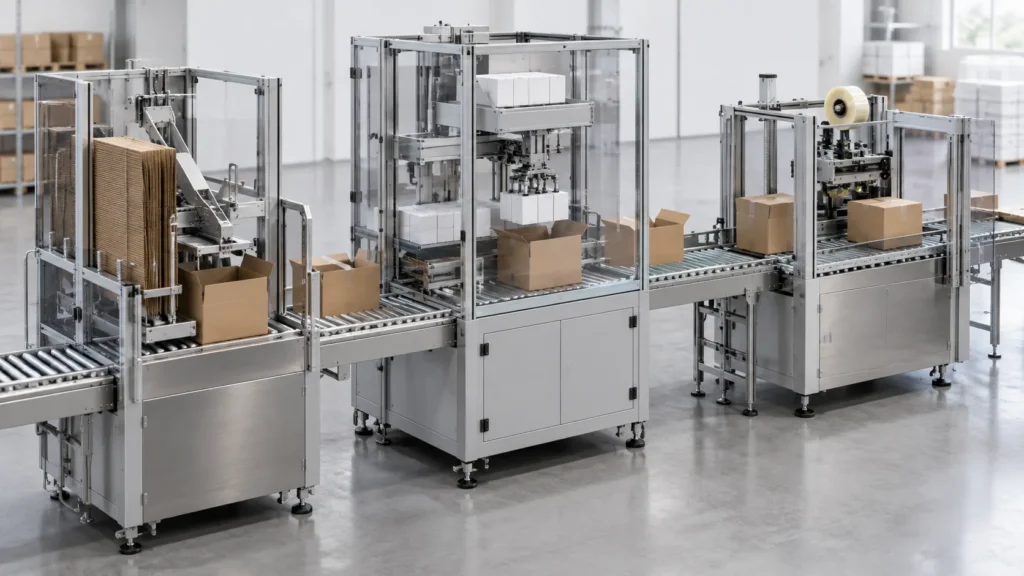
| Case erector | Carton erector, box erector, case former, box former | Case sealer, which closes cases after loading |
| Tray former | Tray erector, tray forming machine | Tray sealer (seals film lids onto filled trays) |
| Case packer | Case loader, casepacker, packer | Cartoner; case packers load products or cartons into shipping cases |
| Wraparound case packer | Wraparound packer, wrap-around case former and loader | Case erector; the case is formed around the product instead of before loading |
| Erect-load-seal system | Integrated case packing system, case erector-packer-sealer | Three separate machines doing the same jobs; the scope of supply differs |
| Case sealer | Carton sealer, box sealer, case taper, carton taper | Heat sealer (seals film or pouches) |
| Cartoner | Cartoning machine, cartoning system | Case packer; cartoners usually handle folding retail cartons, not corrugated shipping cases |
| Multipacker | Multipacking machine, cluster packer | Shrink bundler, which groups packs with film rather than paperboard |
| Palletizer | Palletiser, pallet stacker; robotic and layer palletizers are common subtypes | Depalletizer (unloads pallets) |
“Case erector” and “case former” are often used as synonyms. Some people reserve “erector” for opening knocked-down cases with pre-glued seams and “former” for building a case or tray from a flat die-cut blank. Ask the supplier which case style the machine handles. For the job split between forming and closing cases, see carton erector vs carton sealer, and for the wider family, end-of-line equipment.
Feeding, conveying and inspection
| Common name | Also called | Easily confused with |
|---|---|---|
| Unscrambler | Bottle unscrambler, container unscrambler, orienter | Rotary accumulation table (buffers containers, does not orient them) |
| Rotary table | Turntable, accumulation table, loading table | Unscrambler |
| Vibratory bowl feeder | Bowl feeder, vibratory feeder | Cap sorter (a bowl feeder may be used as one) |
| Checkweigher | Check weigher, inline checkweigher, dynamic checkweigher | Weigh filler or multihead weigher (dose product) |
| Metal detector | Metal detection system | X-ray inspection system, which can find some non-metal contaminants and check other features |
| Vision inspection system | Camera inspection, machine vision system | Code reader or scanner, which only reads codes |
Abbreviations You Will Meet
| Abbreviation | Usually means | Watch out |
|---|---|---|
| FFS | Form-fill-seal | Covers several machine types; check whether vertical, horizontal or thermoform |
| VFFS | Vertical form-fill-seal | Often simply called a bagger |
| HFFS | Horizontal form-fill-seal | Includes flow wrappers and horizontal pouch machines |
| CIJ | Continuous inkjet | A coding technology, not a machine brand |
| TIJ | Thermal inkjet | Not the same as thermal transfer |
| TTO | Thermal transfer overprinter | Prints with a ribbon onto film or labels |
| DOD | Drop on demand | A family of inkjet methods, including TIJ and piezo printheads |
| RSC | Regular slotted container | A case style, not a machine; case erectors and sealers are often specified by it |
| EOL | End of line | The equipment group from case packing to palletizing, depending on the plant |
Names That Change the Scope of a Quote
Alternate names are not only a search problem. They also affect what you buy. A few examples show how one name can cover different scopes:
- “Filling machine” vs “filling line.” A quote for a filling machine may cover only the filler. A filling line may also include container handling, capping, labeling and coding.
- “Shrink wrap machine.” This can mean a sealer alone, a sealer with a shrink tunnel, or a complete system with infeed conveyors. Confirm which parts are included.
- “Case packer.” Some case packers include case erecting and sealing. Others expect open cases from a separate erector and send loaded cases on to a separate sealer.
- “Labeling machine.” It may be a complete machine with its own conveyor and product handling, or an applicator head meant to mount on an existing line.
- “Monoblock.” The functions combined on one frame vary by supplier.
When comparing suppliers, write your requirement in terms of input, operation and output rather than a machine name alone. Add the product, package format, target output range and the stations you expect to be included. Our machine selection guides cover how to define requirements before requesting quotes.
Frequently Asked Questions
Is a carton sealer the same as a case sealer?
Usually, yes, when both refer to machines that close corrugated cases with tape or adhesive. Some suppliers use “carton sealer” for folding-carton closing as well, so check the package type the machine is designed for.
Is a flow wrapper the same as a horizontal form-fill-seal machine?
A flow wrapper is one type of horizontal form-fill-seal machine. The term HFFS also covers horizontal machines that form and fill pouches, so not every HFFS machine is a flow wrapper.
What is the difference between a shrink wrapper and a shrink tunnel?
The shrink wrapper, such as an L-bar or side sealer, wraps and seals the film around the product. The shrink tunnel applies heat to shrink the film. Some suppliers call the combination a shrink wrapper, so check whether a quote includes both.
Are a checkweigher and a weigh filler the same?
No. A weigh filler doses product by weight into the package. A checkweigher weighs packages after packing and can reject those outside set limits. A line may use both.
Why do suppliers use different names for the same machine?
Naming depends on region, industry, the package vocabulary a supplier uses, and product branding. No single naming standard applies across all manufacturers.
Where to Go Next
- To learn the main equipment families, start at machine types.
- For operating and line vocabulary, see packaging machine terms explained and the glossary.
- If you are matching a machine to your product and package, continue with the machine selection guides.