
A filling machine puts a measured amount of product into a container or package. A weighing machine measures mass. In packaging, the two overlap more than the names suggest: some filling machines use weight to decide when a fill is complete, some weighing machines exist only to portion product for a separate packaging machine, and some weighing machines only check packages after they have been filled.
So the useful question is rarely “filler or weigher?” It is usually: how should this product be measured, and where in the line should weight be controlled or checked?
This guide separates the machines that are often grouped under these two labels, compares volume-based and weight-based filling, and explains where a checkweigher fits.
Why the Two Terms Get Mixed Up
Packaging-machine names are not standardized. Suppliers sell “weighing and filling machines,” “weigh fillers,” “multihead weigher packing machines,” and “automatic weighers,” and the same word can mean different equipment from one manufacturer to the next.
A clearer way to compare them is to describe what each machine receives, what it does, and what it discharges.
| Machine | Receives | Main job | Discharges | Does it set the fill quantity? |
|---|---|---|---|---|
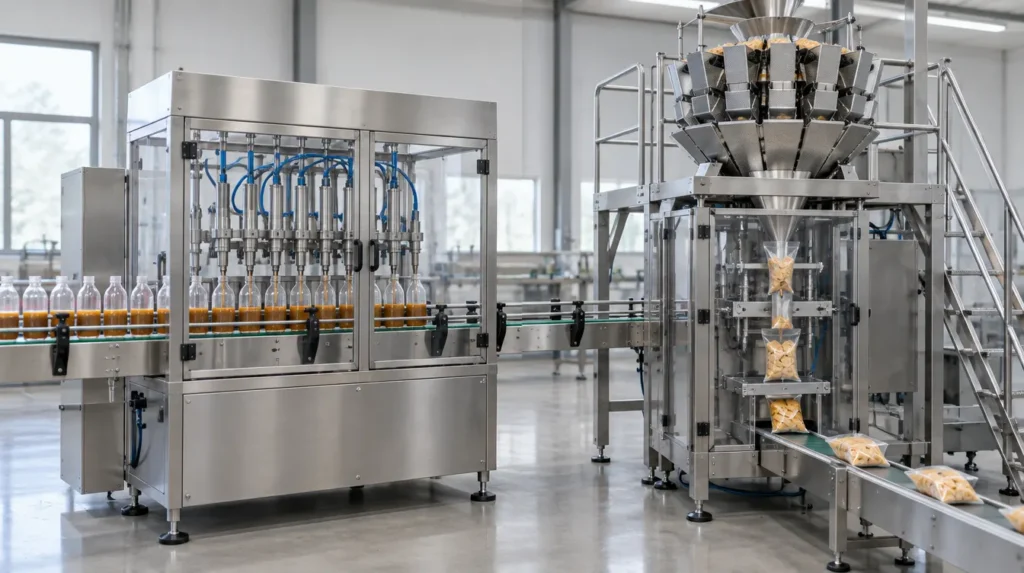
| Volumetric or level filling machine | Bulk product and empty containers | Doses a set volume, or fills to a set level or time | Filled containers | Yes, by volume, level, or time |
| Weigh filler (net or gross weight) | Bulk product and empty containers | Fills until a target weight is reached | Filled containers | Yes, by weight |
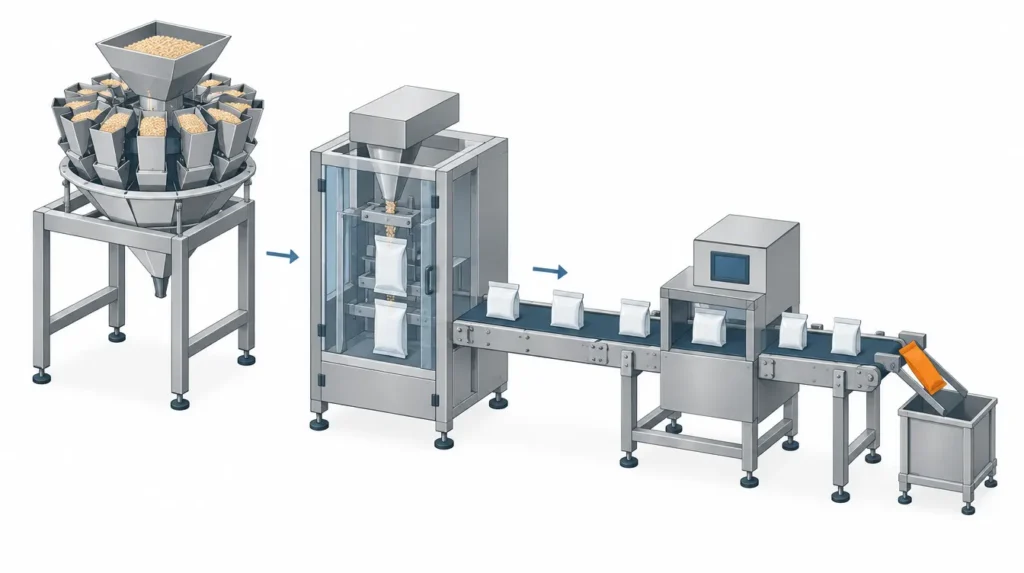
| Multihead, linear, or cumulative weigher | Bulk product, usually solids | Divides product into weighed portions | Weighed portions dropped into a separate packaging machine | Yes, by weight, but it does not package the product itself |
| Checkweigher | Filled, usually closed packages | Weighs each package and sorts or rejects those outside set limits | Accepted and rejected packages | No. It verifies; it does not dose |
Two of these four are filling machines. One is a weighing unit that does the dosing for a packaging machine. Only the last one is a weighing machine in the inspection sense.
What “Weighing Machine” Usually Means in Packaging
1. Weighing dosing units: multihead, linear, and cumulative weighers
These machines portion product by weight and hand it to another machine that forms or holds the package, commonly a vertical form fill seal bagger, a cup or container filling line, or a tray line.
A multihead weigher (also called a combination weigher) feeds product into a ring of small weigh hoppers mounted on load cells. Each hopper holds only part of the target weight. The controller then selects the combination of hoppers whose total is closest to the target and discharges them together. Because the fill is built from several partial loads rather than one large one, the method suits free-flowing granules and pieces such as snacks, frozen foods, nuts, or hardware. Sticky, oily, very fine, or dusty products can be harder to handle and may need special hopper surfaces, a different weighing method, or a different filling principle.
A linear weigher feeds product into one or a few weigh buckets in a straight line, while a cumulative weigher builds a fill through more than one weighing cycle. Which design fits depends on the product, target weight range, and required output.
International legal-metrology guidance treats these as filling instruments, not just scales. OIML Recommendation R 61, which covers automatic gravimetric filling instruments, includes associative (combination), cumulative, and subtractive weighers. That classification is a useful reminder that a “weigher” on a packaging line is doing the dosing job.
2. Weigh fillers: filling machines that fill by weight
A weigh filler is a filling machine whose fill is controlled by a load cell rather than by a cylinder volume or a fill level. Two arrangements are common:
- Net-weight filling: product is weighed in a separate hopper or bucket, then discharged into the container. The container’s own weight does not enter the measurement.
- Gross-weight filling: the container stands on the scale while it is filled, and the controls account for the container’s weight.
Weigh fillers are used for liquids, powders, granules, and bulk solids, and in formats ranging from small containers to large bags and drums. Our overview of filling methods, including net weigh filling explains how weight-based filling sits alongside piston, gravity, overflow, and pump fillers.
3. Checkweighers: weighing after filling
A checkweigher weighs packages one at a time as they move along a conveyor and sorts them by how far their weight deviates from a nominal set point. In OIML terms it is a type of automatic catchweighing instrument (Recommendation R 51).
A checkweigher does not put product into anything. It confirms that the filler or weigher upstream did its job, rejects packages outside the set limits, and often records weight data for quality review.
How a Filling Machine Measures Without Weighing
Many filling machines never weigh the product. They control something that should correspond to a consistent quantity:
- Piston fillers displace a set volume per stroke.
- Auger fillers dose powder by a set number of screw revolutions.
- Volumetric cup fillers fill measuring cups of a set volume.
- Flow meter fillers measure the volume that passes through the meter.
- Time-gravity fillers open a valve for a set time at a controlled flow.
- Overflow (level) fillers fill each container to the same height.
Each method gives a consistent volume, level, or time. Whether that also gives a consistent weight depends on the product.
For a liquid with stable density and temperature, a consistent volume usually means a fairly consistent weight. For powders and granules, bulk density can shift with aeration, settling in the hopper, particle size, and moisture, so a fixed volume can contain a varying amount of product. Level filling has a different trade-off: every container looks equally full, but the actual quantity follows the container’s internal dimensions.
Volume-Based Filling vs Weight-Based Dosing
This table compares the two measurement principles, whether the weight-based equipment is a weigh filler or a separate weigher feeding a packaging machine.
| Factor | Volume, level, or time-based filling | Weight-based dosing or filling |
|---|---|---|
| What is controlled | Volume, fill height, or time | Mass of product |
| Effect of density changes | Fill weight drifts if density changes | Fill weight stays tied to the target; volume varies instead |
| Typical product fit | Liquids, pastes, creams, and powders with reasonably stable density | Products sold by weight, irregular pieces, granules, products with variable density |
| Products that can be difficult | Aerated or variable-density powders, irregular pieces | Sticky, oily, or very dusty products (depends on design) |
| Dependence on container | Level filling depends on container consistency | Gross-weight filling must account for container weight variation |
| Sensitivity to the environment | Temperature, viscosity, and entrained air affect volume | Vibration, air movement, and unstable mounting can affect weighing |
| Setpoint changes | May involve mechanical adjustment or change parts | Often a control setpoint, though product changes may still need setup and recalibration |
| Ongoing verification | Usually checked by periodic or inline weighing | Scales need calibration and verification under the applicable rules |
| Cost categories to compare | Change parts, wear parts, calibration checks | Load cells, controls, calibration, any legal-for-trade verification |
Neither principle is better across the board. A volumetric filler matched to a consistent product can perform very well, and a weigher applied to a product it handles poorly can struggle. Actual accuracy and output depend on the specific machine, product, target quantity, and setup, so treat supplier figures as conditional and ask what product and conditions they were measured with.
Where a Checkweigher Fits
A checkweigher is not an alternative to either filling method. It sits downstream, usually after the package is closed, and answers one question: is this package within the weight limits?
Three points matter when planning a line:
- It detects; it does not correct. A checkweigher can reject an underfilled pack, but the product loss and the root cause remain upstream.
- It can support the filler. On some lines, checkweigher trend data is used to adjust filler or weigher setpoints. Whether this is possible depends on the equipment and how it is integrated, so confirm it with the suppliers involved.
- It is often used with both methods. A volumetric filler may rely on a checkweigher to confirm weight, and a weight-based filler may still use one for final verification, data records, or customer requirements.
If packages are already failing weight checks, start with the filling process. Our guide to a filling machine not filling accurately covers common causes such as unstable product, worn parts, and calibration.
How to Decide What Your Line Needs
Define the requirement before choosing the machine. These questions usually point toward the right measurement approach:
- How is the quantity declared on the label? Products declared by mass often use weight-based dosing, or volumetric filling with weight verification. Products declared by volume often use volumetric or level filling. Practice varies by product and market.
- How stable is the product’s density? The more density varies between batches or during a run, the harder it is to hold a consistent weight with volume alone.
- What form is the product? Free-flowing granules, irregular pieces, fine powder, sticky product, liquid, and paste each favor different equipment.
- What is the package? A rigid container moving through a filler is a different problem from a bag formed and sealed under a weigher.
- How costly is overfill or underfill? For high-value products, giveaway can be a major operating cost. For any declared quantity, underfill can create compliance and customer issues.
- What output and changeover pattern do you need? Weighing needs time for readings to stabilize, and different designs handle this differently. Frequent product changes affect cleaning and setup time for both approaches.
- How will it integrate? A weigher must be timed with the packaging machine below it. A filler must work with container handling, capping or sealing, and conveyors. Layout, platform height, and access for cleaning all matter.
- Which weighing rules apply? If the fill quantity is used for trade, check which instrument requirements and verification apply in your market. OIML recommendations are reference documents that national authorities adopt in different ways.
Trials with your actual product, packaging, and target quantities are the most reliable way to compare options. For a wider framework, see our machine selection guides.
Example Line Configurations
The examples below illustrate how the equipment is commonly combined. They are not recommendations for a specific product.
| Example product | A common arrangement | Where weight is controlled or checked |
|---|---|---|
| Snack chips in pillow bags | Multihead weigher above a vertical form fill seal bagger, then a checkweigher | Weigher sets the portion; checkweigher verifies sealed bags |
| Sauce in bottles | Piston or flow meter filler, capper, then a checkweigher or fill-level inspection | Filler sets volume; downstream check confirms it |
| Powder in jars | Auger filler, sometimes with weight feedback or a downstream checkweigher | Auger sets volume; weighing confirms or corrects |
| Bulk material in large bags | Net or gross weigh bagging system | Weighing unit sets the fill directly |
Common Misunderstandings
“A weighing machine is always more accurate than a filling machine.” Not necessarily. Accuracy depends on how well the method suits the product, and on design, setup, and environment.
“A multihead weigher is a complete packaging machine.” It portions product. It needs a bagger, container line, or other packaging machine to create the finished pack.
“A checkweigher will fix fill accuracy.” It identifies and removes out-of-limit packs. Fixing the cause happens at the filler or weigher.
“Filling by weight removes the need to calibrate.” Load cells and weighing controls still need calibration and verification, following the manufacturer’s instructions and any applicable rules.
Practical Limits
Speed, accuracy, and suitability figures for any filler, weigher, or checkweigher depend on the model, product, target quantity, and line setup, so they should come from the manufacturer’s documentation for your application. Calibration, adjustment, and any work inside guards or on load cells, drives, or controls should follow the OEM manual and site procedures and be carried out by qualified personnel.
To compare other equipment pairs, browse our machine-vs-machine comparisons, or explore the filling machines hub for more on filling equipment.
FAQ
Is a weigh filler a filling machine or a weighing machine?
Both. It is a filling machine that uses weighing to control the fill, which is why the two terms overlap.
Can a filling machine fill by weight?
Yes. Net-weight and gross-weight fillers stop the fill at a target weight. Many other fillers control volume, level, or time instead.
Is a multihead weigher a filling machine?
It is a weighing and dosing unit. It determines how much product goes into each pack, but it relies on a separate packaging machine to hold or form the package.
Do I need a checkweigher if I already fill by weight?
It depends on your quality system, customer requirements, and the rules that apply to your product. Many lines use one for final verification and data records, even with weight-based filling.
Which is better for powders, volumetric or weight-based filling?
There is no single answer. Auger filling is widely used for powders, and weight-based filling or weight feedback is often considered when bulk density varies. Trials with the actual powder are the best way to decide.