

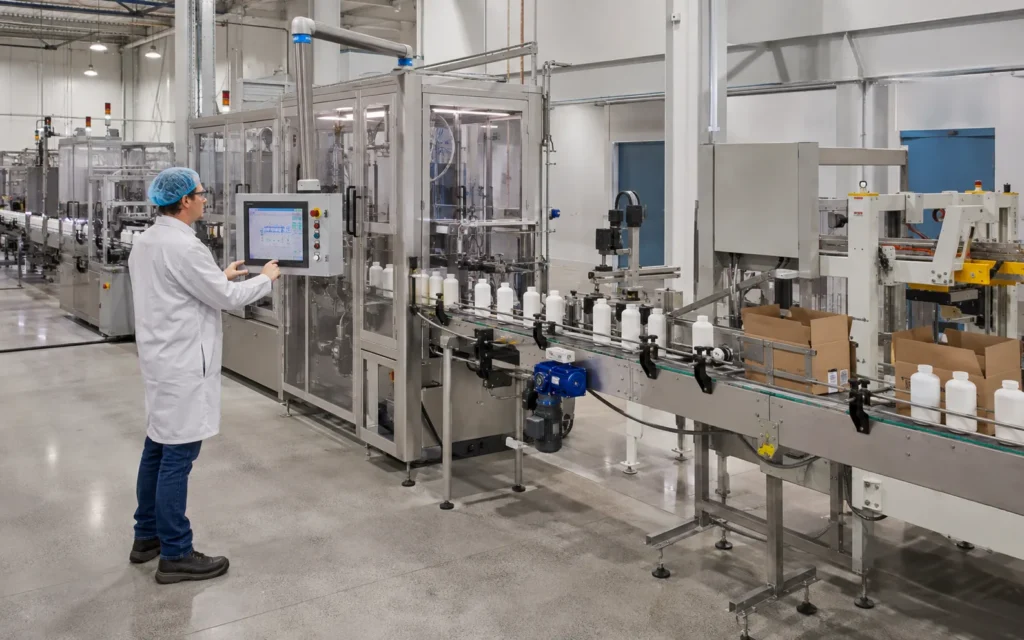
Packaging machinery combines vocabulary from several different areas: package formats, machine functions, automation and controls, production performance, material handling, maintenance, and end-of-line operations. That is why a quotation can mention a “servo-driven intermittent-motion cartoner with recipe-based changeover” and leave a perfectly experienced production person wondering which details actually matter. Terminology also varies between manufacturers, industries, countries, and individual factories. This guide explains common packaging machine terms in the context of a real production line rather than treating them as isolated dictionary definitions.
1. Packaging Levels and Basic Line Terms
Primary Packaging
The packaging level that first contains the product and, in many applications, is designed to come into direct contact with it. Examples include a beverage bottle, a sealed food pouch, a blister holding tablets, or a jar containing sauce.
The idea needs some care because specialized industries can use more precise definitions for sterile barriers, combination packages, unit-dose formats, or other regulated packaging systems. When discussing equipment, identify the actual package rather than assuming everyone uses “primary packaging” in exactly the same way.
Secondary Packaging
Packaging that contains, groups, protects, handles, or presents one or more primary packages. A folding carton around a bottle, a tray holding several containers, or a corrugated case containing finished packs may be described as secondary packaging depending on the operation and terminology being used.
Tertiary Packaging
Packaging associated mainly with bulk handling, distribution, storage, and transport. Palletized loads are a common example. Stretch wrapping, pallet labeling, and some end-of-line operations therefore sit in the tertiary or distribution-packaging part of a factory.
Packaging Line
A sequence of machines and handling equipment that moves a product through packaging operations. A line may include filling, closing, labeling, inspection, conveying, case packing, and palletizing, but there is no requirement for every line to contain every machine type.
Packaging Machine
An individual machine performing one or more packaging functions. A filler, flow wrapper, cartoner, labeler, or case sealer can each be described as a packaging machine.
Packaging System
A broader term that can include several machines plus conveyors, controls, inspection equipment, utilities, safety systems, and interfaces. Suppliers sometimes use “system” for an integrated cell rather than one standalone machine.
Upstream
Equipment or processes earlier in the direction of production flow. If a capper follows a filler, the filler is upstream of the capper.
Downstream
Equipment later in the production flow. A labeler positioned after a capper is downstream of it.
Infeed
The area where products, packages, or materials enter a machine. An infeed may include conveyors, guides, screws, belts, timing devices, sensors, or other mechanisms that establish correct spacing and orientation.
Outfeed
The discharge side of a machine, where processed products leave and transfer to the next operation.
Line Integration
The mechanical, electrical, controls, safety, and production coordination required to make separate machines operate as one line. Connecting conveyors physically is only one part of integration.
End-of-Line Packaging
Operations near the end of packaging, typically after the individual product package is complete. Case packing, case sealing, palletizing, pallet labeling, and load wrapping are common examples. See PackMachineryLab’s end-of-line equipment guide for related equipment categories.
Package Format
The physical package configuration being run: for example, a particular bottle, pouch, carton, tray, case, or multipack style and size. “New format” normally implies that some machine settings or parts may need to change.
SKU
Stock Keeping Unit. In packaging-line discussions, an SKU represents a distinct sellable or inventory item that may require its own product, package size, label, code, case configuration, or machine recipe. More SKUs usually mean more changeover considerations.
2. Machine Function Terms
Filler / Filling Machine
A machine that places a controlled quantity of product into a container or package. The method depends heavily on the product: free-flowing liquid, viscous paste, powder, granules, tablets, and discrete pieces require different handling and dosing principles. Explore the site’s filling machine guides for individual technologies.
Dosing
Measuring or controlling how much product is delivered. Dosing may be based on volume, mass, count, time, level, screw rotation, pump displacement, or another method. A dosing device may be part of a filler rather than a separate machine.
Capping Machine
A machine that applies or tightens caps or similar closures onto containers. Depending on the closure, the operation may involve screwing, pressing, snapping, rolling, or other mechanisms.
Closing Machine
A broad term for equipment that closes a package. Capping is one type of closing, but closing can also involve folding, tucking, crimping, seaming, clipping, or applying another closure.
Sealing Machine
Equipment that creates or completes a seal in packaging material or a package interface. Heat sealing, induction sealing, ultrasonic sealing, adhesive sealing, and tray sealing are examples. “Closing” and “sealing” overlap in everyday machinery language but are not always technically identical. More examples are covered in the sealing machine section.
Form-Fill-Seal (FFS)
A machine architecture in which packaging material is formed into a package, product is filled or inserted, and the package is sealed within the same machine process. FFS is a family of technologies rather than one specific machine design.
VFFS
Vertical Form-Fill-Seal. Packaging material typically travels through a vertical forming process, with product introduced from above. VFFS is widely associated with bags and pouches for snacks, powders, grains, frozen products, and many other products, though the exact machine configuration depends on the application.
HFFS
Horizontal Form-Fill-Seal. The product and packaging material move predominantly through a horizontal process. The term covers several configurations and is commonly associated with flow wrapping and horizontal pouch systems.
Flow Wrapper
A horizontal packaging machine that forms flexible film around products and makes longitudinal and transverse seals. Individual bakery products, bars, produce, medical items, and many other products can be flow wrapped. A flow wrapper is commonly an HFFS machine, but not every HFFS system should automatically be treated as the same type of flow wrapper.
Shrink Wrapper
Equipment that surrounds a product or group with shrinkable film and uses heat to contract the film around it. Systems range from product-level shrink packs to larger bundling and hooding applications.
Stretch Wrapper
A machine that applies stretch film under controlled tension. Pallet wrapping is one of the most common uses, although orbital and specialized stretch wrapping systems handle other load shapes as well.
Shrink and stretch wrapping are different processes. Shrink film contracts through heat; stretch film relies mainly on elongation, tension, and containment force. See the wrapping machine guides for more detail.
Cartoner
A machine that forms or opens cartons, loads product into them, and closes or seals them, depending on the machine design. Horizontal end-load and vertical/top-load cartoners are common categories. In this context, “carton” often means a relatively small consumer or retail paperboard package.
Carton Erector / Case Erector
A case erector usually takes flat corrugated case blanks, opens them, forms the case, folds the bottom flaps, and often seals the bottom. “Carton erector” is less precise because some suppliers use it for paperboard cartons while others use carton, box, and case terminology interchangeably. When reading a quotation, check the blank material, case style, dimensions, and forming method rather than relying on the name alone.
Case Packer
A machine that loads finished products or smaller packages into a shipping case or tray. Loading can be top-load, side-load, bottom-load, drop packing, pick-and-place, robotic, or another arrangement.
Case Sealer
A machine that closes and seals a filled corrugated case, commonly using tape or hot-melt adhesive. A case erector makes the empty case ready for packing; a case sealer normally closes it after product has been loaded.
Tray Former
A machine that forms flat blanks into trays. Depending on the design, tabs or panels may be folded and locked or adhesive may be applied.
Labeler / Label Applicator
Equipment that applies labels to products, containers, cartons, or cases. Depending on the machine, it may dispense preprinted pressure-sensitive labels, apply glue-based labels, handle sleeves, or form part of a print-and-apply system. Related technologies are grouped in PackMachineryLab’s labeling machine section.
Coding and Marking Equipment
Equipment used to add variable or permanent information such as date codes, lot numbers, batch identifiers, barcodes, serial information, or other marks. Technologies may include inkjet, laser, thermal transfer, thermal inkjet, and print-and-apply systems. Coding is not the same thing as applying a preprinted product label.
Palletizer
A machine or robotic system that arranges cases, bags, trays, or other packages onto pallets according to a defined pattern.
Depalletizer
Equipment that removes products, cases, trays, containers, or layers from a pallet and feeds them into production or packaging operations.
No packaging line needs all of these machine types. A pouch line may never use a bottle capper, while an e-commerce operation may have case sealing and labeling without any filling machine.
3. Product and Material Handling Terms
Many apparent “machine problems” actually begin with product handling. A fast machine cannot maintain output if products arrive at the wrong spacing, orientation, elevation, or rate.
Conveyor
Equipment that transports products, packages, cases, or pallets. Packaging conveyors may use belts, tabletop chains, rollers, modular belts, chains, pucks, or specialized surfaces. For more detail, see the packaging conveyor system guide.
Accumulation
Temporarily holding products between operations so a short stop at one machine does not immediately stop the entire line. Accumulation can be pressure, low-pressure, zero-pressure, mass-flow, table-based, spiral, or another design.
Buffer
A temporary capacity or holding zone between processes. In packaging, a buffer often performs an accumulation function, although “buffer” can also describe storage or time capacity more generally.
Transfer
The point or mechanism where a product moves from one conveyor, machine, belt, or handling device to another. Small transfer gaps and height mismatches can be significant when packages are short, flexible, unstable, or lightweight.
Lane
A defined path of product flow. A line may run single-lane or divide products into multiple parallel lanes before packing, inspection, or another operation.
Lane Divider
A device or conveyor section that separates one incoming stream into two or more lanes.
Merge
The opposite flow concept: two or more incoming product or case streams are combined into fewer lanes or one conveyor.
Indexing
Moving products through controlled steps or positions rather than letting them travel continuously. An indexing conveyor may advance products, stop them for an operation, then advance again.
Continuous Motion
A machine design in which products or major mechanisms continue moving during the packaging operation rather than stopping for every cycle. This can support high throughput, but the term alone does not tell you the machine’s actual output.
Intermittent Motion
A process where product or machine motion periodically stops or indexes so an operation can occur. Intermittent motion is not automatically “slow”; actual capability depends on the application and machine design.
Product Pitch / Spacing
The controlled distance from one product position to the next, often measured center-to-center. Correct pitch is important for timing screws, flights, sealing jaws, robotic picks, sensors, and other synchronized mechanisms.
Singulation
Separating randomly grouped or touching products into distinct individual items so downstream equipment can detect and handle them reliably.
Orientation
The direction or rotational position in which a product is presented. A package may need a cap, seam, label panel, barcode, handle, or opening facing a particular direction before the next operation.
Reject Station
An area where packages failing a defined inspection or process criterion are diverted from normal production flow. The detection device and the physical reject mechanism may be separate components.
Change in Conveyor Elevation
A transition to a higher or lower conveying level using an incline, decline, lift, elevator, spiral, or another device. Product stability, transfer geometry, floor space, and access become important when elevation changes.
4. Speed and Production Terms
Throughput
The quantity of product or packages that moves successfully through a machine, process, or complete line over a given time. Depending on the report, throughput may mean total processed units or accepted/good output, so the counting basis should be stated.
Machine Speed
The operating rate of a specific machine. It may be given in cycles per minute, packages per minute, containers per minute, linear speed, or another measure. The term is incomplete without a unit and operating condition.
Line Speed
This phrase is particularly ambiguous. It may mean overall packaging output, the target rate through a line, or the physical speed of a conveyor or web. When someone says “line speed is 30 meters per minute,” they mean something different from “the line runs 200 bottles per minute.”
Rated Speed
A stated machine capability under defined or assumed operating conditions. Rated speed should not automatically be treated as guaranteed sustained output on every product, material, package size, or integrated line.
Actual Output
What the process really produces over a measured period. Actual output is affected by short stops, material replenishment, changeovers, rejects, upstream supply, downstream blocking, operator activity, and other real production conditions.
Units per Minute
A generic rate expression. The “unit” must be defined. A specification may use bottles per minute, bags per minute, cartons per minute, cases per minute, or cycles per minute. Do not assume abbreviations such as UPM or PPM represent the same physical package across different machines or suppliers.
Cycle Time
The time required for one machine or process cycle. What constitutes a cycle depends on the equipment. One cycle may make one pack, several packs, one machine index, or one group.
Takt Time
A production-demand concept: available production time divided by customer demand. Takt time expresses the required production rhythm needed to match demand. It is not simply another name for a machine’s measured cycle time.
Bottleneck
The process or constraint that limits the achievable output of the overall line under the conditions being considered. The nominally slowest machine is not always the real bottleneck; reliability, accumulation, changeovers, and product handling also matter.
Starved
A machine is starved when it is ready to run but does not receive enough product or material from upstream. A labeler waiting for bottles because the filler has stopped is a straightforward example.
Blocked
A machine is blocked when it cannot discharge because downstream equipment or conveying is unable to accept more product.
Downtime
Time during which equipment is not producing when it otherwise could or was expected to produce. Plants differ in exactly which events they include in downtime calculations.
Uptime
A measure of equipment being available or operating over a defined period. The denominator matters: calendar time, scheduled production time, or another time base can produce different percentages.
Planned Downtime
Scheduled non-production time such as planned maintenance, sanitation, inspections, or certain planned changeovers, depending on the facility’s reporting rules.
Unplanned Downtime
Unexpected lost production time caused by breakdowns, jams, faults, material issues, process interruptions, or other unscheduled events.
5. Changeover and Flexibility Terms
Changeover
The work required to switch a machine or line from one product, package, SKU, or production configuration to another. It can include cleaning, replacing mechanical parts, adjusting guides, loading materials, selecting recipes, changing labels or codes, and verifying the new setup.
Format Change
A change associated with package dimensions, shape, configuration, or machine format. Some factories use “format change” and “changeover” almost interchangeably; others reserve format change for mechanical package-size changes.
Recipe
A stored set of machine parameters associated with a product or format. Selecting a recipe may load speeds, positions, timing values, temperatures, fill settings, or other parameters. A recipe cannot physically replace mechanical change parts unless the machine is designed to adjust those functions automatically.
Tooling
Parts or assemblies needed to handle or process a particular package or product. Examples can include guides, forming sets, grippers, pockets, stars, screws, sealing components, or fixtures.
Change Parts
Removable machine components exchanged when switching formats. “Tooling” and “change parts” overlap, but supplier terminology varies.
Adjustment
A position, dimension, setting, tension, pressure, speed, timing value, or similar machine parameter altered for correct operation.
Automatic Changeover
A system in which selected format adjustments are repositioned automatically, often using servos, motorized axes, or controlled actuators. It does not necessarily mean that every changeover action, material change, cleaning step, inspection, or production verification occurs without human intervention.
Tool-Less Changeover
Designed so specified changeover actions can be completed without conventional hand tools. It does not automatically mean there are no change parts, adjustments, checks, or operator tasks.
Quick Changeover
A general description for designs and procedures intended to reduce changeover time. It is not a universal performance specification; ask how changeover time is measured and what tasks are included.
Package dimensions are only part of changeover. Product viscosity, fragility, surface condition, fill weight, container stability, film thickness, label stock, closure design, corrugated quality, and many other product and material characteristics can require different settings or hardware.
Automation level also changes what a changeover looks like. PackMachineryLab’s automatic vs semi-automatic packaging machine guide explains the broader difference in operator involvement.
6. Automation and Controls Terms
PLC — Programmable Logic Controller
An industrial controller that reads inputs, executes programmed logic, and controls outputs. On a packaging machine, the PLC may coordinate sensors, valves, motors, conveyors, sequences, alarms, and machine states. Calling it the machine’s “computer” is useful shorthand, although an automated machine can also contain motion controllers, safety controllers, industrial PCs, drives, and other control hardware.
HMI — Human-Machine Interface
The operator interface used to view status and interact with the machine. It may provide start/stop controls, production information, recipe selection, settings, alarms, maintenance screens, diagnostics, and manual functions depending on access permissions and machine design.
Servo Motor
A motor used with feedback and a servo drive for accurate control of position, velocity, and/or torque. Packaging machines often use servo systems for synchronized motion, accurate indexing, electronic camming, product pitch, or automatic positioning.
VFD — Variable Frequency Drive
An electronic drive commonly used to control the speed and torque of AC motors. Conveyors, pumps, fans, and other rotating equipment frequently use VFDs. Servo and VFD systems overlap in some applications, but a servo system is generally selected where more precise closed-loop motion control is required.
Sensor
A device that detects a physical condition and provides information to the control system. Machines use sensors for presence, position, pressure, temperature, level, speed, distance, safety functions, and many other purposes.
Photoelectric Sensor / Photoeye
A sensor that uses light to detect objects or changes in received light. Packaging machines frequently use photoeyes for product presence, counting, spacing, registration, or conveyor control.
Encoder
A feedback device that converts mechanical motion into electrical information representing position and/or speed. Encoders can help synchronize conveyors, film movement, sealing jaws, printing, cutting, and servo-controlled mechanisms.
Pneumatic System
A system using compressed air to power cylinders, grippers, valves, actuators, or other functions. “Air requirement” in a specification normally needs both pressure and flow information, not pressure alone.
Vacuum System
A system using negative pressure for suction, gripping, lifting, opening cartons, holding film or packages, or other handling functions.
I/O — Inputs and Outputs
The signals through which controllers receive information and command devices. A sensor may provide an input; a solenoid valve or motor command may be an output. I/O can be physical, networked, digital, analog, safety-related, or another type.
Alarm
A message or indication that a condition requires attention. Some alarms allow continued production; others lead to a stop. The exact classification is machine-specific.
Fault
A detected abnormal condition that often prevents normal operation or requires corrective action. Manufacturers do not use “fault” and “alarm” identically, so the machine manual is the correct source for a particular alarm hierarchy.
Interlock
A logical or physical condition that prevents an action unless required conditions are satisfied. Process interlocks can coordinate machines or stop conflicting actions.
Safety Interlock
An interlocking function specifically associated with safety, such as monitoring access through a guard door as part of a designed safety system. A normal process interlock should not automatically be assumed to be a safety-rated function.
Recipe Management
The storage, retrieval, control, and sometimes authorization of machine parameter sets for different products or formats. More advanced systems may also manage revision history or communication with line-level systems.
Machine State
A defined operating condition such as stopped, starting, executing, held, suspended, or aborted. Exact state names and transitions depend on the control architecture; standardized approaches such as PackML are intended to make these behaviors more consistent.
What Does PackML Mean?
PackML is an automation framework developed through OMAC and adopted by ISA that standardizes concepts around machine states, machine behavior, and consistent data/interface structures. It is intended to make automated equipment easier to integrate and understand across machines and production systems.
For example, instead of every machine builder inventing completely different terminology for operating states and production data, PackML provides a common model that can help OEMs, integrators, and end users structure that information more consistently.
PackML is not a type of packaging machine, physical controller, packaging material, or packaging method. It also should not be assumed that every modern packaging machine implements PackML. When a specification says “PackML compliant” or “PackML compatible,” determine which version, machine-state model, PackTags/data structures, and customer requirements are actually being implemented.
7. Performance and OEE Terms
OEE — Overall Equipment Effectiveness
OEE is a production-performance metric built from three broad factors:
- Availability: how much of the planned production time the equipment was operating.
- Performance: how actual operating rate compares with the defined ideal or target rate.
- Quality: the proportion of output considered good according to the defined calculation.
It is commonly expressed as:
OEE = Availability × Performance × Quality
The useful part is not merely the final percentage. Breaking losses into availability, performance, and quality categories helps identify whether production is being lost to stops, slow running/minor interruptions, or unacceptable output.
Do not compare OEE values between plants without checking the calculation rules. Planned time, ideal cycle rate, reject definitions, startup losses, microstops, and data collection practices can differ.
Availability
The time-based OEE component associated with how much planned production time remains after relevant downtime losses.
Performance
The rate-based OEE component associated with running slower than the defined ideal rate and, depending on the implementation, other speed-related losses.
Quality
The OEE component representing acceptable output compared with total output under the organization’s chosen calculation method.
Good Count
The number of units meeting the defined acceptance criteria. What qualifies as “good” should be clear when production data is compared.
Reject / Scrap
Output removed because it fails a defined requirement. “Reject” may include units that can be reworked, while “scrap” often means material or products that will not be recovered, but company terminology varies.
Microstop / Minor Stop
A brief production interruption that may not be classified as conventional downtime in some reporting systems. There is no universal duration threshold; each organization should define how minor stops are recorded.
MTBF — Mean Time Between Failures
A reliability metric describing average operating time between defined failures for repairable equipment over the dataset being analyzed. It is a statistical metric, not a guarantee that the next failure will occur after that exact number of hours.
MTTR — Mean Time To Repair
A maintainability metric describing average time associated with repairing or restoring equipment after defined failures. Some organizations use slightly different interpretations of what time starts and stops the measurement, so check the local definition.
8. Safety and Machine-Protection Terms
Machine Guarding
Physical or engineered protection intended to prevent people from reaching hazardous machine areas or being exposed to hazards during operation. Guarding can include fixed guards, movable guards, interlocked doors, enclosures, barriers, and other protective measures appropriate to the machine.
Emergency Stop / E-stop
A control intended to initiate an emergency stopping function when an urgent hazardous situation requires it. An emergency stop should not be casually treated as the same thing as isolating hazardous energy for servicing.
Interlock
In a safety context, an interlocking device or function can monitor a protective condition and prevent or stop hazardous operation when that condition is not satisfied. Safety architecture depends on the machine and applicable standards.
Lockout/Tagout (LOTO)
A hazardous-energy control practice used during covered servicing and maintenance activities to protect workers from unexpected energization, startup, or release of stored energy. Requirements depend on applicable law and workplace procedures. An HMI stop button or ordinary machine stop is not automatically an energy-isolating device.
9. Maintenance Terms
Preventive Maintenance
Maintenance carried out on a planned schedule or usage basis to reduce the probability of deterioration or failure. Typical activities can include inspection, cleaning, lubrication, tension checks, and scheduled replacement.
Predictive Maintenance
Maintenance decisions based on equipment condition, trends, measurements, or analytical indicators rather than only a fixed calendar interval. Examples may involve vibration, temperature, current, pressure, cycle counts, or condition-monitoring data.
Corrective Maintenance
Work performed to correct a detected fault, defect, or failure and restore equipment to its required condition.
Wear Part
A component expected to deteriorate through normal use, friction, repeated contact, heat, flexing, or another operating mechanism. Belts, seals, blades, bushings, pads, and similar components may be considered wear parts depending on the machine.
Consumable
A material or item routinely consumed during operation or maintenance. Film, tape, labels, ink, ribbon, adhesive, filters, or lubricants may fall into this category depending on the process.
Spare Part
A replacement component kept or sourced to restore equipment when an installed part fails, wears out, or is damaged. A spare part is not necessarily a normal consumable.
Lubrication Point
A specified location where the OEM requires a particular lubricant to be applied using a defined method and interval.
Inspection Interval
The prescribed time, operating hours, cycles, or other interval between inspections of a component or system.
Maintenance Schedule
The machine-specific plan stating what maintenance is required and when. Internet checklists can help organize work, but OEM documentation should determine actual intervals, lubricants, inspection criteria, and replacement requirements.
Root Cause
The underlying condition or mechanism responsible for a recurring problem rather than merely its visible symptom. A repeated jam, for example, may be caused by misaligned guides, variable package dimensions, transfer geometry, sensor timing, or another underlying issue.
Jam
A condition in which product, packaging material, or a component becomes obstructed and normal movement cannot continue. “Jam” describes the event, not its cause.
10. A Packaging Line Example Using the Terms
Consider a straightforward bottle packaging line:
Empty bottles arrive on the infeed conveyor. The filler doses product into them, and the capper closes the containers. At this point, the filler is upstream of the labeler; the case packer is downstream of both.
A PLC coordinates machine logic while operators use an HMI to monitor status, select permitted settings, review alarms, and choose the appropriate product recipe.
Suppose the line is running one 500 mL bottle and production needs to switch to a different bottle and label. The changeover might involve changing guide positions, selecting another recipe, installing suitable change parts, loading the new labels, confirming the code, and checking the first packages. If some axes reposition themselves automatically, that is part of an automatic changeover; it does not mean the entire switch is necessarily hands-free.
The line’s throughput is determined by what the integrated system can sustain, not simply by the highest number shown on one machine’s specification sheet. If the case packer cannot consistently accept the incoming production rate, it can become a bottleneck.
A short downstream interruption can make the labeler blocked because it has nowhere to discharge bottles. A correctly sized accumulation section may temporarily absorb product and keep upstream equipment operating. Conversely, if the filler stops and the labeler runs out of bottles, the labeler becomes starved.
If the line stops unexpectedly for a mechanical fault, that period can contribute to unplanned downtime according to the plant’s reporting rules. The example shows why packaging line terminology is interconnected: controls, conveyors, machine functions, production metrics, and maintenance describe different parts of the same production system.
Quick-Reference Packaging Machinery Glossary
| Term | Plain-English meaning | Where you see it | Common confusion |
|---|---|---|---|
| Primary packaging | First packaging level containing the product; commonly direct-contact packaging. | Specifications, package design | Definitions can require nuance in specialized applications. |
| Secondary packaging | Groups or protects primary packages. | Cartoning, trays, cases | Boundary with tertiary packaging can vary by context. |
| Tertiary packaging | Distribution and transport packaging. | Palletizing, warehousing | Not simply “any large package.” |
| Upstream | Earlier in production flow. | Line layouts, fault reports | Direction is relative to the point being discussed. |
| Downstream | Later in production flow. | Integration discussions | Same machine can be upstream of one machine and downstream of another. |
| Infeed | Machine entry section. | Conveyors, machine drawings | More than just the first conveyor. |
| Outfeed | Machine discharge section. | Layouts, integration | May include transfer equipment. |
| Filler | Puts a controlled amount of product into a package. | Food, beverage, chemical, pharma lines | Filling method depends on product. |
| Dosing | Controls how much product is delivered. | Filling systems | Not always a separate machine. |
| Capper | Applies or secures closures. | Bottle lines | Capping is one form of closing. |
| Sealer | Creates or completes a package seal. | Pouches, trays, bags, cases | Not identical to every type of closer. |
| FFS | Forms, fills, and seals a package in one machine process. | Flexible packaging | A technology family, not one machine design. |
| VFFS | Vertical form-fill-seal. | Bags and pouches | Not interchangeable with every bagger. |
| HFFS | Horizontal form-fill-seal. | Flow wraps and pouches | Covers more than one machine architecture. |
| Flow wrapper | Wraps products horizontally in film and seals the pack. | Bakery, bars, produce | Usually HFFS, but HFFS is broader. |
| Shrink wrapper | Uses heat to contract shrink film. | Products, trays, multipacks | Not stretch wrapping. |
| Stretch wrapper | Applies tensioned stretch film. | Pallets, large loads | Normally no shrink tunnel is involved. |
| Cartoner | Loads products into cartons and closes them. | Secondary packaging | Not the same job as a case packer. |
| Case erector | Opens and forms flat corrugated case blanks. | End-of-line | Not a case sealer. |
| Case packer | Loads products into cases. | End-of-line | Does not necessarily form or seal the case. |
| Case sealer | Closes and seals filled cases. | End-of-line | Often confused with a case erector. |
| Conveyor | Moves products or packages. | Throughout the line | Conveyor speed is not automatically line throughput. |
| Accumulation | Temporarily holds production between machines. | Conveyor systems | Not unlimited storage. |
| Transfer | Movement between conveyors or machines. | Machine interfaces | Small gaps can create major handling problems. |
| Indexing | Controlled step-by-step movement. | Intermittent machines | Not the same as continuous motion. |
| Pitch | Controlled spacing between product positions. | Servo, infeed, wrapper systems | Often center-to-center rather than empty gap. |
| Throughput | Quantity processed over time. | Production reports, RFQs | Not necessarily rated machine speed. |
| Rated speed | Stated machine capability under defined conditions. | Specifications | Not guaranteed sustained line output. |
| Cycle time | Time required for one defined process cycle. | Machine analysis | Not takt time. |
| Takt time | Production rhythm required to meet demand. | Production planning | Not simply machine cycle time. |
| Bottleneck | Constraint limiting overall output. | Line analysis | Not always the machine with the lowest catalog speed. |
| Starved | Machine cannot run because upstream supply is missing. | Line controls | Opposite situation from blocked. |
| Blocked | Machine cannot discharge downstream. | Line controls | Not necessarily a fault inside that machine. |
| Changeover | Switching from one production setup to another. | Multi-SKU production | Can include far more than mechanical adjustment. |
| Recipe | Stored machine parameter set. | HMI/control systems | Does not replace physical tooling unless designed to. |
| Change parts | Replaceable parts for different package formats. | Changeovers | Not necessarily ordinary spare parts. |
| PLC | Industrial controller running machine logic. | Control cabinets, specifications | Not necessarily the only controller in a machine. |
| HMI | Operator-machine interface. | Control panel | Interface, not the PLC itself. |
| Servo | Feedback-controlled precision motion system. | Indexing, positioning, synchronization | Not simply another word for motor. |
| VFD | Drive controlling AC motor speed/torque. | Conveyors, pumps, fans | Different control objectives from many servo applications. |
| Photoeye | Light-based object sensor. | Conveyors, registration | One type of sensor, not a general name for all sensors. |
| Encoder | Provides motion position/speed feedback. | Conveyors, film feeds, servos | Different function from a simple presence sensor. |
| Alarm | Condition requiring operator attention. | HMI | May or may not stop production. |
| Fault | Abnormal condition affecting machine operation. | Diagnostics | Alarm/fault terminology varies by OEM. |
| Interlock | Prevents an action unless conditions are satisfied. | Controls and safety | Normal interlock is not automatically safety-rated. |
| PackML | Standardized machine-state and data/interface concepts. | Automation specifications | Not a machine or packaging method. |
| OEE | Availability × performance × quality. | Production reporting | Not the same as uptime. |
| Microstop | Short production interruption. | OEE/loss analysis | No universal duration threshold. |
| MTBF | Average operating time between defined failures. | Reliability analysis | Does not predict the exact next failure. |
| MTTR | Average time to repair/restore after failures. | Maintenance metrics | Exact calculation boundaries may vary. |
| Wear part | Part expected to deteriorate in normal use. | Maintenance manuals | Different from every consumable. |
| Consumable | Material routinely consumed in operation. | Operations and purchasing | Not necessarily a machine component. |
| Jam | Obstruction preventing normal movement. | Troubleshooting | A symptom/event, not the root cause. |
Related Packaging Terms That Should Not Be Confused
| Terms | Practical distinction |
|---|---|
| Carton vs Case | A carton often means a smaller paperboard consumer package, while a case often means a corrugated shipping container. Real industry usage is not completely consistent, so confirm material, dimensions, and style. |
| Cartoner vs Case Packer | A cartoner typically puts products into cartons. A case packer normally loads finished products or smaller packages into larger cases or trays for handling and distribution. |
| Case Erector vs Case Sealer | The erector forms an empty case from a flat blank and normally closes the bottom. The sealer handles a filled case and closes/seals it for downstream handling. |
| Shrink Wrapper vs Stretch Wrapper | Shrink wrapping uses heat to contract shrinkable film. Stretch wrapping applies stretch film under tension; pallet load containment is a common application. |
| Throughput vs Machine Speed | Machine speed describes a machine’s operating rate. Throughput describes how much product actually moves through a process over time. A line can have lower throughput than the nominal speed of its fastest machines. |
| Cycle Time vs Takt Time | Cycle time describes how long a process cycle takes. Takt time is derived from available production time and demand. One describes process behavior; the other expresses the production rhythm needed to meet demand. |
| Uptime vs OEE | Uptime is fundamentally time-related. OEE incorporates availability, performance, and quality, so a machine can have high uptime while still losing effectiveness through slow running or rejects. |
| Alarm vs Fault | An alarm is generally a notification requiring attention, while a fault often represents an abnormal condition preventing or disrupting normal operation. OEM naming conventions differ, so use the machine’s own documentation. |
| Consumable vs Wear Part | A consumable is routinely used up during operation, such as film, tape, labels, or ink. A wear part is a machine component expected to deteriorate through service. Some items may fall into both categories depending on how the organization manages them. |
| Preventive vs Predictive Maintenance | Preventive maintenance follows planned intervals or usage rules. Predictive maintenance uses equipment condition or measured trends to help determine when intervention is needed. |
References and Further Reading
- ISO — Packaging Vocabulary. ISO’s packaging terminology provides formal context for primary, secondary, and tertiary packaging terminology. ISO Online Browsing Platform.
- PMMI — The Association for Packaging and Processing Technologies. PMMI’s machinery classifications cover equipment categories including capping, cartoning, case/tray sealing, case erecting, form-fill-seal, loading, inspection, and related packaging machinery. PMMI machinery classifications.
- OMAC — PackML. Industry information on PackML, common machine states, machine data, and packaging-machine integration concepts. OMAC PackML.
- International Society of Automation (ISA). Discussion of PackML state models and PackTags as machine communication concepts. Packaging Machine Communication Standards.
- Syntegon. Manufacturer documentation describing horizontal form-fill-seal and flow-wrapping technology. Horizontal Flow Wrapper / HFFS.
- Rockwell Automation. Explanation of programmable logic controllers and their role in industrial automation. PLC/PAC Controllers.
- Rockwell Automation. Technical overview comparing variable-frequency-drive and servo-drive applications. Variable Frequency Drives.
- Lean Enterprise Institute. Definition and production context for takt time as available production time divided by customer demand. Takt Time.
- Siemens. Manufacturing guidance describing OEE through availability, performance, and quality. MTBF, MTTR and OEE.
- U.S. Occupational Safety and Health Administration (OSHA). General-industry requirements and guidance concerning control of hazardous energy during servicing and maintenance. Control of Hazardous Energy — Lockout/Tagout.
Terminology and operating definitions can vary by manufacturer, application, industry, and facility. For equipment-specific settings, maintenance intervals, alarm meanings, safety functions, and servicing requirements, use the applicable OEM documentation and site procedures.