
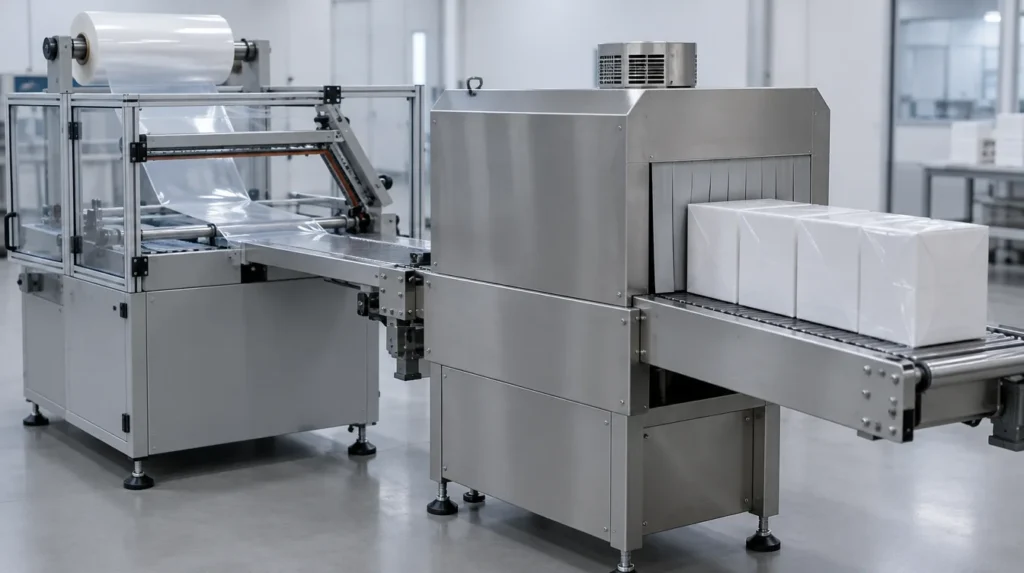
A “shrink wrap machine” is rarely one machine. In most operations it is a small system: a sealer that wraps film around the product and seals it, a heat source (usually a shrink tunnel) that shrinks the film tight, and the film itself. Buying well means choosing those three parts together, then picking the automation level, output and line fit that suit your operation.
The most common buying mistake is to start with a machine catalog. Start with the product and the finished package instead. The right sealer, tunnel and film follow from those.
This guide assumes you already know shrink wrapping is the right method. If you are still deciding between shrink wrapping and pallet stretch wrapping, read shrink wrap machine vs stretch wrapping machine first. If you are weighing shrink wrap against vacuum packaging, see shrink wrap machine vs vacuum packaging machine.
Step 1: Define What the Wrap Has to Do
Shrink film is used for different jobs, and each job points to different equipment.
- Retail presentation and protection. A single item, or a small set, is fully enclosed for shelf appeal and to keep out dust and handling marks. This usually means a full-enclosure wrap with thinner, clearer film.
- Bundling. Several items, such as bottles, cans or trayed goods, are held together as one unit. Appearance matters less than holding strength. This usually means a sleeve wrap with heavier film.
- Grouping for internal handling or shipping. Items are held together between process steps or in transit. Here the wrap’s job is mainly to contain the load.
Then describe the product in practical terms:
- Size range. List the smallest and largest package you will run, not just the typical one. The largest package often decides the sealer size and the tunnel opening.
- Shape. Square cartons wrap more easily than round, tapered or irregular items.
- Rigidity. Shrink film pulls inward as it shrinks. Thin cartons, light bottles and soft goods can distort if the film shrinks too hard.
- Heat sensitivity. The package passes through hot air. Contents that soften, melt or degrade with heat need careful testing, and sometimes a different approach.
- SKU count. One product all day is a very different buying problem from dozens of sizes in short runs.
Write these down before you contact suppliers. They are the inputs every supplier will ask for, and they let you compare quotes on the same basis.
Step 2: Understand the Three Building Blocks
| Building block | What it does | What you are deciding |
|---|---|---|
| Sealer | Wraps film around the product, seals it and cuts it free from the roll | Sealer type, seal area size, manual to automatic operation |
| Heat source | Applies heat so the film shrinks around the product | Tunnel or heat gun; tunnel opening, length, airflow and conveyor |
| Shrink film | Forms the wrap | Film type, thickness (gauge), format (centerfold or single-wound), width, perforation |
These parts are interdependent. The sealer type decides which film format you can use. The film type affects how much heat and cooling the tunnel needs. The tunnel’s speed and length decide how fast the sealer can usefully run. Evaluate them as one system, even if you buy them separately.
Step 3: Choose the Sealer Type
Names vary between manufacturers, but most shrink sealers fall into a few families.
L-bar sealers
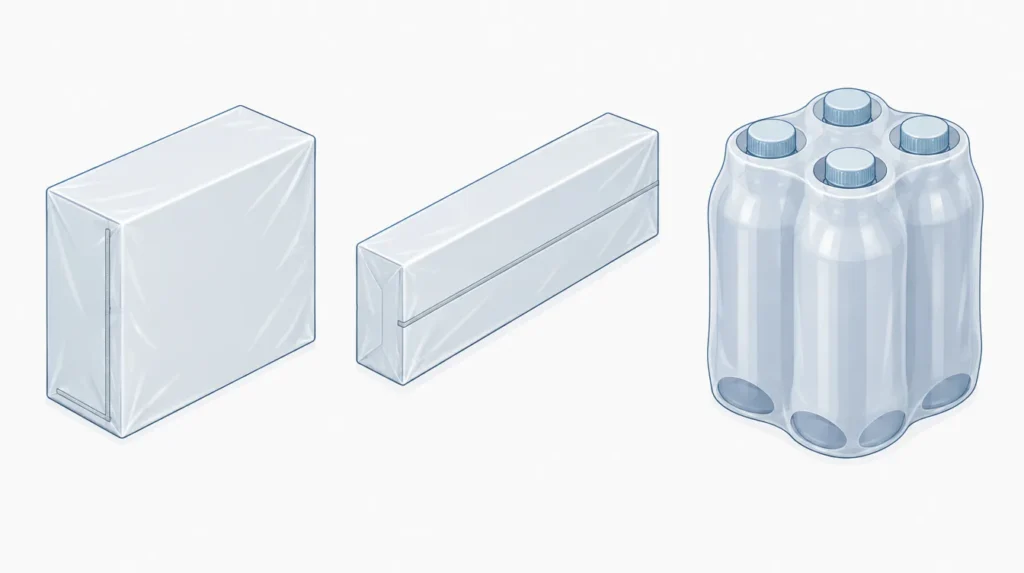
An L-bar sealer uses centerfold film: film folded in half lengthwise on the roll. The product is placed between the two layers, and an L-shaped sealing bar comes down to seal and cut the open side and end in one action. The result is a fully enclosed package.
L-bar sealers range from manually operated units, where the operator lowers the bar, to semi-automatic and automatic models. They are a common starting point for low to moderate volumes and mixed product sizes, because a range of sizes can often run without major changeover.
Points to check:
- Seal area size. The L-bar’s dimensions limit the largest package you can wrap. Confirm the limit with your largest product, including height.
- Air escape. A fully sealed package traps air, which can stop the film from shrinking tight. Film is commonly perforated, either pre-perforated or by a perforator on the machine. Ask how the machine handles this for your package.
Side sealers
A side sealer seals continuously along the side of the package as it travels through, and seals across the film between packages. Because the side seal is continuous, package length is generally less constrained than with an L-bar’s fixed seal area. That makes side sealers a common choice for long items and for higher-volume automatic lines.
Side sealers are offered in intermittent-motion designs, where the product briefly stops for the cross seal, and continuous-motion designs, where the cross seal moves with the product. Which suits you depends on the output and the product. The supplier should show the machine running your package, not a demonstration product.
Sleeve wrappers and shrink bundlers
A sleeve wrapper usually draws film from rolls above and below the product. The product pushes through a film curtain, and a seal bar closes the film behind it. The ends stay open. After shrinking, each open end forms a round opening often called a bullseye.
Sleeve wrapping is widely used for bundling multipacks and trayed products, often with heavier polyethylene film. Film width affects the size of the bullseye: wider film generally leaves a smaller opening. Bundling usually needs a tunnel built for it, with a larger opening, more heat and enough cooling after the heated section.
Hand-held heat guns
For very low volumes, film can be sealed with a simple sealer and shrunk with a hand-held heat gun instead of a tunnel. This keeps equipment simple, but the finish depends on operator skill and is harder to keep consistent. It suits occasional or very small-batch work rather than steady production.
Sealer comparison
| Sealer type | Typical result | Typical film | Often suits | Watch for |
|---|---|---|---|---|
| L-bar sealer | Full enclosure | Centerfold | Retail items, mixed sizes, low to moderate volume | Seal-area limit, air escape, operator load on manual models |
| Side sealer | Full enclosure | Usually centerfold | Long items, higher volume, automatic lines | Infeed requirements, setup for each package size |
| Sleeve wrapper / bundler | Open ends (bullseyes) | Often heavier polyethylene | Multipacks, trayed goods, bundling | Tunnel heat and cooling, bundle stability |
| Heat gun (with a basic sealer) | Varies with operator | Varies | Occasional, small-batch work | Consistency, operator time |
Step 4: Choose the Heat Source
For anything beyond occasional use, the tunnel matters as much as the sealer. Many shrink-quality problems that show up after installation trace back to the tunnel, not the sealer.
How much the film shrinks depends on heat and dwell time. Dwell time is how long the package spends in the heated section, which the conveyor speed and tunnel length decide. Too little heat leaves loose film and weak bundles. Too much can tear the film, distort graphics or crush light packages.
Questions to ask:
- Opening size. Will your largest package pass through with enough clearance?
- Airflow. How is hot air directed? Uneven airflow is a common source of uneven shrink, wrinkles and distorted print.
- Length and speed. At your required output, does the package get enough dwell time? A short tunnel can limit how fast the whole system runs.
- Cooling. Some films, especially heavier polyethylene used for bundling, need cooling after the heated section to set properly. Check whether cooling fans and enough outfeed length are included.
- Conveyor. Ask how the conveyor style suits your package base, and whether it will mark, tip or shift your product.
- Utilities. Tunnels are typically electrically heated and can draw significant power. Confirm the electrical supply with the supplier and your electrician before ordering.
- Room conditions. A tunnel adds heat to the work area. Consider where it will sit and how the area is ventilated.
Step 5: Choose the Film With the Machine
Film and machine have to be chosen together. The sealer type sets the film format, and the film type sets how the sealer and tunnel need to run. The three common film families behave differently.
| Film family | General characteristics | Common uses | Points to check |
|---|---|---|---|
| Polyolefin (POF) | Clear, good appearance, shrinks well; often considered tougher than PVC | Retail packages, many consumer goods | Film grade and gauge for your product; food-contact status if relevant |
| PVC | High clarity, low shrink force; can become brittle in cold storage | Some retail and display packaging | Sealing can give off fumes; check the film supplier’s safety data and your ventilation |
| Polyethylene (PE) | Thicker and stronger, lower clarity, needs more heat and cooling | Bundling, multipacks, heavier items | Tunnel heat and cooling capacity |
These are general tendencies. Actual behavior depends on the specific film grade and supplier.
Other film decisions:
- Format. L-bar sealers use centerfold film. Sleeve wrappers commonly use two rolls. Confirm the format before you order film stock.
- Gauge. Thicker film adds strength but changes sealing and shrink settings.
- Width. Width affects how much film each package uses and, for sleeve wraps, the bullseye size.
- Food contact. If the film touches food, confirm the specific film’s food-contact status with the film supplier for your market. Food packagers can also see packaging machines for the food industry for wider equipment context.
Test with the film you actually plan to buy. A machine that wraps one supplier’s film well may need different settings for another.
Step 6: Decide the Automation Level
The real difference between manual, semi-automatic and automatic shrink systems is which tasks the operator still does.
- Manual: The operator places the product in the film, lowers the seal bar and moves the package to the heat source.
- Semi-automatic: The operator usually loads the product. The machine then seals automatically, and a conveyor may carry the package into the tunnel.
- Automatic: Products are fed from a conveyor. The machine wraps, seals and transfers them without handling by the operator, who supervises, changes film and clears faults.
Move up a level when operator time, inconsistent wraps or the need to keep pace with upstream equipment become the real constraint, not because a catalog speed looks attractive. For the general trade-offs, see automatic vs semi-automatic packaging machine.
Step 7: Size Output to the Whole System
A sealer’s rated speed is not what the line will produce. Actual output depends on:
- how fast product arrives and how evenly it is spaced;
- how quickly operators can load, on manual and semi-automatic machines;
- whether the tunnel gives enough dwell time at that speed;
- film roll changes, changeovers and stoppages;
- what happens downstream: packing, labeling, palletizing.
Ask suppliers what output to expect with your package and your film, and how they arrived at that figure. Size the system to the slowest step, and allow for growth you can realistically plan for. The capacity and output guides cover how to set an output target before you compare machines.
Step 8: Plan for Changeover, Line Fit and Running Costs
Changeover. If you run many sizes, ask exactly what changes between products: seal height, film width, conveyor guides, tunnel settings. Ask how long it takes and whether operators can repeat it reliably. On automatic machines, ask whether settings can be stored for each product.
Line fit. Check infeed and discharge heights, conveyor direction, the space needed for the tunnel and its cooling section, and room for film storage and roll changes. Make sure operators and maintenance staff can reach the machine.
Running costs. The purchase price is one cost among several. Ask the supplier to help you estimate:
- film use per package;
- energy use, mainly from the tunnel;
- wear parts such as seal wires or knives, non-stick seal covers and seal pads;
- routine maintenance time;
- scrap from poor seals or poor shrink during setup.
Ask which wear parts are standard, how easy they are to get, and what preventive care the manufacturer recommends. For what that care usually involves, see preventive maintenance for shrink wrap machines.
Step 9: Ask About Safety Before You Buy
Shrink systems combine hot seal bars, hot tunnel surfaces and hot air with moving seal jaws and conveyors. Ask the supplier:
- what guarding and interlocks are fitted, and what they protect;
- how the machine stops, and where emergency stops are located;
- what the manual says about safe cleaning, film threading, jam clearing and wear-part replacement;
- which machine-safety requirements the equipment is designed to meet for your market.
Requirements vary by country and site. Use the manufacturer’s manual, your site procedures and qualified personnel for installation, maintenance and any work near hot or moving parts. This guide is not a substitute for any of them.
Step 10: Run a Sample Test Before You Commit
A sample test is the most reliable check on everything above. Send the supplier real products, including your smallest, largest and most difficult package, and the film you plan to use. Ask for the samples back, or a video of the run, at the speed you expect to run.
Check the results for:
- seal strength and appearance, with no weak, burnt or open seals;
- tight, even shrink without loose areas or excess wrinkles;
- corner “dog ears”, the small film pockets that can form at package corners;
- bullseye size on sleeve wraps;
- distorted labels or graphics;
- crushed, bowed or heat-affected products;
- bundle stability when you pick the pack up and handle it.
Ask the supplier to record the settings used. Those settings are a useful baseline during installation.
Shrink Wrap Machine Buying Checklist
- Purpose of the wrap defined: presentation, bundling or containment.
- Smallest, largest and hardest package listed with dimensions and weight.
- Heat sensitivity and rigidity of each product reviewed.
- Sealer type chosen: L-bar, side sealer, sleeve wrapper or a simple sealer with heat gun.
- Seal area, or package length range, confirmed against the largest product.
- Tunnel opening, airflow, length, cooling and conveyor confirmed for your packages.
- Film type, format, gauge and width chosen and tested on the actual machine.
- Food-contact status confirmed for the film if relevant.
- Automation level matched to labor and line pace.
- Expected output confirmed with your package, not a demonstration product.
- Changeover steps and time reviewed for every SKU.
- Floor space, infeed and discharge heights, electrical supply and ventilation checked.
- Running costs estimated: film, energy, wear parts, maintenance, scrap.
- Guarding, manuals and service and parts support confirmed.
- Sample test completed and settings recorded.
Frequently Asked Questions
Do I need a shrink tunnel, or is a heat gun enough?
A heat gun can work for very low, occasional volumes. For steady production, a tunnel gives more consistent shrink because heat and dwell time are controlled rather than depending on the operator’s hand.
What is the difference between a shrink wrapper and a shrink bundler?
The terms overlap. “Shrink wrapper” often refers to machines that fully enclose a product, such as L-bar and side sealers. “Shrink bundler” usually refers to sleeve wrappers that group several items with open ends, often using heavier film and a tunnel built for bundling.
Can one shrink wrap machine handle different product sizes?
Often, within limits. L-bar sealers can run a range of sizes up to their seal-area size. Automatic machines may need more adjustment between sizes. List every product you plan to run and ask the supplier what changes between them.
Which shrink film is best?
No single film is best for every job. Polyolefin is widely used for retail packages, polyethylene for bundling, and PVC for some display applications. Choose the film with the machine, and test it on your product.
Is a semi-automatic shrink wrap machine enough for a small business?
It can be, if loading by hand keeps up with demand and the wrap quality meets your standard. The packaging machine buying guide for small business covers how to plan equipment purchases in stages.
Where to Go Next
- Compare shrink wrapping with other wrapping equipment in wrapping machines.
- Apply the same requirement-first approach to other equipment with the machine selection guides.
- Browse all packaging machine buying guides.
This guide is general information. Machine capability, film behavior, output and safety requirements depend on the specific model, film, product and site. Confirm details with the manufacturer, the film supplier and qualified personnel.