
Buying your first packaging machine can feel a little overwhelming. There are filling machines, sealing machines, shrink wrappers, labeling machines, pouch packing machines, carton sealers, and fully automated packaging lines. Every supplier seems to promise better speed, lower labor cost, and cleaner packaging.
But for a small business, the best machine is not always the biggest or most expensive one.
The right packaging machine should fit your product, your packaging format, your daily output, your budget, and your growth plan. A machine that is too simple may slow you down within a few months. A machine that is too advanced may eat up cash, require more training, and leave you paying for features you rarely use.
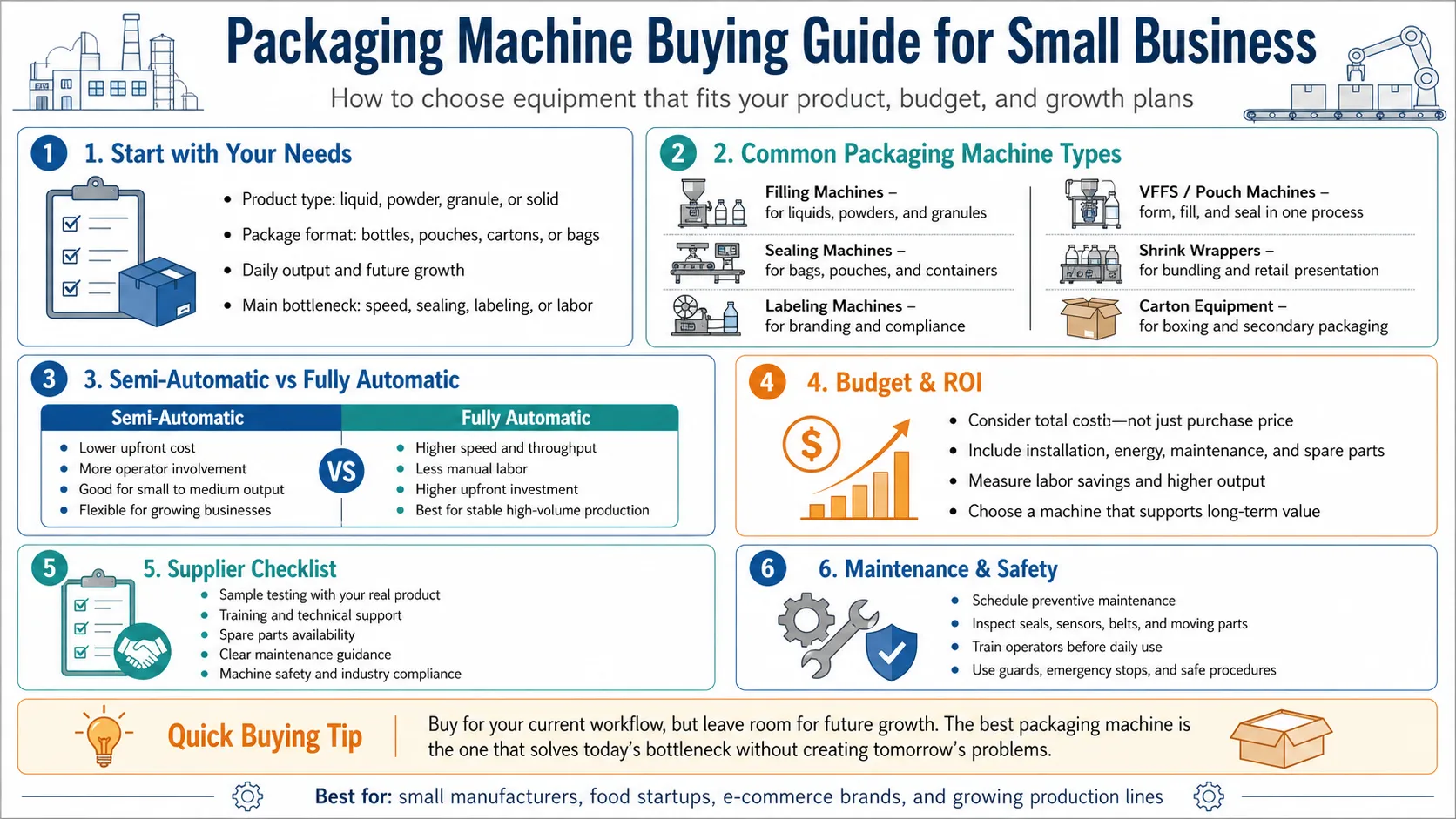
This packaging machine buying guide for small business owners will walk you through the main things to consider before investing: product type, packaging materials, automation level, machine cost, maintenance, supplier support, safety, and scalability.
Packaging Machine Buying Guide for Small Business: Start With Your Real Needs
Before comparing machine models, start with your actual production situation. This sounds basic, but many small businesses make the mistake of shopping for machines before clearly defining what they need the machine to do.
Ask yourself:
What product am I packaging?
Is it liquid, powder, granule, solid, fragile, sticky, frozen, hot-filled, or irregularly shaped?
What package format do I use?
Bottles, jars, cans, pouches, bags, cartons, trays, boxes, or shrink-wrapped bundles all require different handling.
How many units do I package per day?
Your current production volume matters, but your expected growth matters too.
What is my biggest packaging problem right now?
Is it slow manual labor, inconsistent filling, poor seals, messy labels, product damage, or high material waste?
A small bakery packaging 200 bags of cookies per day does not need the same solution as a beverage startup filling 3,000 bottles per shift. A cosmetics brand using small jars has different needs from an e-commerce seller wrapping product bundles.
The better you understand your product and workflow, the easier it becomes to avoid buying the wrong machine.
Match the Machine to Your Product Type
Your product is the first filter when choosing packaging equipment.
Liquids
Liquid products usually need a filling machine. The best type depends on viscosity. Water-like liquids, oils, sauces, lotions, and thick pastes all behave differently during filling.
Common options include:
- Volumetric liquid fillers
- Piston fillers
- Peristaltic fillers
- Net weight fillers
- Gravity fillers
For example, a thin beverage may work well with a gravity or volumetric filler, while a thick cream or sauce may require a piston filling machine.
Powders and Granules
Powder and granular products need accurate dosing and clean sealing. Coffee, spices, flour, protein powder, seeds, pet food, and chemical powders often use:
- Auger fillers
- Volumetric cup fillers
- Weighing systems
- Vertical form-fill-seal machines
Powders can create dust, so sealing quality and machine cleaning are especially important.
Solid Products
Solid products may need counting, weighing, wrapping, or placing systems. Candy, hardware parts, electronics accessories, toys, and small consumer goods can use different machine designs depending on size and shape.
For fragile items, gentle handling matters more than raw speed. For small uniform items, counting and weighing accuracy may be the priority.
Perishable Foods
For meat, cheese, seafood, prepared meals, and fresh food products, shelf life and hygiene become key concerns. Vacuum packaging machines, tray sealers, and modified atmosphere packaging systems may be more suitable than simple bag sealers.
Choose the Right Packaging Format
The package format directly affects the type of machine you should buy.
If you use bottles, you may need a filling machine, capping machine, labeling machine, and possibly a coding machine.
If you use pouches, you may need a premade pouch packing machine or a form-fill-seal machine.
If you use cartons, you may need carton erecting, carton sealing, or carton filling equipment.
If you sell retail bundles, shrink wrapping may be a practical solution.
Here is a simple way to think about it:
| Packaging Format | Common Machine Types |
|---|---|
| Bottles and jars | Filling machine, capping machine, labeling machine |
| Pouches and bags | Premade pouch packing machine, VFFS machine, heat sealer |
| Boxes and cartons | Carton erector, carton sealer, carton filling machine |
| Retail bundles | Shrink wrapping machine, flow wrapper |
| Food trays | Tray sealer, vacuum sealer, MAP packaging machine |
| Individual wrapped products | Flow wrapping machine |
The package should fit the machine’s working range. Always check pouch width, bottle diameter, container height, film type, sealing area, and label size before making a purchase.
Understand the Main Types of Packaging Machines
There are many types of packaging machinery, but small businesses usually start with one of the following categories.
Filling Machines
Filling machines are used to fill containers with liquids, powders, granules, pastes, or small solids. They are common in food, beverage, cosmetics, pharmaceuticals, chemicals, and household products.
A filling machine is a good investment if your current manual filling process is slow, inconsistent, messy, or hard to scale.
Sealing Machines
Sealing machines close bags, pouches, bottles, trays, and cartons. They may use heat sealing, induction sealing, pressure sealing, adhesive sealing, or other methods.
For many small businesses, a reliable heat sealer is one of the first packaging machines worth buying. Poor sealing can lead to leaks, contamination, customer complaints, and product returns.
Shrink Wrapping Machines
Shrink wrapping machines use film and heat to wrap products tightly. They are often used for books, gift sets, cosmetics, food trays, bottles, boxes, and retail bundles.
Shrink wrapping can improve product presentation and provide basic protection during storage and shipping.
Flow Wrapping Machines
Flow wrappers wrap individual products or grouped products in a continuous film. They are commonly used for baked goods, candy, hardware, medical items, and small consumer products.
They are useful when you need neat, consistent wrapping at moderate to high speed.
Vertical Form-Fill-Seal Machines
A vertical form-fill-seal machine, often called a VFFS machine, forms bags from rollstock film, fills them, and seals them in one continuous process.
VFFS machines are often used for coffee, snacks, grains, powders, pet food, frozen food, and other free-flowing products. They can be efficient, but they may be more than a very small operation needs at the beginning.
Premade Pouch Packing Machines
Premade pouch packing machines fill and seal ready-made pouches. They are suitable for brands that want attractive stand-up pouches, zipper pouches, or shaped pouches without forming the pouch from roll film.
They are common for snacks, coffee, pet treats, powders, sauces, and specialty foods.
Labeling Machines
Labeling machines apply labels to bottles, jars, boxes, bags, and other containers. A good labeling machine improves branding, consistency, and compliance.
If your labels are often crooked, wrinkled, or slow to apply by hand, a semi-automatic labeling machine can make a noticeable difference.
Carton Packaging Machines
Carton erecting, carton filling, and carton sealing machines help automate secondary packaging. These are useful when your products are already packed individually and need to be boxed for shipping or retail distribution.
Semi-Automatic vs Fully Automatic Packaging Machines
For small businesses, this is one of the most important decisions.
A semi-automatic packaging machine still requires an operator to load products, place containers, adjust materials, or trigger the process. It reduces manual work but keeps the operator involved.
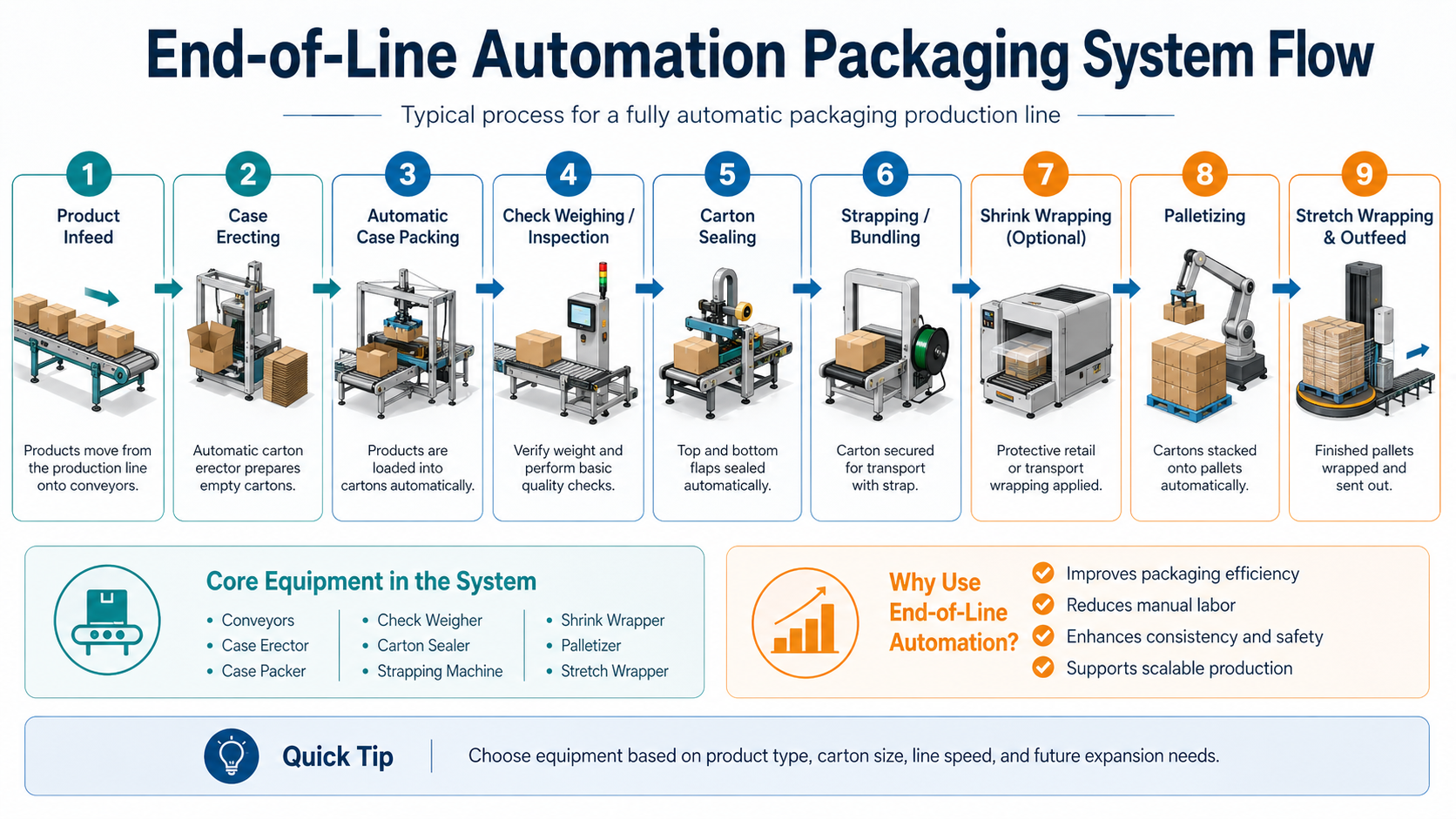
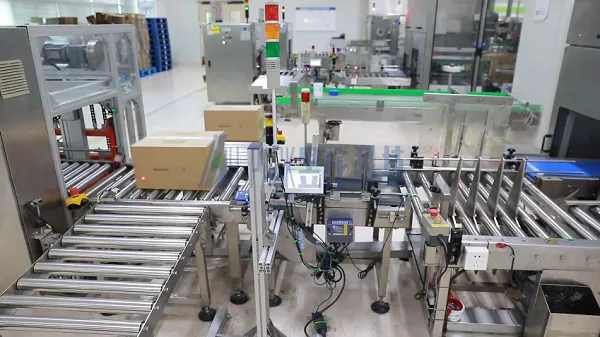
A fully automatic packaging machine handles most of the process with minimal human intervention. It may include conveyors, sensors, filling systems, sealing units, coding systems, and automatic discharge.
| Feature | Semi-Automatic Machine | Fully Automatic Machine |
|---|---|---|
| Best for | Small to medium output | Medium to high output |
| Labor requirement | Moderate | Low |
| Initial cost | Lower | Higher |
| Flexibility | Usually higher | Depends on machine design |
| Training difficulty | Easier | More technical |
| Space requirement | Smaller | Larger |
| Best use case | Growing small business | Stable high-volume production |
For many small businesses, semi-automatic equipment is the most practical first step. It improves speed and consistency without requiring the budget, floor space, and technical support of a fully automated line.
Fully automatic equipment becomes more attractive when your order volume is stable, labor cost is high, packaging format is consistent, and downtime has a major impact on revenue.
Do Not Buy More Speed Than You Need
Speed is important, but it should not be the only reason you choose a machine.
Packaging machine speed is often measured in packages per minute, bottles per hour, bags per minute, or cartons per minute. A supplier may advertise a high maximum speed, but your real output may be lower depending on product handling, material quality, operator skill, changeover time, and downstream processes.
For example, a machine that can seal 60 bags per minute is not useful if your team can only fill and place 20 bags per minute. In that case, the bottleneck is not the sealing machine.
A better approach is to calculate your real production requirement:
Daily orders
Expected units per day
Working hours per shift
Number of operators
Peak season demand
Expected growth in the next 1–3 years
Then choose a machine with enough capacity to support growth, but not so much extra capacity that you overspend.
Check Material Compatibility Before Buying
Packaging material is not just a design choice. It affects machine selection directly.
Common packaging materials include:
- PET
- HDPE
- LDPE
- PP
- PVC
- Aluminum
- Steel
- Glass
- Paperboard
- Cardboard
- Flexible films
- Laminated films
- Compostable or recyclable materials
Not every machine works well with every material. Some heat sealers may not seal certain films properly. Some labeling machines may struggle with curved containers or textured surfaces. Some filling machines may not work well with foaming liquids or sticky products.
Before buying, send your real samples to the supplier. Test the exact product, container, film, label, cap, and carton you plan to use. A successful demo with “similar” materials is helpful, but a successful demo with your actual materials is much better.
Think About Total Cost, Not Just Machine Price
The purchase price is only one part of the real cost.
When budgeting for packaging equipment, include:
- Machine price
- Shipping
- Installation
- Tooling or mold costs
- Spare parts
- Training
- Electricity and compressed air requirements
- Packaging material cost
- Maintenance
- Downtime risk
- Future upgrades
- Operator labor
A cheaper machine can become expensive if it causes frequent downtime, wastes film, produces weak seals, or requires hard-to-find replacement parts.
A more expensive machine may be a better value if it reduces labor, improves consistency, lowers product waste, and runs reliably for years.
The question is not simply, “How much does the machine cost?”
The better question is, “How much will this machine cost and save over its working life?”
Calculate ROI in a Practical Way
Small businesses do not always need a complicated financial model, but you should have a basic ROI estimate before buying.
Consider these areas:
Labor Savings
Will the machine reduce the number of people needed for packaging?
Will it allow one worker to package more units per hour?
Higher Output
Can you fulfill more orders per day?
Can you handle peak season without hiring temporary labor?
Reduced Waste
Will the machine reduce overfilling, product spills, film waste, label waste, or rejected packages?
Better Quality
Will it reduce customer complaints, returns, damaged goods, or inconsistent presentation?
Growth Potential
Will the machine help you accept larger wholesale, retail, or distributor orders?
A machine does not need to pay for itself immediately, but you should have a realistic idea of when and how it will start creating value.
Choose a Machine That Operators Can Actually Use
A machine can look impressive in a showroom and still be frustrating on a real production floor.
For a small business, ease of use matters. Many teams do not have full-time engineers or maintenance technicians. A practical machine should have:
- Simple controls
- Clear settings
- Easy cleaning access
- Fast changeover
- Good safety guards
- Error alerts
- Repeatable setup parameters
- A manual or video training support
- Spare parts that are easy to identify
If your staff changes often, avoid overly complicated machines unless the supplier provides strong training and support.
The best machine is not just technically capable. It should be manageable for the people who will use it every day.
Plan for Maintenance and Spare Parts
Every packaging machine needs maintenance. Even a high-quality machine will eventually require cleaning, lubrication, belt replacement, sealing jaw inspection, sensor adjustment, or part replacement.
Before buying, ask the supplier:
How often does the machine need preventive maintenance?
Which parts wear out most often?
Are spare parts kept in stock?
How long does it take to ship replacement parts?
Can your team replace common parts by itself?
Is remote technical support available?
Do they provide videos, manuals, or live training?
Downtime can be more expensive than the repair itself. If a small part stops production for a week, your business may lose orders, delay shipments, and disappoint customers.
Good after-sales support is not a bonus. It is part of the machine’s real value.
Do a Safety Review Before Installation
Packaging machinery can involve heat, sharp edges, compressed air, moving belts, electrical systems, and pinch points. Safety should be considered before the machine arrives, not after something goes wrong.
A basic safety review should include:
- Machine guarding
- Emergency stop buttons
- Electrical safety
- Operator training
- Hot surface warnings
- Cleaning procedures
- Lockout procedures
- Safe access for maintenance
- Floor layout and walking space
- Local safety regulations
For more complex equipment, work with the supplier to complete a risk assessment. This helps identify hazards, reduce risks, and document safe operating procedures.
You should also repeat safety checks when you add new machines, change the production layout, or increase operating speed.
Choose a Supplier, Not Just a Machine
The supplier you choose can matter as much as the machine itself.
A good packaging machinery supplier should help you match equipment to your product, not simply sell the most expensive model. They should ask about your product type, packaging format, output target, floor space, power supply, air supply, budget, and growth plan.
Look for a supplier that offers:
- Experience in your industry
- Clear technical communication
- Machine testing with your samples
- Installation support
- Operator training
- Spare parts availability
- Maintenance guidance
- Customization options
- Honest production speed estimates
- Compliance knowledge for your market
Be careful with suppliers that give vague answers, avoid sample testing, or promise unrealistic speeds without asking about your product.
Consider Scalability From the Beginning
Your first machine should solve today’s problem, but it should not block tomorrow’s growth.
Scalable packaging equipment may allow you to add:
- Extra filling heads
- Conveyors
- Coding machines
- Labeling systems
- Checkweighers
- Vision inspection systems
- Automatic feeding
- Larger hoppers
- Different sealing jaws
- Integration with other production equipment
For a small business, modular equipment can be a smart choice. You can start with a semi-automatic system and upgrade gradually instead of replacing everything at once.
A good rule is to leave some extra capacity for seasonal demand, new product sizes, or increased order volume. But avoid buying a huge system based only on hope. Growth planning should be optimistic, but still grounded in real sales data.
Packaging Machine Buying Checklist for Small Businesses
Before you place an order, go through this checklist:
- What product will the machine handle?
- Is the product liquid, powder, granule, solid, fragile, sticky, or perishable?
- What packaging format will you use?
- What are the exact dimensions of your package?
- What packaging materials will you use?
- What is your current daily output?
- What output do you expect in 12–36 months?
- Do you need semi-automatic or fully automatic equipment?
- What is your real budget, including installation and maintenance?
- Have you tested your actual product and packaging materials?
- Can your operators use and clean the machine easily?
- Are spare parts available?
- Does the supplier provide training and support?
- Does the machine meet safety and industry requirements?
- Can the machine be upgraded later?
- What is the estimated ROI?
If you cannot answer these questions yet, it may be too early to buy. Spend more time testing, measuring, and talking to suppliers.
Final Thoughts
A packaging machine can change how a small business operates. It can make packaging faster, cleaner, more consistent, and more professional. It can reduce labor pressure, improve product presentation, and help you take on larger orders.
But the wrong machine can do the opposite. It can create downtime, waste materials, frustrate operators, and tie up cash that could have been used elsewhere.
The smartest approach is to start with your product, your package, your production volume, and your growth plan. Then compare machines based on fit, not just price or advertised speed.
For most small businesses, the right packaging machine is the one that solves a real bottleneck today while giving you enough room to grow tomorrow.
FAQ
What is the best packaging machine for a small business?
The best packaging machine depends on your product and packaging format. A food startup may need a vacuum sealer or pouch sealing machine, while a cosmetics brand may need a filling machine, capping machine, and labeling machine. For many small businesses, semi-automatic machines are a practical first step because they improve efficiency without requiring the budget and space of a fully automatic line.
How much does a packaging machine cost?
Packaging machine costs vary widely. Simple tabletop sealers or vacuum sealers may cost a few hundred to a few thousand dollars. Semi-automatic machines often cost more, while fully automatic systems can require a much larger investment. You should also budget for shipping, installation, spare parts, training, maintenance, and packaging materials.
Should a small business choose semi-automatic or fully automatic packaging equipment?
Semi-automatic equipment is usually better for small businesses with moderate production volume, limited space, or changing product lines. Fully automatic equipment is better when production volume is high, packaging formats are stable, and labor reduction is a major priority.
What should I check before buying a packaging machine?
Check your product type, package size, material compatibility, production volume, machine speed, operator training needs, safety features, spare parts availability, and supplier support. You should also test your real product and packaging materials before committing to a machine.
Why is material compatibility important in packaging machinery?
Different packaging materials behave differently during filling, sealing, wrapping, and labeling. A film that works well on one heat sealer may not seal properly on another. Labels may not apply cleanly to certain container shapes or surfaces. Testing your actual materials helps prevent weak seals, jams, waste, and poor package appearance.
How can I calculate ROI for a packaging machine?
Start by estimating labor savings, increased output, reduced product waste, lower packaging errors, and improved order capacity. Then compare those savings with the total cost of the machine, including purchase price, installation, maintenance, energy use, and spare parts. A good machine should improve both daily efficiency and long-term profitability.