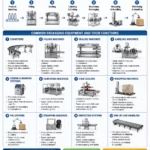

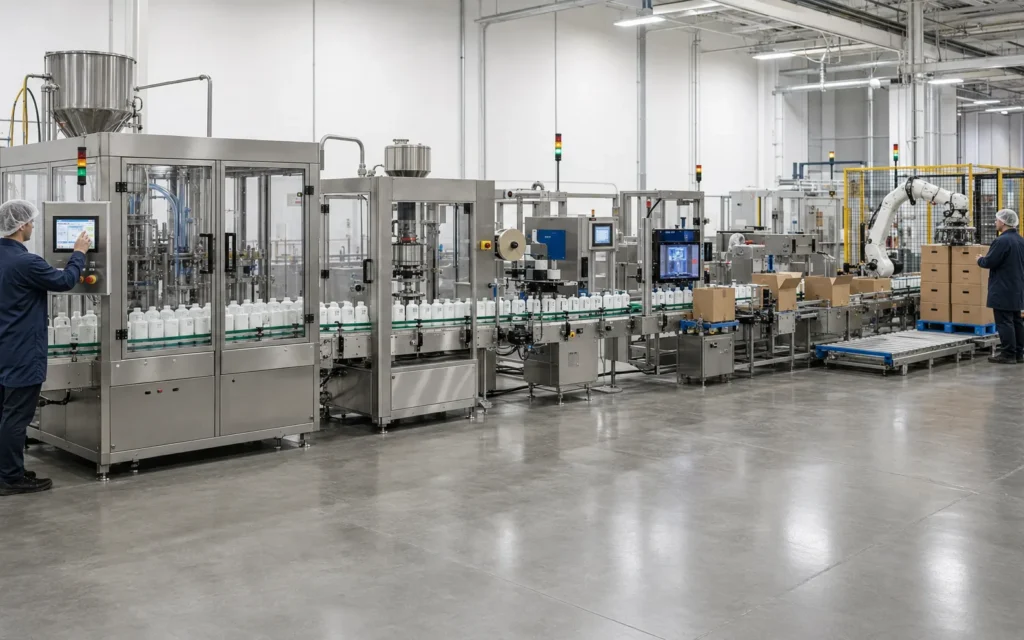
What are the main types of packaging machines? In practical terms, they include product feeding and dosing equipment, filling machines, form-fill-seal machines, closing and sealing machines, wrappers, cartoners, case erectors, case packers, case sealers, labelers, coding systems, inspection equipment, conveyors, and palletizing or other end-of-line equipment. A complete production line usually combines several of these functions rather than relying on one machine to do everything.
The easiest way to understand packaging machinery is not to memorize a long list of machine names. Instead, follow the product through the line and ask what has to happen next: Does the product need to be measured? Put into a container? Sealed? Labeled? Loaded into a shipping case? Palletized?
That functional view also explains why two factories can package similar products with very different equipment. A bottle filling plant, a snack pouch line, and an e-commerce fulfillment operation all use packaging machinery, but the machines and sequence can be quite different.
Primary, Secondary, and Tertiary Packaging
Before looking at individual machine types, it helps to separate three broad levels of packaging.
Primary packaging is generally the packaging most directly associated with containing the product. Depending on the application, that might be a bottle, pouch, tray, cup, tube, blister, jar, bag, or similar package. Filling, capping, pouch forming, tray sealing, and some wrapping operations normally happen around this stage.
Secondary packaging groups or protects one or more primary packages. Folding cartons, multipacks, trays, and corrugated cases are common examples. Cartoners, case erectors, case packers, and case sealers are therefore commonly found in secondary packaging areas.
Tertiary or end-of-line packaging prepares packaged goods for handling, warehousing, and transport. Palletizing, pallet stretch wrapping, strapping, pallet conveying, and related load-handling equipment normally sit here.
The Main Types of Packaging Machines
1. Product Feeding and Dosing Equipment
Before a product can be packaged, it often has to reach the packaging machine at the correct orientation, spacing, quantity, or dose.
Feeding equipment can include hoppers, vibratory feeders, augers, pumps, elevators, product conveyors, unscramblers, counting systems, weighers, and other product-handling devices. Some feed bulk product into a filler. Others present individual components or products to a wrapper, cartoner, or robotic loading system.
Dosing is more specific: it controls how much product is delivered to each package. The appropriate method depends heavily on the product. A free-flowing liquid behaves differently from a thick paste, fine powder, snack food, tablet, or irregular solid item.
Feeding equipment deserves its own place in a packaging-line discussion even though it may not actually form or close a package. Poor feeding can starve the next machine, cause inconsistent spacing, create jams, or prevent a theoretically fast machine from reaching useful production output.
2. Filling Machines
Filling machines place a measured amount of product into a pre-made container or package. They are used for products ranging from water and oil to sauces, creams, powders, granules, tablets, hardware, and other solids.
There is no universal filling principle. Common approaches include volumetric filling, gravimetric or weight-based filling, piston filling, pump filling, auger dosing, gravity filling, counting, and combination weighing.
The correct choice depends on variables such as:
- product viscosity and flow behavior;
- whether the product foams, drips, contains particles, or separates;
- required dose control;
- container opening and geometry;
- cleaning requirements;
- temperature and process conditions;
- required production output.
This is why asking only for a “liquid filling machine” or “powder filler” is often not enough to specify useful equipment.
3. Form-Fill-Seal Machines
A form-fill-seal machine combines several operations. Instead of receiving a completely finished empty package, the machine forms packaging material into a bag or pouch, introduces the product, and closes the package as part of one coordinated process.
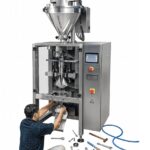
VFFS means vertical form-fill-seal. Film normally travels through the machine vertically while the package is formed, filled, and sealed. VFFS is widely used for products such as snacks, powders, granules, frozen foods, coffee, and other products suited to flexible bags or pouches.
HFFS means horizontal form-fill-seal. The package-forming and product-loading arrangement is horizontal and can be useful for products or package formats that benefit from horizontal handling.
Do not assume that every flexible-packaging machine uses identical seal jaws, heating methods, motion systems, or film structures. Sealing technology and package formation vary considerably with the machine and packaging material.
4. Closing, Capping, and Sealing Machines
Once a product is inside a container or package, the package often has to be closed. This broad category includes several quite different technologies.
Capping machines apply or secure closures to bottles, jars, and other rigid containers. Depending on the closure, a system might screw, press, roll, snap, plug, or otherwise apply the cap.
Heat sealing equipment joins compatible packaging surfaces using controlled heat, pressure, and time. It is common with bags, pouches, trays, cups, and flexible packaging structures.
Tray and cup sealers apply and seal lidding material over a container. Induction sealing is another distinct process used with appropriate container and closure systems.
Farther downstream, case sealers close corrugated shipping cases, commonly with pressure-sensitive tape or adhesive depending on the system.
The important point is that “sealing machine” describes a function, not one single machine design.
5. Wrapping Machines
Wrapping equipment applies packaging material around an individual product, a group of products, or a transport load.
Flow wrappers feed products horizontally and create a flexible package around them. They are widely associated with products such as bakery goods, confectionery, bars, individual components, and other regularly fed items.
Shrink wrapping systems place shrinkable film around a product, tray, or bundle and then expose it to controlled heat so the film contracts around the load.
Stretch wrapping is different. Stretch film is elongated and wrapped under tension. Pallet stretch wrapping is normally an end-of-line load-stabilization process and does not require a shrink tunnel.
That distinction matters when selecting equipment. Our separate guide to shrink wrap machines vs stretch wrapping machines looks at the two processes in more detail.
Bundling equipment may also wrap or contain several products together, but machine layouts vary according to the bundle and material.
6. Cartoning Machines
Cartoners work with folding cartons, such as the paperboard cartons commonly used around food, pharmaceuticals, cosmetics, household goods, tubes, bottles, and other retail products.
A cartoner may erect a flat carton, load the product, and close the carton. Loading arrangements include horizontal/end-load and vertical/top-load concepts, among others.
It is useful to keep folding cartons separate from corrugated shipping cases when discussing packaging machinery. In everyday conversation, people sometimes call both a “box” or even a “carton,” but equipment manufacturers may distinguish them because the materials, forming methods, loading methods, and machinery are different.
7. Case Erectors
A case erector prepares corrugated cases for loading. It typically takes a flat or knock-down corrugated case, opens it into shape, folds the appropriate bottom flaps, and closes or seals the bottom according to the machine configuration.
The erected case is then discharged to a manual packing station or automatic case packer.
Case erectors are easy to confuse with case packers or case sealers because all three may be installed within a few metres of one another. Their jobs are different:
- Case erector: prepares the empty case.
- Case packer: loads product into the case.
- Case sealer: closes the loaded case.
8. Case Packers
A case packer takes finished products, cartons, pouches, bottles, trays, or bundles and loads them into a corrugated case or tray for downstream handling.
There are several loading concepts. Products may be top loaded, side loaded, dropped under controlled conditions, accumulated into layers, or picked and placed robotically.
For example, a robotic top-load case packer can collect incoming packages, organize them into the required pack pattern, and place them into an erected case. Another system may collate products and push them horizontally into a case.
Case packing therefore has to be matched not only to case size but also to product orientation, pack pattern, fragility, incoming product flow, changeovers, and downstream case handling.
9. Case Sealers
After the case is packed, a case sealer closes it for further handling. Depending on the application, the machine may fold top flaps and apply tape, hot-melt adhesive, or another specified closure system.
Some lines handle long runs of one case size. Others process frequently changing or mixed case sizes, which changes the type of adjustment and automation required.
If case sealing is an immediate equipment-selection problem, see our practical carton sealer selection guide.
10. Labeling Machines
Labeling machines apply pre-produced labels to packages, containers, cartons, or cases.
Pressure-sensitive labeling is common. Depending on the package, a label may be applied to the front, back, top, bottom, side, around a cylindrical container, or in multiple positions.
Product presentation to the labeler matters. A bottle that enters at the wrong angle or inconsistent spacing can result in poor label placement even if the label applicator itself is functioning correctly.
Labeling should not be confused with coding. A labeler generally applies a label substrate. Coding and marking equipment creates variable information directly on the package or on another packaging component.
11. Coding and Marking Equipment
Coding systems add changing production information such as date codes, lot or batch identification, serial information, barcodes, and other variable marks.
Common technologies include continuous inkjet, thermal inkjet, thermal transfer overprinting, laser marking, and print-and-apply systems. The appropriate technology depends on the substrate, code content, line arrangement, environmental conditions, required permanence, and other application details.
A coding system may be physically small compared with a filler or cartoner, but it still has to be integrated with product detection and line movement so that the correct information is produced in the correct position.
12. Inspection Equipment
Inspection machines do not normally create the package, but they are an important part of many packaging lines.
Checkweighers dynamically check packaged-product weight. Vision inspection systems can examine visible package features such as labels, codes, closures, or package presentation. Metal detectors and other inspection technologies may be used where appropriate for the product and industry.
Inspection systems are often connected to a reject device so a package that fails defined inspection criteria can be removed from normal product flow.
Inspection equipment should therefore be considered during line design rather than added as an isolated machine without considering conveyor stability, package spacing, reject handling, and downstream controls.
13. Conveyors and Accumulation Systems
Conveyors rarely fill, seal, or label anything, but a packaging line cannot be understood properly without them.
They transfer containers and packages between machines, establish product spacing, change elevation, merge or divide streams, and provide accumulation between processes.
Accumulation is particularly important. If one downstream machine stops briefly, a correctly designed buffer can sometimes allow upstream product to accumulate rather than forcing every connected machine to stop immediately.
Product transfers are equally important. Unstable bottles, flexible pouches, small cartons, heavy cases, and delicate packs require different handling approaches.
For a deeper look at belts, tabletop chains, rollers, accumulation, transfers, guides, and line layout, see our packaging conveyor system guide.
14. Palletizing and End-of-Line Equipment
Once products have been packed into cases, trays, bags, or other shipment units, end-of-line equipment prepares them for storage and transport.
Palletizers arrange cases, bags, trays, or other loads into layers or patterns on a pallet. Systems can use conventional mechanisms or robotic handling depending on the application.
Depalletizers perform the reverse function when containers, cases, or other incoming goods need to be removed from pallets and fed into production.
After palletizing, a pallet stretch wrapper may apply stretch film to stabilize the load. Strapping and other load-stabilization equipment can also be used where appropriate.
This equipment generally belongs to tertiary or end-of-line packaging because the emphasis has shifted from creating the consumer package to preparing finished goods for material handling, warehousing, and shipment.
Packaging Machine Types at a Glance
| Machine type | Main function | Common package/product examples | Typical position in the line | Key selection consideration |
|---|---|---|---|---|
| Feeding / dosing | Presents or meters product | Powders, snacks, components, caps, tablets | Before filling, wrapping, or loading | Product flow and required dose control |
| Filling machine | Places product into a pre-made package | Bottles, jars, tubs, containers | Primary packaging | Product characteristics and fill method |
| Form-fill-seal | Forms package, fills it, then seals it | Bags, pouches, sachets, stick packs | Primary packaging | Product, film, bag style, sealing process |
| Capping / sealing | Closes a container or package | Bottles, jars, cups, trays, pouches | After filling | Closure and package material |
| Wrapping machine | Wraps product, bundle, or load | Food products, multipacks, pallets | Primary, secondary, or end-of-line | What is being wrapped and why |
| Cartoner | Forms, loads, and/or closes folding cartons | Retail cartons, tubes, bottles, blister packs | Secondary packaging | Carton style and loading direction |
| Case erector | Forms flat corrugated blanks into empty cases | Corrugated shipping cases | Before case loading | Case styles and size range |
| Case packer | Loads finished packages into cases | Bottles, pouches, cartons, trays | Secondary / end-of-line | Pack pattern and product handling |
| Case sealer | Closes loaded corrugated cases | Shipping cases | After case packing | Case dimensions and closure method |
| Labeler | Applies labels | Bottles, jars, cartons, cases | Usually after package closure | Package geometry and label placement |
| Coding / marking | Adds variable production information | Pouches, bottles, cartons, cases | Various points in the line | Substrate and required code |
| Inspection equipment | Checks defined product or package attributes | Individual packs, cartons, cases | After critical packaging operations | Inspection objective and product presentation |
| Conveyor / accumulation | Transfers and buffers products | Containers, pouches, cartons, cases | Throughout the line | Product stability, spacing, transfers |
| Palletizing / load stabilization | Builds and stabilizes shipping loads | Cases, trays, bags, pallet loads | End of line | Load pattern, stability, downstream handling |
What Does a Complete Packaging Line Look Like?
A useful way to understand packaging line equipment is to follow one simplified process from beginning to end:
That is only an example. Actual sequence varies according to the product and package format. Some lines form the package before filling. Some products go into a carton before inspection. Some packages are coded before filling or labeled before another closure operation. Other plants do not palletize at all.
Example: Bottled Beverage Line
A simplified beverage line might include container handling, rinsing where required by the process, filling, capping, labeling, coding, inspection, multipacking or case packing, case or tray handling, palletizing, and pallet stretch wrapping.
Conveyors connect these processes and maintain container flow. In higher levels of automation, controls between adjacent machines also matter because the filler, labeler, packer, and palletizer cannot be treated as unrelated islands.
Example: Snack Pouch Line
A snack operation might convey product to a weighing or dosing system above a VFFS machine. The machine forms the bag, receives the measured product, and seals the package. The finished pouches can then pass through coding and inspection before being accumulated and packed into corrugated cases. Loaded cases are sealed and sent toward palletizing.
Example: E-Commerce or Case-Packing Operation
An e-commerce or distribution operation may have no product filler at all. Its packaging equipment might instead include case forming, operator or automated product loading, void-fill equipment where required, case sealing, shipping-label application, conveyors, sortation, and pallet or outbound handling.
This is why buying equipment from a generic list of “packaging machine types” is rarely enough. Start with the package journey.
How Do You Know Which Packaging Machines You Need?
Machine selection should start with the product and process, not with an equipment catalogue.
Define the Product
Document whether the product is liquid, viscous, powder, granule, fragile solid, irregular part, food product, industrial component, or something else. Record characteristics that affect feeding, filling, contamination control, cleaning, or handling.
Define the Primary Package
Is the product going into a bottle, jar, pouch, bag, tray, cup, folding carton, tube, or another package? Is that package supplied pre-made or formed by the packaging machine?
The answer quickly narrows the relevant machine families.
Specify the Packaging Material
Film, paperboard, corrugated board, labels, tapes, caps, trays, and other packaging materials are part of the machine application. A machine that works with one material structure should not automatically be assumed to run another without validation.
Use a Realistic Output Requirement
Define the output the operation actually needs rather than choosing equipment simply because its advertised maximum speed is higher.
Useful line output depends on the slowest or least stable parts of the process, product supply, operators, changeovers, material replenishment, planned stops, and machine-to-machine coordination.
Map the Existing Labor Process
Write down what operators do today. They may orient products, load caps, erect cases, fold flaps, inspect labels, apply tape, move completed cases, or build pallets.
That makes it easier to decide where automation removes an actual bottleneck rather than simply adding machinery.
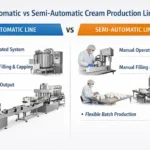
If automation level itself is the main question, see our guide to automatic vs semi-automatic packaging machines.
Check the Full Package Size Range
Do not specify equipment using only the most common SKU. Record the smallest and largest relevant product and package dimensions and identify which formats change frequently.
Consider Changeovers
A machine may be well suited to a long production run but awkward for a plant that changes package sizes several times each shift. Look at adjustment points, format parts, recipes, material changes, cleaning, verification, and restart procedures.
Measure the Available Floor Space
The machine footprint is only part of the space requirement. You also need infeed and discharge conveyors, operator access, guarding, maintenance access, material staging, cleaning access, electrical cabinets, and safe movement around the line.
Review Upstream and Downstream Equipment
A new machine has to receive product correctly and discharge it in a form the next machine can accept. Check conveyor elevation, direction of flow, package orientation, spacing, accumulation requirements, and control interfaces.
Define Cleaning and Maintenance Requirements
Cleaning expectations differ greatly between dry industrial goods, food products, beverages, cosmetics, pharmaceutical applications, and other manufacturing environments.
Maintenance capability matters too. Ask who will inspect, lubricate, adjust, troubleshoot, and replace wear components after installation.
Confirm Utilities
Packaging equipment may require electrical power, compressed air, vacuum, heat, cooling, extraction, network connections, or other services. Requirements are machine-specific and should be confirmed from the equipment manufacturer rather than assumed.
Think About Future Production
A line does not have to be designed for every hypothetical future product, but known expansion plans matter. Additional package sizes, new SKUs, different materials, higher output, and downstream automation can affect what is sensible to install today.
Common Misunderstandings About Packaging Machinery
“One automatic packaging machine does the whole job.”
Sometimes several functions are integrated into one system, but many production lines still consist of multiple machines. A filler does not necessarily cap, a capper does not necessarily label, and a case packer does not normally form the consumer package.
“The machine with the highest maximum speed gives the highest line output.”
Machine capability and sustainable line output are not the same thing. Product supply, package stability, changeovers, upstream and downstream machines, accumulation, operators, and planned or unplanned stops all affect actual production.
“A conveyor is not really packaging equipment.”
A conveyor may not create the package, but line integration depends on reliable product transfer, spacing, orientation, and accumulation. A high-performance labeler or cartoner cannot compensate for badly controlled product flow at its infeed.
“Automatic means no operators.”
Automation can reduce specific manual tasks, but machinery still needs material replenishment, monitoring, changeovers, cleaning, inspection, maintenance, troubleshooting, and production supervision. The exact operator requirement depends on the system.
“Every manufacturer uses machine names in exactly the same way.”
They do not. One supplier may use “carton” where another prefers “case,” and equipment categories may be grouped differently. When comparing quotations, focus on what the machine physically receives, what operations it performs, and what it discharges.
“A packaging problem must be caused by the main packaging machine.”
Not necessarily. Packaging problems can come from product variation, packaging materials, incorrect setup, sensors, utilities, worn components, poor transfers, or another machine upstream. If you are diagnosing an existing line rather than selecting equipment, our packaging machine troubleshooting guide provides a more systematic starting point.
So, What Are the Main Types of Packaging Machines?
The most useful answer is to group packaging machinery by the job it performs. Product feeding and dosing systems prepare product for packaging. Fillers place it into containers. Form-fill-seal equipment creates flexible packages while filling them. Cappers and sealers close packages. Wrappers apply film around products, bundles, or loads. Cartoners and case equipment create secondary packages. Labelers and coders identify them. Inspection equipment checks defined package or product conditions. Conveyors connect the process. Palletizers and load-stabilization systems prepare finished goods for shipment.
A real plant may use only a few of these categories or nearly all of them. The correct combination comes from tracing the product from its uncontained state to the form in which it leaves the factory.
For someone planning a line, that process map is more valuable than starting with a shopping list of machine names.
References and Further Reading
-
PMMI — Fundamentals of Packaging Machinery. Packaging machinery training topics covering bagging, pouching and wrapping; cartoning and case packaging; coding and labeling; conveying and feeding; filling and closing; inspection; palletizing; robotics; and related equipment.
PMMI Fundamentals of Packaging Machinery -
PMMI — Standards, Technical Reports, Regulations and Directives. Includes the scope of ANSI/PMMI B155.1 for machinery performing primary, secondary and tertiary packaging functions and associated conveying.
PMMI Standards and Regulations -
Syntegon — Vertical Form Fill Seal Machines. Manufacturer information on vertical bag forming, filling, sealing, product dosing and flexible package formats.
Syntegon VFFS Machines -
Krones — Filling and Packaging Lines. Manufacturer overview of integrated beverage-line processes including container handling, filling, labeling and downstream packaging.
Krones Filling and Packaging Lines -
Pearson Packaging Systems — Secondary Packaging Equipment. Manufacturer references for case erecting, case packing, case sealing and integrated end-of-line systems.
Pearson Packaging Machinery -
Videojet — Date Printing and Coding Solutions. Technical overview of continuous inkjet, thermal inkjet, thermal transfer, laser and other variable-data coding methods.
Videojet Coding and Marking Overview -
METTLER TOLEDO — Product Inspection Systems. Manufacturer information covering checkweighing, metal detection, x-ray and machine-vision inspection.
METTLER TOLEDO Product Inspection -
OMAC — Packaging Workgroup and PackML. Industry resources relating to packaging-machine integration, interoperability and standardized machine behavior.
OMAC Packaging Workgroup