Choosing the right carton sealer sounds simple at first. After all, the machine only needs to close and tape boxes, right?
In reality, a carton sealer can have a big effect on your packing speed, labor cost, box consistency, and even how professional your shipments look when they arrive at the customer’s door. The wrong machine may slow down your line, struggle with certain box sizes, waste tape, or require too much manual adjustment during the day.
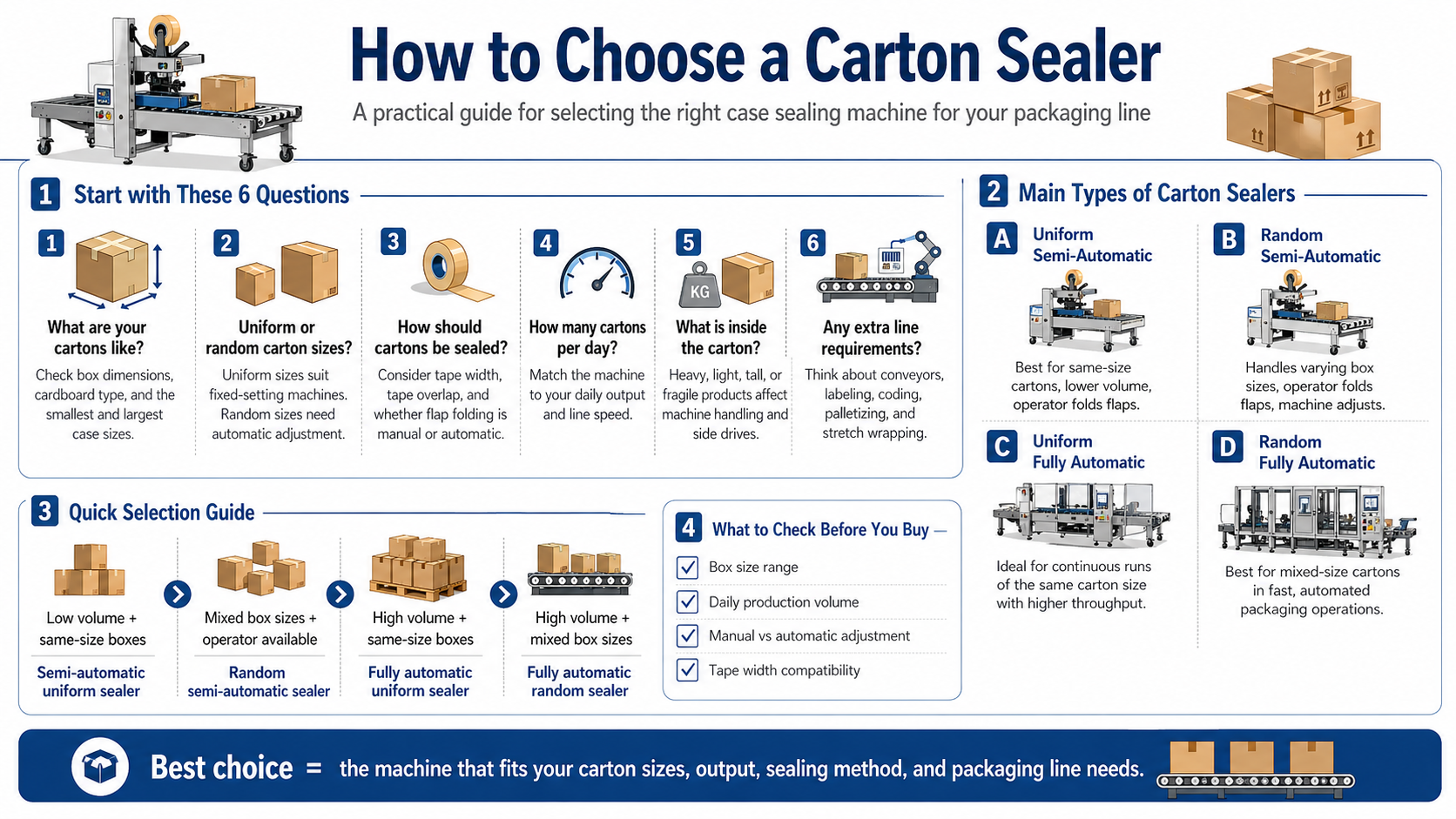
If you are wondering how to choose a carton sealer, the best place to start is not with the machine itself, but with your packaging process. What kind of cartons do you use? Are the box sizes always the same? How many cartons do you seal per day? Are your products light, heavy, fragile, or irregular?
This guide walks through the main points you should consider before buying a carton sealer, especially if you are building or upgrading a packaging line.
What Is a Carton Sealer?
A carton sealer is a packaging machine used to close and seal cardboard boxes, usually with adhesive tape. It is also commonly called a case sealer or box taping machine.
Instead of asking workers to manually tape every box, a carton sealer moves the carton through the machine and applies tape to the top and/or bottom flaps. In many operations, this small change can make the packing process faster, cleaner, and more consistent.
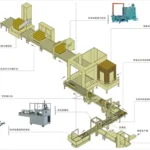
A carton sealer is often used as part of a larger end-of-line packaging system. It may work together with conveyors, labeling machines, coding machines, palletizers, stretch wrapping machines, or other automated packaging equipment.
How to Choose a Carton Sealer for Your Business
The right carton sealer depends on your boxes, production volume, labor setup, and future growth plans. Before comparing models, answer these key questions.

1. What Are Your Cartons Like?
Start with the cartons themselves.
You need to know the basic details of the boxes you want to seal:
- Box length
- Box width
- Box height
- Cardboard thickness
- Box strength
- Minimum and maximum carton size
- Whether the boxes are low, tall, narrow, or heavy
This matters because not every carton sealer can handle every box dimension. Some machines are designed for regular medium-sized cartons, while others are better for very low boxes, oversized cartons, or heavier cases.
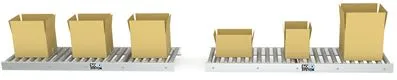
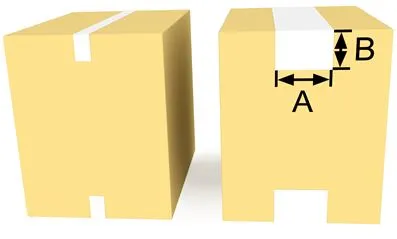
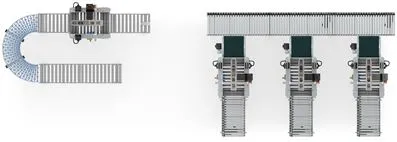
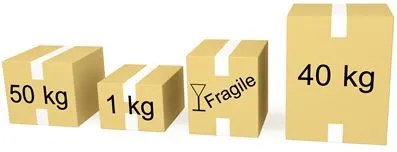
A good buying habit is to make a simple list of all box sizes used in your operation. Include the smallest and largest cartons, not just the most common size. If your machine cannot handle your full box range, you may still need manual taping for part of your production.
2. Do You Use Uniform or Random Carton Sizes?
This is one of the most important questions when choosing a carton sealer.
If your cartons are mostly the same size for long production runs, a uniform carton sealer may be enough. The operator sets the machine to one box size, and the machine seals cartons of that same size repeatedly.
This is common in factories or warehouses that package the same product all day.
But if your line handles different box sizes one after another, you may need a random carton sealer. A random carton sealer can automatically adjust to different carton heights and widths, which makes it much more suitable for mixed-size packaging operations.
For example:
| Packaging Situation | Better Choice |
|---|---|
| Same box size for long runs | Uniform carton sealer |
| Different box sizes in batches | Adjustable semi-automatic sealer |
| Random box sizes one after another | Random automatic carton sealer |
| E-commerce or mixed-order packing | Random carton sealer |
For businesses with many SKUs or frequent order changes, random size handling can save a lot of operator time.
3. Semi-Automatic or Fully Automatic Carton Sealer?
The next decision is the automation level.
Semi-Automatic Carton Sealer
A semi-automatic carton sealer usually requires an operator to fold the carton flaps and push or feed the box into the machine. The machine then applies tape to the top and bottom of the carton.
This type is often a good choice for:
- Small to medium production volumes
- Businesses starting to automate packaging
- Operations with available packing staff
- Lower budget projects
- Uniform or batch-based carton sizes
Semi-automatic machines are usually easier to install, easier to operate, and more affordable than fully automatic systems.
Fully Automatic Carton Sealer
A fully automatic carton sealer can fold the flaps and seal the cartons with little or no manual handling. It is usually installed in a more complete packaging line with conveyors and upstream equipment.
This type is better for:
- High-volume production
- Continuous packaging lines
- Operations with labor shortages
- Faster carton flow
- More consistent sealing quality
- Integration with other end-of-line equipment
If you are sealing hundreds or thousands of cartons per day, a fully automatic carton sealer may be a better long-term investment.
4. How Many Cartons Do You Seal Per Day?
Your daily carton volume directly affects the type of machine you should choose.
If you only seal a small number of cartons per day, a simple semi-automatic carton sealer may be enough. It can reduce manual taping work without adding unnecessary complexity.
But if your production line seals cartons continuously throughout the day, you need a machine that can keep up with your throughput. A machine that is too small for your workload may cause bottlenecks, downtime, and premature wear.
Think about both your current and future needs:
- How many cartons do you seal per hour?
- How many cartons do you seal per day?
- Do you have seasonal peaks?
- Will your production volume grow in the next 1–3 years?
- Is carton sealing currently slowing down your packing line?
A carton sealer should not just match your current output. Ideally, it should give you some extra capacity for growth.
5. How Do You Want the Cartons to Be Sealed?
Not every carton sealing requirement is the same.
You should check:
- Tape width
- Tape overlap
- Top sealing requirement
- Bottom sealing requirement
- Single-side or double-side sealing
- Manual or automatic flap folding
- Tape quality and compatibility
Tape width and tape overlap are easy to overlook, but they matter. A poor tape application may lead to weak sealing, wasted tape, or cartons opening during shipping.
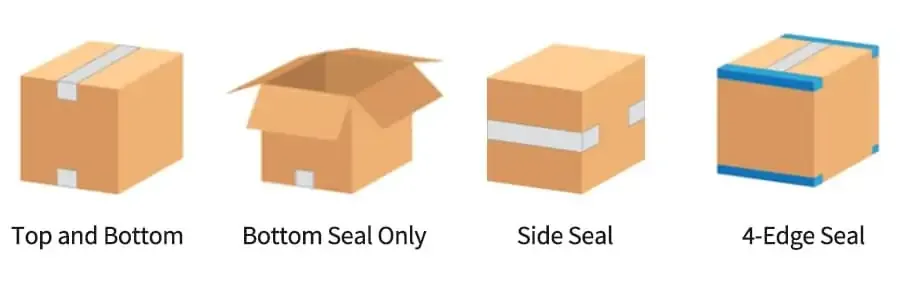
For standard shipping cartons, many case sealers apply tape to both the top and bottom center seams. However, some products may require special sealing patterns, stronger tape, or wider tape for extra security.
Before buying the machine, confirm that the sealer supports the tape size and sealing style your packaging requires.
6. What Are You Packing Inside the Cartons?
The contents of the carton also affect machine selection.
Ask yourself:
- Are the products heavy or light?
- Are they fragile?
- Are the cartons tall or unstable?
- Is the box tightly packed or partly empty?
- Could the product be damaged by pressure or vibration?
Heavy boxes may need stronger side drive belts or more stable conveying. Light boxes may require gentler handling to avoid slipping or misalignment. Tall boxes may need better support during sealing.
For example, tall or heavy cartons often need stronger side drives, while low or lightweight cartons may work better with smaller side drive configurations. The goal is to move the carton smoothly through the sealing area without crushing, shifting, or losing alignment.
A carton sealer should not only seal the box. It should handle the carton in a way that protects the product inside.
7. Do You Need Manual or Automatic Adjustment?
Adjustment is another key point.
If your team runs one box size for several hours, manual adjustment may not be a problem. The operator can set the height and width once, then continue sealing.
But if your carton sizes change often, manual adjustment can become annoying and inefficient. Workers may forget to adjust the machine correctly, which can lead to poor tape placement or machine jams.
Automatic adjustment is useful when:
- Box sizes vary frequently
- Orders are picked and packed individually
- Operators need to move quickly
- You want to reduce setup time
- You want fewer errors during changeovers
For e-commerce, third-party logistics, and mixed-product warehouses, automatic adjustment is often worth the extra cost.
8. How Much Space Do You Have?
A carton sealer needs enough room for safe and smooth operation.
Before choosing a machine, check:
- Machine footprint
- Infeed and outfeed space
- Operator working area
- Conveyor connection points
- Maintenance access
- Power supply location
- Emergency stop access
A machine may look compact in a product photo, but in a real packing area, it needs enough space before and after the sealing section. If you plan to connect it with conveyors, labeling machines, coding systems, or palletizing equipment, the layout becomes even more important.
Measure your available floor space carefully before ordering.
9. Will the Carton Sealer Be Part of a Larger Packaging Line?
Many carton sealers are not standalone machines. They often work inside a complete end-of-line packaging system.
Your carton sealer may need to connect with:
- Conveyor systems
- Carton erectors
- Filling or packing stations
- Labeling machines
- Inkjet coding machines
- Checkweighers
- Palletizers
- Stretch wrapping machines
- Production control systems
If you already have a production line, the carton sealer must match the line speed, conveyor height, carton flow direction, and control logic. If you are building a new packaging line, it is better to think about the carton sealer as part of the whole system rather than as a separate machine.
A modular system can be useful because it allows different machines to work together more efficiently.
Main Types of Carton Sealers
To make the decision easier, here are the common types of carton sealers.
Uniform Semi-Automatic Carton Sealer
A uniform semi-automatic carton sealer is designed for cartons of the same size. An operator folds the flaps and feeds the box into the machine. The sealer applies tape to the carton, usually on the top and bottom.
This is a practical choice for businesses that use consistent box sizes and want a simple way to reduce manual taping.
Best for:
- Uniform carton sizes
- Small to medium output
- Lower automation budgets
- Simple packing lines
Random Semi-Automatic Carton Sealer
A random semi-automatic carton sealer is used when carton sizes vary. The operator still folds the flaps, but the machine can adjust to different carton widths and heights.
This is useful when your business handles different box sizes but does not need a fully automatic flap-folding system.
Best for:
- Mixed carton sizes
- Batch packing
- Warehouses with varied products
- Businesses that still use operators at the packing station
Uniform Fully Automatic Carton Sealer
A uniform fully automatic carton sealer is designed for continuous runs of the same carton size. The machine can fold the flaps and seal the carton automatically after it is set up.
This type works well in production lines where the same product and box size are packed repeatedly.
Best for:
- High-volume production
- Same-size cartons
- Automated packaging lines
- Reduced manual labor
Random Fully Automatic Carton Sealer
A random fully automatic carton sealer is the most flexible option. It can handle different carton sizes one after another and automatically adjust to each box.
This type is ideal for operations where box sizes change constantly, especially in e-commerce, distribution centers, and mixed-product packaging lines.
Best for:
- Random carton sizes
- High labor-saving requirements
- E-commerce fulfillment
- Continuous mixed-size packaging
- Automated end-of-line systems
Carton Sealer Buying Checklist
Before choosing a carton sealer, review this checklist:
- What are the minimum and maximum carton sizes?
- Are the cartons uniform or random in size?
- How many cartons do you seal per hour or per day?
- Do you need semi-automatic or fully automatic operation?
- Who will fold the carton flaps: the operator or the machine?
- What tape width and overlap do you need?
- Are the cartons heavy, light, fragile, tall, or low?
- Does the machine need to connect with conveyors or other equipment?
- How much floor space do you have?
- What is your budget for the machine, installation, and maintenance?
- Do you need future expansion or customization?
- Is the machine easy to adjust, clean, and maintain?
This checklist can help you avoid buying a machine that looks suitable on paper but does not fit your real packaging process.
Common Mistakes When Choosing a Carton Sealer
A carton sealer is a practical machine, but buying the wrong one can create avoidable problems. Here are a few mistakes to watch out for.
Choosing Based Only on Price
A cheaper machine may be enough for simple, low-volume work. But if it cannot handle your carton sizes, production speed, or box weight, it may cost more in downtime and maintenance later.
Ignoring Box Size Variation
Many businesses underestimate how often their box sizes change. If your line uses many carton sizes, a random carton sealer may be more efficient than a basic uniform model.
Forgetting About Future Growth
A machine that fits today’s volume may become too slow next year. Choose a carton sealer with some room for growth if your business is expanding.
Not Checking Tape Requirements
Tape width, tape quality, and tape overlap affect sealing strength. Always confirm compatibility before purchase.
Treating the Carton Sealer as a Standalone Machine
If the carton sealer will be part of a larger packaging line, make sure it can connect properly with conveyors, coding machines, labeling systems, or palletizing equipment.
So, Which Carton Sealer Should You Choose?
Here is a simple way to think about it.
If you seal a small number of same-size boxes each day, a uniform semi-automatic carton sealer is often enough.
If your box sizes change but you still have operators at the packing station, a random semi-automatic carton sealer may be a better fit.
If you run high volumes of the same carton size, a uniform fully automatic carton sealer can improve speed and consistency.
If you handle many carton sizes in a fast-moving operation, a random fully automatic carton sealer is usually the most efficient option.
The best carton sealer is not always the most advanced machine. It is the one that matches your carton sizes, production volume, labor setup, sealing requirements, and packaging line layout.
Final Thoughts
Learning how to choose a carton sealer is really about understanding your packaging process. The machine should fit your cartons, your output, your workers, and your future plans.
Before buying, take time to measure your box sizes, review your daily carton volume, check your tape requirements, and think about whether your packaging line will need more automation later. A well-chosen carton sealer can make your packing process faster, cleaner, and more reliable — and that can make a real difference in daily operations.
FAQ
What is a carton sealer used for?
A carton sealer is used to close and tape cardboard boxes for shipping or storage. It helps reduce manual taping, improve sealing consistency, and speed up the packaging process.
What is the difference between a carton sealer and a case sealer?
In most packaging contexts, “carton sealer” and “case sealer” refer to the same type of machine. Both are used to apply tape to cartons or cases.
How do I choose a carton sealer?
To choose a carton sealer, consider your carton sizes, whether the boxes are uniform or random, your daily production volume, tape width, sealing style, product weight, automation needs, and available floor space.
Is a semi-automatic carton sealer enough for a small business?
Yes, a semi-automatic carton sealer is often a good choice for small businesses or operations with moderate carton volume. It reduces manual taping while keeping the investment relatively simple.
When should I choose a fully automatic carton sealer?
A fully automatic carton sealer is better when you have high production volume, continuous packaging runs, labor-saving goals, or a packaging line that needs automatic flap folding and sealing.
What is a random carton sealer?
A random carton sealer is a machine that can adjust to different carton sizes. It is useful for e-commerce, warehouses, and packaging lines where box dimensions change frequently.
Can a carton sealer handle heavy boxes?
Yes, but you need to choose a machine designed for heavy cartons. Heavy boxes may require stronger drives, stable conveying, and suitable machine construction.
Does tape width matter when choosing a carton sealer?
Yes. The carton sealer must be compatible with your required tape width and tape overlap. These details affect sealing strength and carton security during shipping.