Choosing a filling machine starts with understanding your product, not comparing machine prices. The right equipment must handle your material, deliver the required fill quantity, work with your containers, and maintain a practical production speed.
A machine that fills water efficiently may struggle with honey. An auger filler that works well with fine powder may not be the best choice for irregular snack pieces. Even a machine with excellent specifications can become a production bottleneck if it takes too long to clean or change between products.
Quick answer: To choose a filling machine, identify your product’s flow characteristics, select a suitable filling method, confirm the container and fill range, calculate your required output, and evaluate accuracy, cleaning, automation, and operating costs. Before purchasing, ask the supplier to demonstrate the machine with your actual product and packaging.
This guide explains how to make those decisions without paying for features you do not need—or overlooking requirements that matter once production begins.
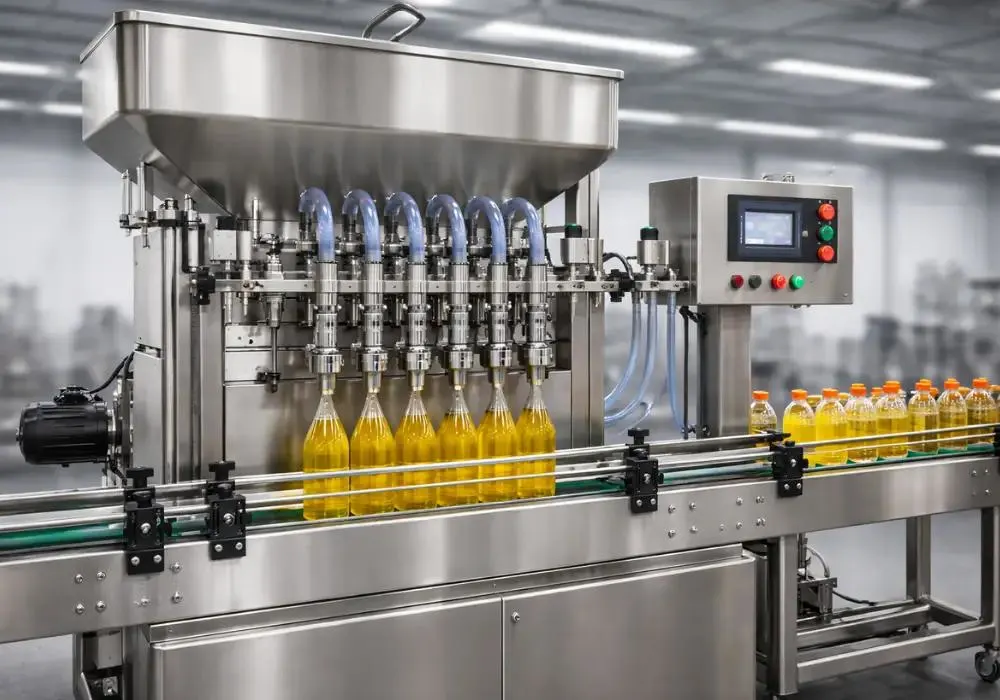
1. Start With the Product You Need to Fill
Before considering a filling machine, describe the product in enough detail to understand how it behaves during processing.
The most important distinction is whether you are filling a liquid, paste, powder, granule, or irregular solid.
However, product categories alone do not tell the whole story.
Two liquid products can behave very differently. Water flows easily through narrow passages, while a thick cream may need a positive-displacement pump or piston. Similarly, free-flowing sugar and cohesive milk powder may require different feeding and dosing arrangements.
For liquids and pastes
Consider:
- Viscosity: How easily does the product flow at the actual filling temperature?
- Foaming: Does it produce foam when pumped or discharged?
- Particles: Does it contain fruit pieces, seeds, pulp, or other solids?
- Temperature: Does it need heating or cooling during filling?
- Chemical compatibility: Can the product safely contact the selected seals, tubing, valves, and metal surfaces?
- Product sensitivity: Can pumping, recirculation, or exposure to air affect quality?
For example, a thin, free-flowing beverage may be compatible with a gravity filling system. A thick sauce may require a piston filler, particularly when it contains particles.
But viscosity alone is not enough to decide. Nozzle dimensions, particle size, container openings, and cleaning requirements also affect the selection.
For powders and granules
Important properties include:
- Particle size and distribution
- Bulk density
- Free-flowing or cohesive behavior
- Moisture sensitivity
- Dust generation
- Tendency to bridge or form lumps
- Fragility and susceptibility to product damage
An auger filler can meter many fine powders, while a weigh-filling system may be more suitable for irregular pieces or products whose bulk density varies.
Practical tip: Give prospective suppliers representative product samples, rather than relying on a product name or a brief description.
2. Compare the Main Types of Filling Machines
Different filling technologies control product quantity in different ways.
Some dispense a measured volume. Others fill to a consistent level, use a controlled pump, or measure product weight.
Understanding this difference is one of the most useful steps in selecting equipment.
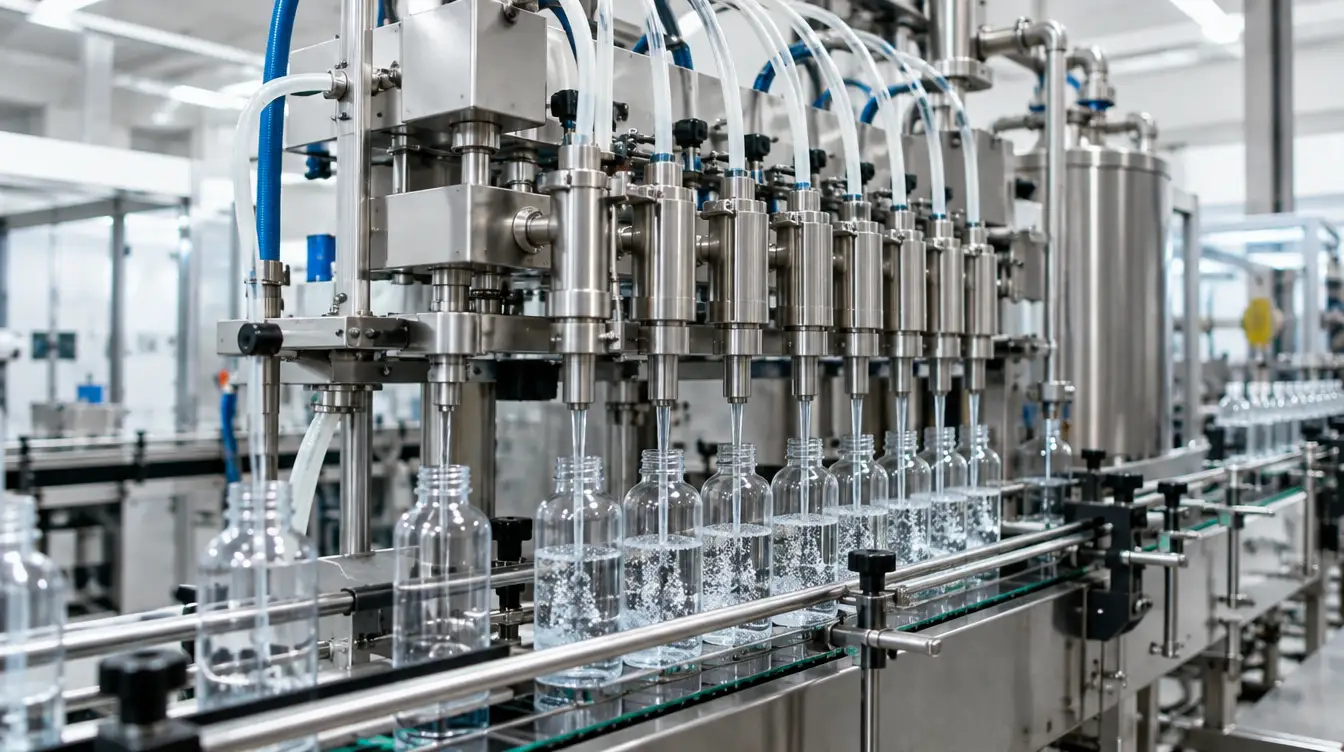
Filling machine selection chart
| Filling method | Common applications | Main consideration |
|---|---|---|
| Gravity filler | Water-like liquids, thin cleaners, suitable beverages | Needs sufficiently consistent product flow |
| Overflow filler | Thin liquids in clear, rigid bottles | Controls visible fill level, not identical volume |
| Piston filler | Sauces, creams, gels, pastes | Cylinder range, valves, and cleaning access |
| Pump filler | Oils, lotions, liquid chemicals | Pump design must match product behavior |
| Flow meter filler | Suitable liquids where flow can be measured reliably | Meter compatibility and flow conditions |
| Net-weight filler | Products requiring mass-based dosing | Weighing stability and fill-cycle time |
| Auger filler | Fine powders, spices, powdered ingredients | Bulk-density changes and powder flow |
| Volumetric cup filler | Consistent, free-flowing dry products | Changes in bulk density affect fill weight |
| Combination weigher with packer | Snacks, nuts, small irregular pieces | Product feeding and integration with packaging |
These are starting points, not universal rules. A filling trial may show that more than one method works for the same product.
Gravity filling machines
Gravity fillers use the product’s own weight to move liquid from a supply tank into containers. In common timed-gravity designs, valves remain open for a controlled interval.
They are often suitable for thin, free-flowing liquids.
Their relatively simple product path can be attractive, but flow variation caused by pressure, temperature, or supply conditions can affect the quantity dispensed.
Piston filling machines
A piston filler draws a defined volume into a cylinder and then discharges it into a container.
It is commonly considered for thick liquids, creams, sauces, and pastes.
Some designs also handle products containing small solid pieces, provided the valves and product passages are suitable.
When comparing piston fillers, check the cylinder volume range, stroke adjustment, valve design, nozzle shutoff, and disassembly requirements.
Overflow filling machines
Overflow fillers are designed to produce a consistent visible fill height.
That is useful for transparent bottles displayed next to one another on a retail shelf.
However, equal liquid heights do not necessarily mean equal quantities. Differences in container dimensions can produce volume differences.
An overflow system also requires a suitable path for returning excess liquid. Products that foam excessively, separate, or cannot tolerate recirculation need additional evaluation.
Powder and granular filling machines
Powder filling typically relies on auger dosing, weighing, volumetric cups, or combinations of these methods.
An auger measures product through controlled screw rotation. Its performance can be affected by changes in bulk density or powder feed conditions.
Weighing systems directly measure mass and may be useful when package weight must remain consistent despite changes in product volume.
For a deeper explanation of the difference between filling and weighing, read our Filling Machine vs Weighing Machine guide.
3. Check Your Container Type and Fill Volume
A suitable dosing system is only part of the solution. The machine must also handle the package reliably.
For bottles and jars, document:
- Minimum and maximum container dimensions
- Neck diameter and opening size
- Container material and rigidity
- Empty container stability
- Required fill volume range
- Cap or closure type
- Any unusual shapes or positioning requirements
Consider a business filling both 100 mL and 1 L bottles.
A supplier may advertise that the machine handles both volumes, but this does not guarantee acceptable speed and accuracy at both ends of the range.
Smaller doses may require different metering components. Larger bottles may require nozzle height adjustments, additional filling time, or changes to container handling.
Flexible pouches introduce another set of considerations. They may need opening, positioning, support, sealing, or spout-handling mechanisms that would not be necessary for rigid bottles.
Before ordering, request a trial using both your smallest and largest approved container formats.
4. Calculate the Filling Capacity You Actually Need
Production capacity is often misunderstood.
Manufacturers typically express filling speed in bottles per minute, containers per hour, or fills per minute.
But a machine’s advertised maximum speed is not necessarily the output a production line will deliver across an entire shift.
Actual results depend on filling time, product supply, container loading, cleaning, adjustments, interruptions, and downstream equipment.
A practical capacity calculation
Suppose your operation needs to produce 12,000 acceptable bottles during an eight-hour shift.
If the line runs productively for an estimated 75% of scheduled time, and 98% of filled bottles are acceptable, the required operating speed is:
Required operating speed = Good bottles needed ÷ (Available minutes × Productive-time factor × Good-product yield)
Using the example:
12,000 ÷ (480 × 0.75 × 0.98) = approximately 34 bottles per minute.
This is a planning example, not a universal performance allowance.
A machine rated for exactly 34 bottles per minute at ideal conditions would leave little margin. You might therefore investigate models that can sustain around 40–50 bottles per minute with your actual product, while confirming the expected performance through testing.
The important word is sustain.
A filler running at 60 bottles per minute is of limited value if the capping machine can handle only 35.
If you are designing a connected packaging line, our Packaging Conveyor System Guide explains how transfers, accumulation, and line integration affect output.
5. Decide How Much Automation You Need
Filling machines are commonly available in manual, semi-automatic, and fully automatic configurations.
The right level depends on production volume, operator availability, batch sizes, and the wider packaging process.
Manual and benchtop equipment
A manual or small benchtop filler can be practical for low-volume production, product development, or occasional filling.
Its advantages are simplicity, flexibility, and potentially lower initial investment.
The trade-off is greater operator involvement and, depending on the design, lower sustained throughput.
Semi-automatic filling machines
With a semi-automatic machine, an operator may position each container and initiate the fill, while the machine controls the dosing cycle.
This arrangement can be useful for businesses with moderate production volumes or frequent product changes.
However, operator loading and unloading must be included in capacity calculations.
Fully automatic filling machines
Automatic systems typically coordinate container feeding, positioning, filling, and discharge.
They can reduce repetitive manual handling and improve production continuity when supplied with containers and product reliably.
Automation also brings additional requirements for controls, guarding, maintenance, integration, and troubleshooting.
A fully automatic machine is not automatically the best investment for a small business.
For a wider comparison, see Automatic vs Semi-Automatic Packaging Machine.
6. Understand Filling Accuracy Before Comparing Specifications
A filling machine may be described as highly accurate, but that claim is incomplete unless the measurement method and test conditions are defined.
First, establish what the filling process needs to control:
- Net mass
- Dispensed volume
- Visible fill level
- Product count, where applicable
Next, decide how acceptable variation will be measured.
For example, a supplier might advertise a percentage filling tolerance. Ask whether it represents individual fills, average deviation, repeatability, or a result measured under particular test conditions.
Those are not interchangeable.
Questions to ask about accuracy
- At which filling volume was the accuracy tested?
- Which product was used?
- What were the temperature and operating speed?
- How many containers were measured?
- Were results recorded at startup and during continuous operation?
- What happens after a product change or adjustment?
- How will underfilled and overfilled packages be detected?
For products sold by declared net quantity, the applicable market’s labeling and metrology requirements should also be checked.
In the United States, NIST Handbook 133 provides procedures for checking the net contents of packaged goods.
Meeting a machine manufacturer’s internal filling specification does not automatically establish compliance with all applicable net-content rules.
7. Evaluate Cleaning, Hygiene, and Material Compatibility
Cleaning requirements can eliminate an otherwise attractive machine from consideration.
A filler used for food or cosmetics may need frequent product changes. Residual material trapped in tubing, valve seats, seals, or difficult-to-access passages can increase cleaning time and contamination risk.
Consider the complete product-contact path:
- Product hopper or supply tank
- Pumps or pistons
- Valves and manifolds
- Tubing and connections
- Filling nozzles
- Seals and gaskets
Check whether these components can be accessed, inspected, cleaned, and maintained appropriately.
Some systems are designed for clean-in-place (CIP). Others require manual disassembly or clean-out-of-place procedures.
Neither approach should be assumed adequate without reviewing the actual product and cleaning process.
Industry-specific requirements
For food applications, hygienic equipment design and cleanability are important. The European Hygienic Engineering & Design Group (EHEDG) publishes guidance covering hygienic design principles and hygienic or aseptic filling equipment.
In the United States, 21 CFR 117.40 includes requirements concerning equipment cleanability, maintenance, materials, and protection against contamination in covered food operations.
For pharmaceutical, sterile, aseptic, corrosive, or flammable products, further application-specific engineering and regulatory review may be necessary.
Do not assume that a stainless-steel machine, a sanitary-looking enclosure, or a general certification claim makes a filler suitable for every regulated process.
8. Compare Total Operating Cost, Not Just Purchase Price
The lowest-priced filling machine is not necessarily the least expensive to operate.
A realistic comparison should account for:
| Cost factor | What to evaluate |
|---|---|
| Purchase and installation | Machine, tooling, commissioning, utilities |
| Labor | Operators needed per shift |
| Product loss | Overfill, dripping, startup waste, rejected packs |
| Maintenance | Consumables, seals, tubing, pumps, spare parts |
| Cleaning | Labor, water, chemicals, lost production time |
| Changeovers | Time required between products and packages |
| Downtime | Availability of technical support and replacement parts |
| Integration | Conveyors, capping, sealing, labeling, inspection |
A machine with a higher purchase price may offer lower operating costs if it reduces manual handling, waste, or downtime.
The reverse can also be true. For occasional small batches, a simpler semi-automatic filler may make more economic sense than an automated line that is underused.
Compare realistic annual operating scenarios rather than relying on a general promise of return on investment.
9. Ask for a Demonstration With Your Actual Product
A supplier demonstration is particularly valuable when the product is viscous, foamy, sensitive, dusty, or difficult to handle.
The test should reproduce the proposed operating conditions as closely as practical.
Before the demonstration, agree on the required output, fill tolerance, sample size, and acceptance criteria.
Ask the supplier to show:
- Filling at the required production speed
- Performance with your actual product and containers
- Individual fill measurements and recorded results
- Startup and stop-start behavior
- Dripping, splashing, foaming, or product loss
- Cleaning and product-contact access
- A timed changeover between relevant formats
- Integration with upstream and downstream equipment, where applicable
A short demonstration using water does not establish that the same machine will perform equally well with a thick sauce.
For larger purchases, the Factory Acceptance Test (FAT) should document the agreed scope and results before shipment. A Site Acceptance Test (SAT) may then confirm performance after installation under the actual site’s conditions.
Neither test should rely solely on a brief video of the machine running.
10. Common Mistakes When Buying a Filling Machine
Choosing by advertised speed alone
A high maximum speed is useful only when the machine can maintain the required output with your actual product and package.
Assuming one machine can fill everything
A machine may accommodate several products, but changes in viscosity, particles, density, temperature, or cleaning needs can require different components or entirely different equipment.
Ignoring changeover time
A fast machine can become inefficient when production involves many small batches and lengthy adjustments.
Overlooking the rest of the packaging line
Filling is often followed by capping, sealing, labeling, coding, inspection, and packing.
Each stage must support the intended line output.
Buying without checking service support
Confirm spare-parts availability, manuals, electrical documentation, operator training, maintenance requirements, and technical support arrangements before committing.
Filling Machine Buying Checklist
Use this checklist when requesting quotations from manufacturers.
- Product type and representative samples provided
- Viscosity, density, temperature, particle or powder characteristics documented
- Container dimensions and samples supplied
- Minimum and maximum filling quantities confirmed
- Required output and shift pattern calculated
- Filling tolerance and acceptance method specified
- Cleaning, product-contact materials, and regulatory needs reviewed
- Manual, semi-automatic, or automatic operation selected
- Utilities, footprint, and line connections confirmed
- Changeover and maintenance requirements understood
- Product trial and FAT acceptance criteria agreed
- Spare parts, training, warranty, and service scope documented
Providing every supplier with the same requirements makes their quotations easier to compare.
Frequently Asked Questions
What is the best filling machine for a small business?
A manual or semi-automatic filling machine is often worth considering when production volumes are modest, batches are small, or product changes are frequent. The best option depends on product characteristics, required output, available labor, and growth plans.
Which filling machine is best for thick liquids?
Piston fillers and suitable positive-displacement pump fillers are common options for thick liquids such as creams, sauces, and gels. The final selection depends on actual viscosity, temperature, suspended particles, nozzle design, and cleaning requirements.
Is a piston filler better than a gravity filler?
Not in every application. Gravity fillers are often practical for thin, free-flowing liquids, while piston fillers can be more suitable for viscous materials. A piston system may add unnecessary complexity when a simpler machine already meets the requirements.
Should I choose filling by weight or volume?
Choose according to the required measurement, product characteristics, and acceptable variation. Weight-based filling measures mass directly, while volumetric systems measure or control volume. Products with variable density may benefit from weight-based control or additional verification.
How do I know what filling speed I need?
Start with the number of acceptable packages required per shift. Account for scheduled time, expected productive running time, and rejected packages. Then verify that the selected machine can sustain the required speed with your product and packaging.
Can one filling machine handle multiple bottle sizes?
Many machines can, but the allowable size and fill-volume ranges depend on the design. Different nozzles, metering parts, guides, or change components may be needed. Test the full proposed range before purchasing.
Final Thoughts: Choose for the Process, Not the Specification Sheet
The best filling machine is not necessarily the fastest, most expensive, or most automated model.
It is the machine that can fill your actual product into your actual package, achieve the required output and quantity control, and remain practical to clean, maintain, and operate.
Start by defining the product and packaging requirements. Use those requirements to narrow the filling technology. Then compare suppliers using documented tests, realistic operating costs, and clearly defined acceptance criteria.
That approach makes it easier to avoid unnecessary equipment costs and select a filling system that fits the production process.
For a basic introduction to filling equipment, see our guide to what a filling machine is and how it works.
Technical References
- NIST Handbook 133: Checking the Net Contents of Packaged Goods (2026)
- EHEDG Guideline 8: Hygienic Design Principles
- EHEDG Guideline 46: Aseptic and Hygienic Filling Machines
- 21 CFR 117.40: Equipment and Utensils
Editorial note: This guide is based on publicly available engineering references and equipment-selection principles. It does not report independent machine testing. Machine-specific performance should be verified with the manufacturer and appropriate qualified personnel.