
When packaging equipment stops producing reliable seals, the problem is not always a broken machine. A packaging line may continue running at normal speed while producing bags that open too easily, pouches with small leaks, or seals that look wrinkled or damaged.
These problems can result from incorrect temperature settings, insufficient sealing time, uneven pressure, contaminated sealing surfaces, incompatible packaging film, or worn machine components.
If your packaging equipment is not sealing properly, start by identifying the visible defect and checking whether the packaging material, machine settings, or product has recently changed. Avoid increasing the sealing temperature automatically. Excessive heat can damage the film without correcting the original problem.
This guide explains how to recognize common sealing problems, investigate their causes, and restore consistent package quality.
What Does It Mean When Packaging Equipment Is Not Sealing Properly?
A packaging seal must form a continuous, reliable bond that meets the requirements of the product and package.
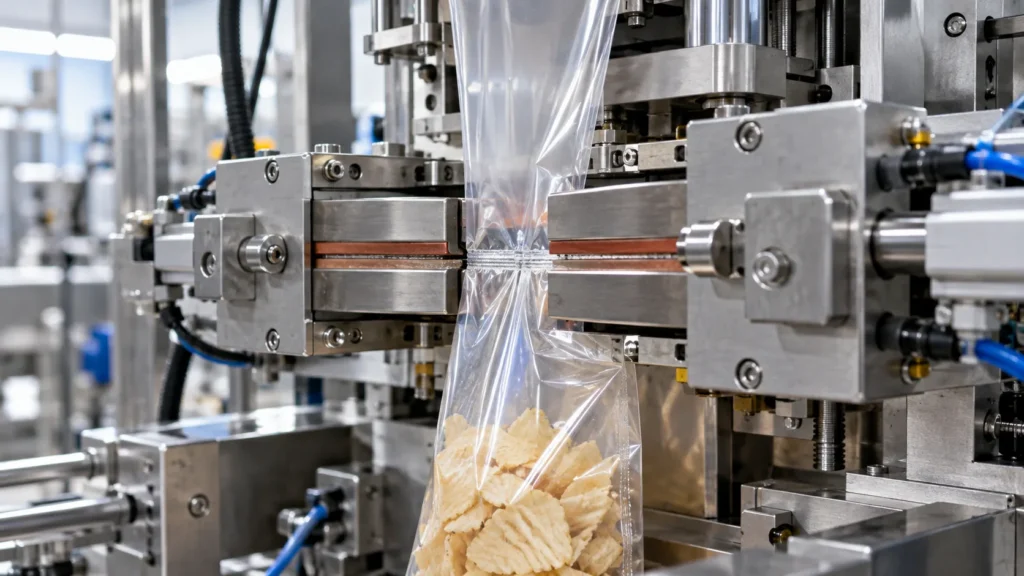
For flexible packaging, heat sealing generally involves bringing compatible sealant surfaces together under controlled heat, pressure, and contact time. The resulting bond must be strong enough for the intended filling, handling, storage, and distribution conditions.
A sealing problem may appear in several ways:
- The package opens with little resistance.
- One section of the seal is weaker than another.
- Air or liquid escapes from a closed package.
- The film wrinkles around the sealing area.
- The packaging material becomes discolored or distorted.
- The film sticks to the sealing jaws.
- Seals fail intermittently, even though machine settings appear unchanged.
These symptoms do not necessarily have the same cause.
A weak seal may indicate insufficient heat transfer, while a leaking package may contain a narrow channel caused by trapped product or a film wrinkle.
This distinction matters because a package can have reasonable seal strength in one location while still leaking elsewhere.
The following troubleshooting advice primarily applies to heat-sealing systems used with flexible bags, pouches, sachets, and roll-stock packaging.
Carton sealing machines that use adhesive tape or hot-melt glue require a different diagnostic approach.
Quick Troubleshooting Chart: Symptoms, Causes, and Checks
| Sealing problem | Possible causes | What to check first |
|---|---|---|
| Weak or easily opened seal | Insufficient heat, short dwell time, incompatible film | Approved sealing recipe and material specification |
| Burned or distorted seal | Excessive heat exposure, unsuitable film | Actual temperature and sealing time |
| Seal weak on one side | Uneven pressure, jaw misalignment, damaged pad | Sealing-surface condition and alignment |
| Intermittent leaks | Product contamination, unstable feeding, temperature fluctuations | Defect location and production timing |
| Wrinkled seal | Uneven film tension, poor tracking, folds | Film path and pouch presentation |
| Film sticking to jaws | Excessive heat, residue, damaged release surface | Jaw condition and approved cleaning procedure |
| Seal opens after filling | Insufficient hot strength, early mechanical loading | Cooling and package transfer conditions |
| No seal forms | Incorrect material, heater or actuator fault | Film specification, alarms, and machine status |
Use this table to narrow the investigation. It is not a substitute for the machine manufacturer’s troubleshooting procedure.
9 Common Reasons Packaging Equipment Is Not Sealing Properly
1. Incorrect Sealing Temperature
Sealing temperature is one of the first parameters operators examine when a package fails to close correctly.
However, both low and excessive temperatures can cause problems.
When the temperature is too low, the heat-sealable layer may not reach the condition needed to form a reliable bond. The seal may look closed but separate under relatively light force.
When the temperature is too high, the film may shrink, distort, stick to the jaws, or suffer damage that reduces package performance.
The correct temperature depends on several factors:
- Packaging film structure
- Type and thickness of the sealant layer
- Sealing-jaw design
- Contact time
- Packaging speed
- Heat transfer through the material
A controller displaying the expected setpoint does not necessarily prove that the required temperature is being achieved across the sealing surface.
What to do: Compare the actual operating conditions against the approved machine recipe and film supplier’s sealing recommendations. If temperature verification is needed, a qualified technician should use the measurement method specified for the equipment.
Do not use a universal temperature setting for every packaging material.
2. Insufficient Sealing Time
Sealing time, also called dwell time, describes how long the sealing surfaces remain in contact with the packaging material during the sealing cycle.
The sealant layer needs sufficient time to receive heat and develop a bond.
If the contact time is too short, the interface may not seal correctly even when the displayed temperature appears normal.
This problem can become noticeable after an increase in packaging speed.
For example, a vertical form-fill-seal machine may produce acceptable seals during a slower trial but develop weak seals when production speed increases.
The actual relationship depends on the machine’s motion and sealing mechanism.
What to do: Check whether the machine speed or sealing recipe changed before the problem appeared. Compare operation at the approved production settings with previously validated conditions.
Where permitted, controlled trials can help determine whether sealing time is contributing to the defect.
Do not change dwell time and temperature simultaneously during diagnosis.
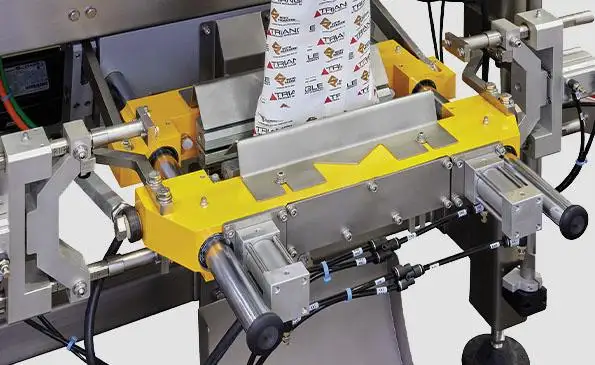
3. Uneven Sealing Pressure
Heat alone is not sufficient for a reliable heat seal. The sealing surfaces must also make suitable contact.
If pressure is uneven, portions of the film may not contact correctly.
This can produce a seal that appears strong across most of its width but opens near one edge.
Potential causes include:
- Misaligned sealing jaws
- Damaged pressure pads
- Uneven actuator movement
- Mechanical wear
- Unstable pneumatic pressure
- Film folds preventing consistent contact
Excessive pressure is not necessarily an improvement. Depending on the material and equipment, it may thin or damage the softened sealing layer.
What to do: Inspect the visible condition of the sealing assembly using the manufacturer’s approved procedure.
If alignment, actuator pressure, or mechanical adjustment is required, assign the work to qualified maintenance personnel.
Do not reach into an operating sealing mechanism or bypass a guard to observe jaw contact.
4. Product Contamination in the Sealing Area
Product contamination is another important cause of poor packaging seals.
During filling, powder, crumbs, oil, moisture, or liquid may enter the area where the film surfaces are supposed to bond.
The material trapped between the layers can interrupt sealing or create narrow leak channels.
This is particularly relevant when packaging:
- Ground coffee
- Flour and powdered ingredients
- Granular foods
- Snacks and small particles
- Sauces and liquids
- Sticky or oily products
For example, a pouch may form an acceptable seal during an empty-film trial but leak when filled with powder.
That pattern suggests the filling operation or product movement may be contributing to the problem.
What to do: Inspect defective packages for product trapped in the seal. Check fill timing, product cutoff, bag positioning, and any relevant dust-control systems.
Use an approved empty-package test, where appropriate, to help distinguish filling-related contamination from a sealing-process defect.
Increasing temperature will not reliably remove contamination.
5. Packaging Film Is Not Compatible with the Machine Settings
Not all packaging films seal under the same conditions.
A packaging material may contain several layers, each serving a different purpose, such as structural support, barrier performance, printability, or sealing.
Even films that look similar may have different sealant materials and heat-sealing characteristics.
Problems can begin after:
- Switching to a different film supplier
- Changing film thickness
- Introducing a new laminate
- Loading the incorrect film grade
- Using film with the heat-sealable surface incorrectly oriented
- Running a material outside its recommended sealing window
A machine setting that worked with one film may not produce the same result with another.
What to do: Verify the film identification, structure, roll orientation, and approved material specification.
Compare the current material lot with a previously accepted lot.
If the film has changed, work with the material supplier and equipment manufacturer to establish appropriate production settings.
6. Dirty, Worn, or Damaged Sealing Components
Sealing components experience repeated heating, compression, and contact with packaging materials.
Over time, their condition may deteriorate.
Common wear-related concerns include:
- Damaged nonstick jaw covers
- Worn silicone pressure pads
- Film residue on sealing surfaces
- Scratched or uneven jaw faces
- Faulty heating elements
- Damaged temperature sensors
- Loose or deteriorated mechanical components
A damaged sealing surface may create a recurring weak point in the same location on every package.
What to do: Follow the machine’s preventive-maintenance procedure.
Inspect accessible components only when it is safe and authorized to do so.
Replace worn parts according to the manufacturer’s specifications. Use only approved cleaning methods and replacement materials.
For a broader maintenance schedule, see our Packaging Machine Maintenance Checklist.
7. Film Tracking or Tension Problems
Packaging film must enter the sealing area in the correct position.
If the film moves sideways, wrinkles, or folds, the sealing jaws may compress an uneven number of material layers.
This can lead to incomplete seals, wrinkles, and channels where the package leaks.
Possible causes include:
- Incorrect film-roll positioning
- Uneven web tension
- Misaligned guide rollers
- Worn pull belts
- Poorly positioned forming components
- Irregular film winding
- Incorrect pouch presentation
Film-related defects often become more noticeable after a roll change or speed adjustment.
What to do: Observe film tracking from the designated safe operating position.
Check the approved threading path, film-roll setup, and relevant machine settings.
If mechanical alignment is required, follow the equipment’s maintenance procedure rather than moving rollers randomly.
8. Insufficient Cooling or Hot Seal Strength
A newly formed heat seal does not necessarily have the same strength as a fully cooled seal.
Some packaging materials require time to develop sufficient strength after the heated jaws release.
This is especially important on high-speed equipment where filled packages are moved, dropped, pulled, or compressed soon after sealing.
If the seal is stressed before it develops adequate strength, the package may open even though its eventual cooled seal strength could otherwise be acceptable.
This behavior is related to hot tack, the strength of a seal while it remains hot.
What to do: Determine when the failure occurs.
Does the seal open immediately after jaw release, during product discharge, on a conveyor, or later during handling?
Review cooling arrangements, bag support, transfer timing, and the film’s hot-tack characteristics.
Do not assume that increasing the sealing temperature will resolve a problem caused by early mechanical loading.
9. Unstable Heating, Pneumatic, or Control Systems
Sometimes the sealing problem appears intermittently without an obvious material change.
One package seals correctly, while the next shows a weak section.
In this situation, the cause may involve inconsistent equipment operation.
Potential problems include:
- Heater cartridge deterioration
- Temperature-control faults
- Damaged thermocouples or other temperature sensors
- Intermittent electrical connections
- Fluctuating compressed-air supply
- Pneumatic actuator problems
- Incorrect motion timing
- Unstable machine control signals
The important clue is variation.
If the seal defect changes from cycle to cycle while the material and approved recipe remain constant, investigate whether the machine is reproducing the same sealing conditions.
What to do: Review alarm records and temperature trends if available.
Ask qualified maintenance personnel to inspect the relevant controls, heating circuits, and pneumatic components.
Electrical and actuator diagnostics should not be attempted by untrained operators.
How to Troubleshoot Packaging Seal Failures Step by Step
Changing multiple settings at once can make a sealing problem harder to diagnose.
A more reliable approach is to isolate one possible cause at a time.
Step 1: Stop and Contain Suspect Production
If defective seals could compromise product quality, stop or hold the affected production according to the facility’s quality procedure.
Identify the potentially affected packages and prevent unintended release.
Follow the equipment manufacturer’s shutdown instructions and the site’s hazardous-energy-control procedures before performing maintenance.
Step 2: Examine the Failed Packages
Collect representative examples of both acceptable and defective packages.
Look for:
- The exact location of the failed seal
- Wrinkles or visible channels
- Trapped product
- Distortion or discoloration
- Differences between the left and right sides
- Whether the problem occurs on every package or intermittently
Record when the defect first appeared.
Step 3: Find Out What Changed
Check for recent changes in:
- Film rolls or suppliers
- Product formulation
- Filling rate
- Machine speed
- Sealing recipe
- Cleaning procedures
- Replacement parts
- Shift or changeover conditions
A defect that appears immediately after a film change should initially direct attention toward material compatibility and setup.
Step 4: Verify the Approved Machine Settings
Compare the displayed operating parameters with the documented settings for the current package.
Confirm that the correct material and product recipe is selected.
Where the machine provides trends, examine whether temperature, timing, or other relevant process values have remained stable.
Do not assume a previous recipe is valid for a different packaging material.
Step 5: Isolate the Sealing Process
If the equipment’s approved procedure permits it, conduct a controlled sealing trial using clean, empty packaging material.
Compare those results with filled-package performance.
If empty packages seal correctly but filled packages do not, investigate product contamination, filling timing, and loading of the fresh seal.
If the empty material also fails, inspect material compatibility, machine settings, and sealing hardware.
This comparison is a diagnostic aid, not proof of a single root cause.
Step 6: Investigate One Variable at a Time
Document the starting conditions.
Have authorized personnel make controlled changes within the manufacturer’s permitted operating range.
After each change, produce enough test samples to evaluate whether the defect has been resolved consistently.
Avoid changing temperature, pressure, speed, and alignment together.
Step 7: Verify Package Quality Before Restarting Normal Production
A visually improved seal is not automatically an acceptable seal.
Verify the corrected process against the product’s approved quality requirements.
This may include seal-strength measurements, package leak testing, visual inspection, or other application-specific tests.
Document the corrective action and the evidence supporting release of the affected process.
Does the Troubleshooting Method Depend on the Packaging Machine Type?
Yes. The underlying sealing principles may be similar, but the equipment design affects how problems appear.
Vertical Form-Fill-Seal (VFFS) Machines
VFFS machines typically form a tube from flexible film and create longitudinal and transverse seals.
Common diagnostic areas include:
- Film tracking around the forming tube
- Longitudinal-seal alignment
- Transverse sealing-jaw condition
- Product falling into the seal area
- Sealing timing and cooling
If only the back seal fails, investigate the longitudinal sealing system rather than assuming every sealing station is defective.
Horizontal Form-Fill-Seal (HFFS) and Flow-Wrapping Machines
Horizontal packaging equipment may experience seal problems related to product spacing, film tension, fin-seal formation, end-seal timing, and jaw alignment.
Products entering the end-seal area at the wrong time can interfere with proper closure.
Check the approved product-positioning and sealing sequence.
Premade Pouch Packaging Machines
Premade pouch systems introduce additional variables associated with pouch opening, gripping, filling, and positioning.
A pouch that is not presented correctly to the sealing station may develop a folded or incomplete top seal.
Product caught around the pouch mouth is another possible cause.
Impulse and Continuous Band Sealers
Impulse sealers depend on a controlled heating cycle, pressure, and cooling interval.
Continuous band sealers also rely on consistent material transport through the sealing section.
Inspect the relevant heating, transport, pressure, and cooling components according to the OEM procedure.
What About Carton Sealing Machines?
Carton sealers using adhesive tape or hot-melt glue should be diagnosed separately.
Poor carton closure can result from incompatible adhesive, contaminated corrugated surfaces, poor tape application, incorrect pressure, or carton-positioning problems.
Heat-sealing temperature and dwell-time advice should not be applied directly to tape-sealing equipment.
How Can You Tell Whether the Seal Is Actually Good?
One of the most important distinctions in packaging quality is the difference between seal strength and seal integrity.
Seal strength describes the force needed to separate a seal.
Seal integrity concerns whether the package has an unintended opening or leakage path.
A strong seal in a tested section does not guarantee that the entire package is free of leaks.
Different test methods answer different questions.
| Test | What it evaluates |
|---|---|
| Visual inspection | Visible wrinkles, gaps, contamination, and damage |
| Seal-strength testing | Force required to separate a seal specimen |
| Package leak testing | Leakage under defined test conditions |
| Hot-tack testing | Strength of a newly formed seal while hot |
| Distribution or handling testing | Package performance under specified handling conditions |
ASTM F88/F88M provides a method for evaluating seal strength in flexible barrier materials.
ASTM F2096 addresses gross-leak detection through internal package pressurization.
These methods are not interchangeable.
The appropriate inspection or testing program depends on the package design, product risk, customer specifications, and applicable regulatory requirements.
For food, pharmaceutical, and medical applications, follow the relevant validated procedures rather than relying on an informal hand-pull test.
Preventive Maintenance Tips for Consistent Sealing
Many recurring sealing problems can be reduced through controlled operation and preventive maintenance.
Before Starting Production
- Confirm that the correct packaging film is loaded.
- Verify the approved production recipe.
- Check for visible damage or contamination.
- Confirm that the equipment has completed its required startup checks.
- Inspect initial production samples using the approved procedure.
During Production
- Monitor seal appearance and reject trends.
- Watch for changes in film tracking.
- Record temperature or control alarms.
- Check whether defects follow material or product changes.
- Inspect package quality at the specified sampling frequency.
During Scheduled Maintenance
- Clean sealing surfaces using approved methods.
- Inspect jaw covers and pressure pads.
- Verify relevant heating and temperature-control components.
- Check mechanical alignment where required.
- Inspect pneumatic equipment and air supply.
- Replace worn parts according to OEM instructions.
For general fault isolation beyond sealing, our Packaging Machine Troubleshooting Guide covers equipment startup, sensors, filling, film feeding, and other common operating problems.
When Should You Call a Maintenance Technician?
Some sealing problems can be identified through routine operator checks. Others require specialized inspection or repair.
Escalate the problem when:
- The sealing jaws do not heat correctly.
- Temperature readings fluctuate without an explained process change.
- One side of the seal repeatedly fails.
- An actuator does not move or close correctly.
- The equipment displays recurring electrical or pneumatic faults.
- A safety device is damaged or unreliable.
- Seal defects persist after approved setup and material checks.
Do not bypass safety interlocks, place hands inside an operating sealing station, or attempt energized repairs without the necessary qualifications and procedures.
Packaging equipment can contain hazardous electrical, pneumatic, mechanical, and thermal energy even after motion has stopped.
Frequently Asked Questions
Why is my packaging machine not sealing the bag completely?
Incomplete sealing can result from incorrect temperature, insufficient dwell time, uneven pressure, film wrinkles, contamination, or incompatible material. Identify whether the failure affects the entire seal or only one section before deciding what to inspect.
Why does my heat sealer produce weak seals?
Weak seals may indicate insufficient heat transfer, short sealing time, poor surface contact, contamination, or material incompatibility. Compare the process with the approved film and machine specifications.
Can too much heat cause a poor seal?
Yes. Excessive heat can distort or damage the packaging film, cause material to stick to sealing surfaces, or reduce seal quality. Increasing temperature is not a universal solution for weak seals.
Why are some bags sealed correctly while others leak?
Intermittent leaks may be associated with inconsistent product filling, contamination, film movement, unstable sealing pressure, or temperature-control variation. Compare defect location, machine cycle, material lot, and production timing.
Why does the seal open after the bag leaves the machine?
The package may be stressed before the newly formed seal develops enough strength. Check cooling, hot-tack performance, package handling, and whether product weight or downstream equipment applies force too early.
Does increasing packaging speed affect sealing quality?
It can. Depending on the machine design, higher speed may reduce effective sealing or cooling time and change film handling. Review the approved operating window instead of assuming the previous settings remain valid.
How do I prevent packaging seal failures?
Use compatible materials, maintain documented machine settings, inspect sealing surfaces, monitor product contamination, and verify package quality through an appropriate inspection program.
Final Thoughts
When packaging equipment is not sealing properly, the best starting point is the defect itself.
A weak seal, burned film, leaking pouch, and wrinkled seam may look like variations of the same problem, but they often require different corrective actions.
Check what changed, examine representative packages, verify the material and approved settings, and investigate one possible cause at a time.
Reliable sealing depends on more than heat. Material compatibility, pressure, timing, film presentation, equipment condition, and cooling all influence the final result.
A documented troubleshooting process helps production teams correct the immediate failure while reducing the chance of the same problem returning during the next shift.