
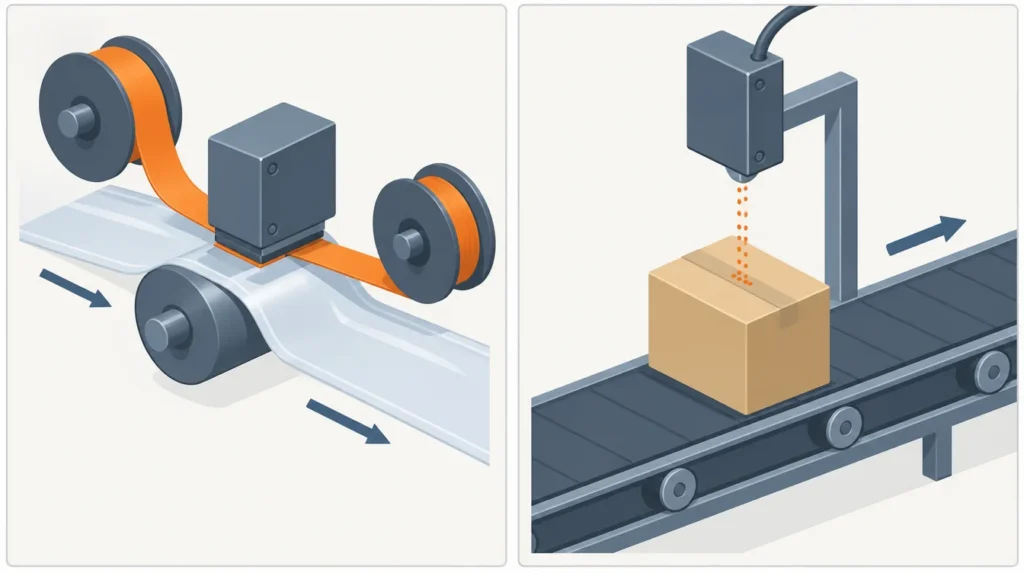
An inkjet coding machine places ink on the package without touching it. A thermal transfer printer, usually called a thermal transfer overprinter (TTO) in packaging, uses a heated printhead to press a ribbon against flexible film or a label web and melt ink from the ribbon onto it.
That one difference, contact with a ribbon versus non-contact with fluid ink, drives most of the practical trade-offs. TTO is built around flat, flexible material held against a backing surface, so it usually sits inside a packaging machine such as a flow wrapper or form-fill-seal machine. Inkjet coders can mark a much wider range of surfaces and shapes, including rigid, curved, and porous packs moving past on a conveyor.
Neither is better in general. The right choice depends on the package material, where on the line the code goes, what the code must contain, and how your team prefers to manage consumables and maintenance.
First, Clarify What Is Being Compared
Both terms cover more than one machine type, and mixing them up leads to poor comparisons.
“Inkjet coding machine” in packaging usually means one of these:
- Continuous inkjet (CIJ): a pressurized ink stream is broken into tiny droplets. Selected droplets are charged and deflected onto the product to form characters; unused droplets are collected and recirculated. CIJ typically uses solvent-based inks and a separate makeup fluid to keep the ink in condition.
- Thermal inkjet (TIJ): a disposable cartridge contains both the ink and the printhead. Tiny heating elements form vapor bubbles that eject ink drops on demand. Changing the cartridge largely replaces the printhead too.
- Large-character or piezo drop-on-demand inkjet: commonly used for larger text, logos, and barcodes on corrugated cases and shipping cartons.
“Thermal transfer printer” can mean two different things:
- A thermal transfer overprinter (TTO) mounted on a packaging machine or a label web, printing variable data directly onto film or labels during production. This is the machine usually compared with inkjet coders.
- A stand-alone thermal transfer label printer, such as a desktop or industrial barcode label printer, or the print engine inside a print-and-apply labeler. It prints onto labels that are then applied to the pack.
This article focuses on the inline coding choice: inkjet coder versus TTO. Note also that direct thermal printing is a separate method. It uses heat-sensitive label stock and no ribbon.
How a Thermal Transfer Overprinter Works
A TTO printhead contains a row of very small resistive heating elements. The ribbon runs between the printhead and the packaging material. When the controller switches selected elements on, the heat releases ink from those spots on the ribbon and pressure from the printhead transfers it onto the substrate. The used ribbon is wound onto a take-up spool.
The printhead needs a backing surface to press against, and TTOs are commonly built for one of two operating modes:
- Intermittent mode: the film and ribbon stop during printing, and the printhead travels across a flat platen to print the code. This suits machines that index the film, such as many horizontal form-fill-seal and thermoforming machines.
- Continuous mode: the film keeps moving, the printhead stays in position, and the image is printed against a rotating print roller while the ribbon moves with the film. This suits machines with continuous film motion. It depends on the film moving fast enough and steadily enough for a good print.
Many ribbon formulations exist (often grouped as wax, wax-resin, and resin types). The ribbon must be matched to the substrate and to the durability the code needs.
How Inkjet Coders Work on a Packaging Line
Inkjet coders are non-contact. The printhead sits a short distance from the product, and the code is built up as the product or the printhead moves.
- CIJ is typically chosen for high-speed lines, curved or uneven surfaces, and difficult substrates such as glass, metal, and many plastics, where suitable inks are available. Because the ink is solvent-based, ink and makeup consumption, solvent handling, and the printer’s ink system all need attention.
- TIJ is typically chosen for sharp text, logos, and 2D codes, especially on cartons and other porous or semi-porous surfaces. Ink options for some non-porous surfaces also exist. The printhead usually needs to sit close to a relatively flat surface.
- Large-character inkjet is typically used for case coding, where larger marks matter more than very fine detail.
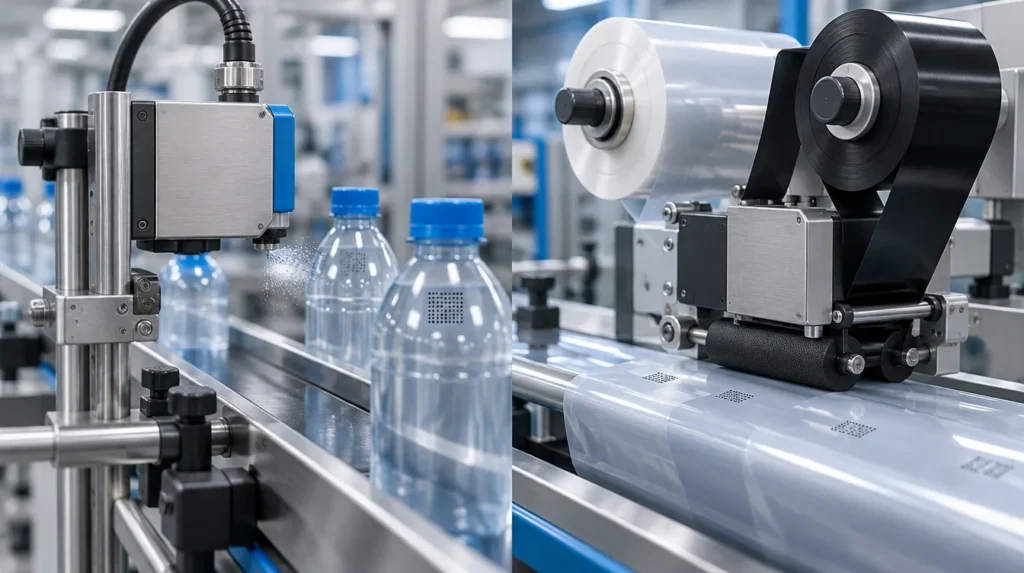
Exact speed, resolution, print distance, and drying behavior depend on the printer, ink, substrate, and setup. Confirm them with the supplier for your own packs.
Inkjet Coding Machine vs Thermal Transfer Printer at a Glance
| Factor | Inkjet coding machine (CIJ / TIJ) | Thermal transfer overprinter (TTO) |
|---|---|---|
| Print method | Non-contact; ink is jetted onto the surface | Contact; a heated printhead transfers ink from a ribbon |
| Typical substrates | Wide range, depending on ink: rigid and flexible plastics, glass, metal, cartons, film | Flexible film, foil laminates, and labels |
| Surface shape | Can mark curved, uneven, or textured surfaces (CIJ especially) | Needs a flat, flexible web pressed against a platen or roller |
| Where it usually sits | Over a conveyor, or mounted on a machine before or after packing | Inside the packaging machine or on the label web, before the pack is formed or the label is applied |
| Consumables | CIJ: ink plus makeup fluid. TIJ: ink cartridges (with integrated printhead) | Ribbon on reels; the printhead is a separate wear part |
| Drying | Wet ink needs time to dry; drying speed depends on ink and substrate | Ink is transferred in a set state, so drying time is generally not a separate concern |
| Typical code content | Dates, batch and lot codes, text, barcodes, and 2D codes (capability varies by technology) | Dates, batch codes, text, 1D and 2D barcodes, small graphics |
| Main maintenance themes | CIJ: ink system, nozzle, filters, startup and shutdown routines. TIJ: cartridge changes, nozzle plate care | Printhead cleaning and wear, ribbon path, pressure and alignment, platen or roller condition |
| Waste stream | Empty fluid containers or cartridges; solvent-containing waste for CIJ | Spent ribbon cores and used ribbon |
Treat this table as a general guide. Individual models and inks differ, and a printer that works well on one film can struggle on another.
Package Material Is Usually the Deciding Factor
Start with what is being printed on, not with the printer.
TTO is a natural fit when:
- the code goes onto flexible packaging film or a foil laminate before the pack is formed, such as on a vertical or horizontal form-fill-seal machine or flow wrapper;
- the code goes onto a label web before the label is applied;
- the material can be pressed flat against a backing surface at the print point.
Inkjet is usually the practical choice when:
- the pack is rigid, such as bottles, cans, jars, closures, trays, or cartons;
- the surface is curved, uneven, recessed, or textured;
- the code must be applied after the pack is filled and closed, as it moves along a conveyor;
- the material is porous, such as uncoated board or corrugated, where TIJ or large-character inkjet is commonly used.
Flexible film is where both technologies genuinely compete. CIJ and TIJ can also code films, and CIJ can code finished bags or wrapped products after forming when suitable inks are chosen. On printed or coated films, ink adhesion, ribbon compatibility, contrast, and resistance to rubbing, moisture, or cold-chain conditions all need testing with your actual material.
Code Content and Print Quality
What the code has to carry matters almost as much as the substrate.
- Simple date and lot codes: all three technologies can usually do this. The decision then rests on substrate, line position, and running considerations.
- 1D barcodes on film or labels: TTO is widely used here because the printhead forms dense, sharp bars on suitable ribbons and substrates.
- 2D codes and small text: TTO and TIJ are often considered where fine detail is needed. CIJ forms characters from a dot matrix, and its resolution is more limited, though suitable codes are possible in many applications.
- Large marks on cases: large-character inkjet is the usual category.
If a barcode or 2D code must be scanned by retailers, customers, or traceability systems, define the required code type, size, and quality grade first. Then check printed samples with a barcode verifier against that requirement. A code that looks clear to the eye can still fail a scan or a quality grade.
For causes of faint, blurred, or broken codes on either technology, see why coding machine print is not clear.
Consumables, Waste, and Day-to-Day Running
The two technologies create different routines for operators and stores.
TTO running considerations
- Ribbons come in specific widths and lengths and must suit the printer, the substrate, and the code durability needed. Changing ribbons is a routine operator task.
- Many TTOs offer ribbon-saving functions, such as advancing the ribbon only by what each print uses. How much ribbon this saves depends on the code layout and the machine.
- Used ribbon keeps a readable negative image of what was printed. If codes include sensitive or controlled data, decide how spent ribbon is stored and disposed of.
- Spent ribbon and cores are a recurring solid waste stream.
Inkjet running considerations
- CIJ printers consume ink and makeup fluid. The ink system maintains ink condition, and the printer usually needs defined startup, shutdown, and idle procedures to avoid nozzle problems.
- CIJ fluids are often solvent-based. Storage, ventilation, handling, and disposal should follow the safety data sheets and your site procedures.
- TIJ cartridges are swapped as units, which keeps routines simple. Cartridge yield, open-time behavior, and drying out between runs all depend on the ink and cartridge.
- Wet ink must dry before the code is touched or rubbed downstream, so line layout and ink choice need to account for drying time.
Maintenance and Downtime Factors
Both technologies are reliable when set up well, but they fail in different ways.
TTO quality depends on printhead condition, print pressure, ribbon tension and path, printhead angle, and the platen or roller surface. Common issues include ribbon breaks or wrinkles, missing dots from a worn or damaged printhead, and faint prints from incorrect energy, pressure, or ribbon-to-substrate matching. The printhead is a wear part, and how long it lasts depends on usage, settings, ribbon, substrate, and cleaning practice.
CIJ relies on a pressurized ink system, nozzle, filters, and print head cleanliness. Problems often come from ink contamination, nozzle blockages, solvent imbalance, or poor startup and shutdown practice. Some printers automate parts of this. Service intervals for filters and core modules depend on the model and operating conditions.
TIJ shifts much of the printhead maintenance into the cartridge, but nozzle plate cleanliness, cartridge handling, and drying out during pauses still affect print quality.
Use the OEM’s maintenance schedule for your specific printer. Work on energized equipment, heated printheads, pressurized ink systems, or anything behind guards should follow the manufacturer’s instructions and site procedures and be done by qualified personnel.
Cost: Compare Categories, Not Headline Prices
Purchase price alone is a poor guide. Compare the full cost categories for your own application:
- printer and integration cost, including mounting, brackets, sensors, encoders, and controls integration with the host machine;
- consumables: ribbon, or ink, makeup fluid, and cartridges, based on your actual code size and print volume;
- wear and service parts, such as printheads, filters, and service modules;
- operator time for consumable changes, cleaning, and job changes;
- downtime risk from coding faults, and the cost of rejected or recoded packs;
- waste handling, including spent ribbon or solvent-containing waste.
Ask suppliers to base consumable and cost estimates on your real code layout, line speed, and production hours, and to state their assumptions.
How to Decide: A Practical Checklist
Work through these questions with samples of your real packaging:
- What is the substrate? Film, foil laminate, label stock, carton, corrugated, glass, metal, or rigid plastic.
- Where can the code go? On the film or label before forming, or on the finished pack after filling and sealing.
- Can the material be supported flat at the print point? If not, TTO is usually ruled out.
- What must the code contain? Lines of text, 1D or 2D barcodes, logos, and any required quality grade.
- How durable must it be? Consider rub, moisture, condensation, chilling or freezing, and handling through distribution.
- How does the host machine move? For TTO, whether film motion is intermittent or continuous decides the printer type and mounting.
- What are your site constraints? Consider solvent handling, ventilation, consumable storage, cleaning regimes, and operator skills.
- What changeovers do you run? Different films, ribbon colors, inks, or code positions add setup steps.
Print trials on your actual packaging under realistic line conditions are the most reliable way to settle the choice. For a broader view of requirement definition before buying, see our machine selection guides.
Common Misconceptions
“Thermal transfer and thermal inkjet are the same thing.” They are not. TIJ is an inkjet technology that uses heat to eject ink drops from a cartridge. TTO uses heat to transfer ink from a ribbon by contact.
“Inkjet can’t code flexible film.” CIJ and TIJ are both used on films. Ink adhesion, drying, and contrast on the specific film need testing.
“TTO can be added anywhere on the line.” TTO needs a flat, supported web at the print point. That is why it is usually mounted inside a packaging machine or on a label web, not over a conveyor of finished rigid packs.
“Non-contact means no maintenance.” Inkjet coders avoid printhead-to-pack contact, but ink systems, nozzles, and cartridges still need regular care.
Related Comparisons
If you are also considering laser marking, read inkjet vs laser coding machine. For an overview of the equipment family, see coding and marking systems. For other technology trade-offs, browse our technology comparisons.
FAQ
Is a thermal transfer printer better than an inkjet coder for food packaging?
Neither is better for all food packaging. TTO is widely used on flexible film and labels, such as snack bags and flow-wrapped products. Inkjet is more common on rigid containers, cartons, and finished packs on a conveyor. Food applications also need inks or ribbons and procedures that suit the product, the package, and the applicable requirements, so confirm suitability with the supplier.
Can a TTO print on bottles or cartons?
Generally not on the finished rigid pack, because TTO needs a flat, flexible material pressed against a backing surface. It can print on labels before they are applied to bottles or cartons.
Is CIJ or TIJ the better comparison with TTO?
It depends on the job. TIJ and TTO often compete for high-resolution text and codes on film, labels, and cartons. CIJ is more often compared with TTO when line speed, curved surfaces, or coding after the pack is formed matter.
Do thermal transfer codes need drying time?
TTO transfers ink in a set state, so it generally doesn’t need the drying allowance that wet inkjet ink does. Rub resistance still depends on matching the ribbon to the substrate.
Which technology produces less waste?
It depends on code size, ribbon-saving features, print volume, and the waste routes available at your site. TTO generates spent ribbon and cores. Inkjet generates empty fluid containers or cartridges, and CIJ also produces solvent-containing waste. Compare both with your real production data.