

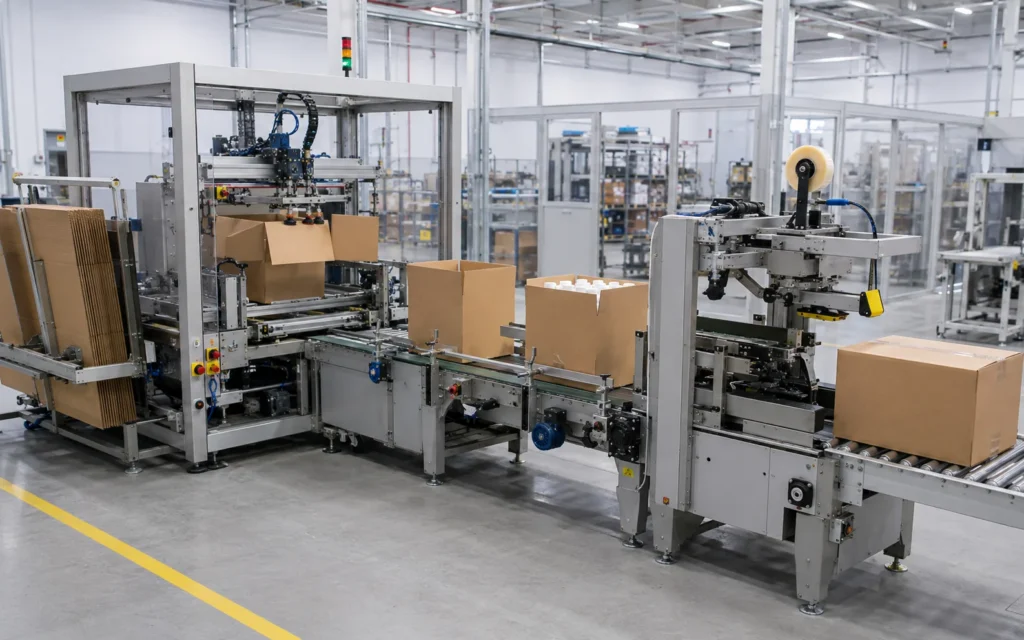
A carton or case erector starts with a flat corrugated case and turns it into an open box ready for loading. A carton or case sealer works later in the process, closing and sealing an erected case, usually after the product has been packed.
On a typical end-of-line packaging system, the erector is upstream of the packing operation and the sealer is downstream. They are therefore complementary machines rather than two names for the same piece of equipment. Exact flap-folding and sealing functions vary by machine design.
A Note About “Carton,” “Case,” and “Box”
Before comparing a carton erector vs carton sealer, it helps to clear up the terminology.
In North American end-of-line packaging, machines that handle corrugated shipping containers are commonly described as case erectors and case sealers. You will also see terms such as carton erector, carton sealer, box erector and box sealer in catalogs, distributor listings and everyday plant conversations.
Those terms are not perfectly interchangeable in every area of packaging. “Carton,” for example, can also mean a folding paperboard carton used around an individual retail product, which is a different package format from a corrugated shipping case.
For this comparison, carton erector and carton sealer refer primarily to machines working with corrugated shipping cases or boxes, particularly regular slotted containers and related corrugated styles.
What Does a Carton or Case Erector Do?
A case erector works near the beginning of the secondary-packaging or end-of-line case-handling process. Its job is to turn knockdown corrugated cases into a repeatable shape that can be loaded by workers or automatic packing equipment.
A typical automatic case-forming sequence looks like this:
Many machines use vacuum cups or similar handling devices to separate a knockdown case from a magazine and pull it open. The mechanism then controls the case as the bottom flaps are folded. Maintaining a reasonably square case is important because a badly skewed case can cause problems at packing, conveying, sealing and palletizing stages.
The bottom may be closed with pressure-sensitive tape, hot-melt adhesive or another closure method supported by the particular machine and case design. The result is normally an open-top case with a completed bottom, ready to receive product.
An erector normally does not pack the product. Its main responsibility is case forming and, on many designs, bottom closure. Product loading is handled by an operator, a case packer, a robot or other downstream equipment.
There are exceptions and combination systems. Some packaging equipment integrates forming, packing and sealing functions in one larger cell. That does not change the basic distinction between the individual operations.
What Does a Carton or Case Sealer Do?
A case sealer is located later in the packaging process. Instead of receiving a flat blank, it receives a case that has already been erected.
In many applications, the case already contains the finished products when it reaches the sealing station.
How much flap handling the sealer performs depends on the machine.
With a basic semi-automatic case sealer, an operator may fold the top flaps before pushing or feeding the case into the machine. The sealer then conveys the box through its sealing section.
A fully automatic sealer can include mechanisms that control or fold the top flaps before applying tape or adhesive. This is useful when cases arrive continuously from an automatic case packer or another upstream process.
Some case sealers are configured for top sealing only. Others can seal both top and bottom seams. That is why the phrase “case sealer” alone does not tell you every operation a particular model performs.
If you are selecting this equipment, the existing guide to choosing a carton sealer covers case dimensions, adjustment methods, line layout and other practical selection factors in more detail.
Carton Erector vs Carton Sealer: Key Differences
| Comparison Point | Carton / Case Erector | Carton / Case Sealer |
|---|---|---|
| Primary job | Forms a corrugated case from its knockdown condition. | Closes and seals an already erected case. |
| Typical input | Flat or knockdown corrugated case. | Erected case, often already loaded with product. |
| Typical output | Open case with its bottom formed and usually secured. | Closed case ready for downstream handling. |
| Position in line | Before manual or automatic case packing. | After the case-loading stage. |
| Flap handling | Usually controls and folds bottom flaps during formation. | May require manual top-flap folding or automatically fold/control the top flaps. |
| Typical sealing area | Bottom of the newly erected case. | Usually the top; some configurations seal both top and bottom. |
| Product loading | Normally no. | Normally no. Product is generally loaded before sealing. |
| Operator interaction | May include magazine loading, replenishment, setup and changeover. | May range from manual flap folding and case feeding to supervision of a fully automatic unit. |
| Automation | Automatic case erectors are common, although assisted forming systems also exist. | Available in semi-automatic and fully automatic configurations. |
| Changeover concerns | Magazine, blank pickup, guides, forming and sealing settings may need adjustment. | Case width, height, guides, belts, flap-folding system and sealing components may need adjustment. |
| Typical upstream process | Corrugated case storage or blank supply. | Manual packing station, case packer or product-loading cell. |
| Typical downstream process | Manual packing, robotic loading or automatic case packing. | Case coding, labeling, inspection, palletizing or shipping. |
| Common trouble areas | Blank separation, case opening, squaring, flap folding and bottom sealing. | Case alignment, flap control, conveying and tape or adhesive application. |
Where They Sit in a Packaging Line
The easiest way to understand case erector vs case sealer is to stop looking at the machines individually and look at the whole packaging flow.
Real lines can be arranged differently. Inspection may occur before or after sealing. A print-and-apply labeler might sit directly after the sealer. Cases may travel through accumulation conveyors before reaching a palletizer. Some operations use manual packing while everything before and after that station is automated.
The important point is that there is normally a loading step between case forming and final case closing.
Conveyor design also matters because the case must arrive at each machine in a controlled position and orientation. For more on transfers, accumulation, line layout and case movement, see the packaging conveyor system guide.
Do You Need an Erector, a Sealer, or Both?
You do not automatically need both machines. The right arrangement depends on which manual tasks you are trying to remove and how the current line is organized.
Sealer Only
A sealer by itself is a common first step into case-handling automation. Workers can continue opening and assembling cases manually, place products inside them, fold the flaps if required, and feed the cases into a semi-automatic sealer.
This removes repetitive hand taping without changing the entire packing station.
Erector Only
An erector can supply ready-to-pack cases to operators while final closing remains manual or takes place elsewhere. This may make sense when case forming is the immediate bottleneck but the operation is not yet ready to automate closing.
As a complete end-of-line automation strategy, however, stopping after automated erection still leaves manual work after filling.
Erector + Manual Packing + Sealer
This is a practical staged-automation layout. The erector supplies open cases, people perform flexible packing or inspection, and a sealer handles final closure.
It can be useful when product loading varies too much to justify an automatic case packer but case forming and taping are repetitive.
Erector + Automatic Case Packer + Sealer
In a more integrated system, the erector feeds formed cases into an automatic loading process. The loaded cases continue directly into an automatic sealer and then toward coding, inspection or palletizing.
This arrangement depends heavily on good machine-to-machine integration, reliable case quality, stable product flow and properly coordinated controls.
If you are deciding how far to automate, the comparison of automatic vs semi-automatic packaging machines provides a broader framework for evaluating operator involvement, flexibility and line integration.
Uniform vs Random Case Handling
Another point that causes confusion is the word automatic. An automatic machine does not necessarily mean that it can receive any case dimension and reconfigure itself without intervention.
A uniform-size case sealer is set for a particular case width and height. If the production run changes to another format, an operator may have to adjust the machine before continuing.
A random case sealer is designed to accommodate changing case dimensions and automatically make relevant adjustments as cases arrive. This is useful where multiple box sizes reach the same sealing station without being grouped into long uniform runs.
There are also more specialized case-forming systems for multiple formats, but the capabilities vary substantially by design. Never assume that “fully automatic” and “random size” mean the same thing.
When requesting quotations, describe the actual case mix. Tell suppliers whether sizes run in long batches, change several times per shift, or arrive randomly one after another.
Tape vs Hot-Melt Closure
Both case erectors and case sealers can be found with different closure technologies. Pressure-sensitive tape and hot-melt adhesive are two common options for corrugated case handling.
Tape systems use a taping head to apply box-sealing tape across a case seam. For many operations, tape is straightforward to identify and inspect, and replenishment involves changing tape rolls. Machine design, tape specification, corrugated surface and operating conditions still affect performance.
Hot-melt systems apply adhesive to the required flap areas before the flaps are compressed or held in position. These systems introduce adhesive supply, application temperature, nozzles and related maintenance considerations.
Neither method is automatically the better choice. Consider:
- corrugated case style and flap geometry;
- board surface and material condition;
- required closure method;
- existing plant standards;
- line layout and equipment configuration;
- consumable handling;
- cleaning and maintenance requirements;
- operating environment;
- supplier support and spare-part availability.
The machine OEM and closure-material supplier should confirm compatibility using your actual cases and operating conditions.
What to Check Before Choosing Equipment
A machine name tells you the function. It does not tell you whether the machine fits your line.
Before requesting a quotation for a carton erector, carton sealer or complete case-handling system, document the real application.
- Case style: Identify the corrugated style rather than assuming every machine handles every case design.
- Minimum and maximum dimensions: Record the smallest and largest cases actually used.
- Case quality: Include samples representing normal variation, not only perfect new cases.
- Product weight: A loaded case may behave differently during conveying from an empty erected case.
- Required output: Define the real line requirement rather than selecting from headline machine speed alone.
- Current packing method: Explain who erects, loads, closes and moves cases today.
- Closure method: Specify tape, adhesive or other requirements.
- Changeover frequency: Note how often sizes or case styles change.
- Uniform or random sizes: State whether cases arrive in batches or mixed sequence.
- Floor space: Include access for operators, replenishment, maintenance and guarding.
- Conveyor interface: Check conveyor height, travel direction, transfers and case orientation.
- Line integration: Identify upstream and downstream machines and the required control interface.
- Utilities: Confirm electrical and pneumatic requirements against the exact OEM model.
- Safety: Review guarding, access, emergency stops and your site’s machine-safety procedures.
- Spare parts: Check availability of belts, tape heads, sensors, wear components and other service items.
- Technical support: Confirm installation, training, documentation and service arrangements.
Do not copy utility requirements, case-size ranges or rated speeds from another machine in the same product category. Those specifications are model-specific.
Common Misunderstandings
“A case erector packs the product too.”
Usually not. A standard case erector forms the corrugated case and prepares it for loading. A separate manual or automatic operation puts the product inside. Combination machinery can integrate several functions, but that should not be assumed from the term “case erector.”
“A case sealer can take flat boxes.”
A normal case sealer expects an already erected case. Creating a case from a knockdown blank is the job of a case erector or another forming system.
“Fully automatic means no operator work.”
Automatic machines still need material replenishment, setup, changeovers, cleaning, inspection and maintenance. The amount of intervention depends on the equipment and line design.
“Any corrugated case should run if its dimensions are correct.”
Dimensions are only part of the picture. Warped blanks, inconsistent scores, damaged edges, excessive dust, dimensional variation and other corrugated conditions can interfere with blank pickup, opening, flap folding and sealing.
“The machine’s rated speed is the production line speed.”
Not necessarily. Sustainable output depends on the complete system: case supply, packing rate, conveyors, product arrival, changeovers, downstream accumulation and other process constraints.
If a case-handling line begins jamming or stopping unpredictably, use a structured troubleshooting process instead of immediately changing machine settings. The packaging machine troubleshooting guide covers utilities, sensors, materials, setup and product-flow issues that are useful starting points.
So, Which Machine Should You Choose?
The practical answer comes down to the task that is currently manual.
If workers are already comfortable forming and packing cases but hand taping is slowing the station down, start by evaluating a case sealer.
If manually opening and bottom-taping knockdown cases is the problem, evaluate a case erector.
If you want formed cases delivered continuously to a packing position and then automatically closed afterward, you are looking at an erector plus sealer, with a manual or automatic packing process between them.
If the objective is a highly integrated end-of-line system, then the decision should be made at line level rather than machine level. Case dimensions, corrugated quality, product loading, conveyor transfers, closure method, controls and downstream pallet handling all need to work together.
That is the main difference in the carton erector vs carton sealer comparison: the erector creates the usable case; the sealer closes it after the packing stage. They solve different parts of the same packaging workflow.
References and Further Reading
- Pearson Packaging Systems — Case Erectors . Technical overview of opening knockdown corrugated cases, bottom-flap folding and sealing.
- Lantech — Case Erectors and Case Sealers . Manufacturer descriptions distinguishing case-forming equipment from equipment used after cases are filled.
- 3M — 3M-Matic Case Sealers . Information on adjustable and random case-sealing configurations.
- Wexxar Bel — Semi-Automatic Case Sealers . Examples of operator-assisted flap handling and uniform/random case sealing.
- Wexxar Bel — Fully Automatic Case Sealing Equipment . Examples of automatic top-flap folding and tape or hot-melt sealing.
- Fibre Box Association — What Is Corrugated? . Corrugated terminology and common box styles including the Regular Slotted Container.