Choosing between an automatic vs semi automatic packaging machine is one of those decisions that looks simple at first, but quickly becomes more complicated once you start thinking about labor, speed, budget, space, product variety, and long-term growth.
A semi automatic machine may feel like the safer choice because it costs less upfront and is easier to introduce into a small production area. A fully automatic machine, on the other hand, can dramatically improve output when your packaging process becomes too slow, too labor-heavy, or too inconsistent.
The right answer is not always “buy the most automated machine you can afford.” In many cases, the smarter choice is the machine that fits your current production volume while giving your business enough room to grow.
Below is a practical comparison to help you decide which type of packaging machine makes more sense for your operation.
What Is a Semi Automatic Packaging Machine?
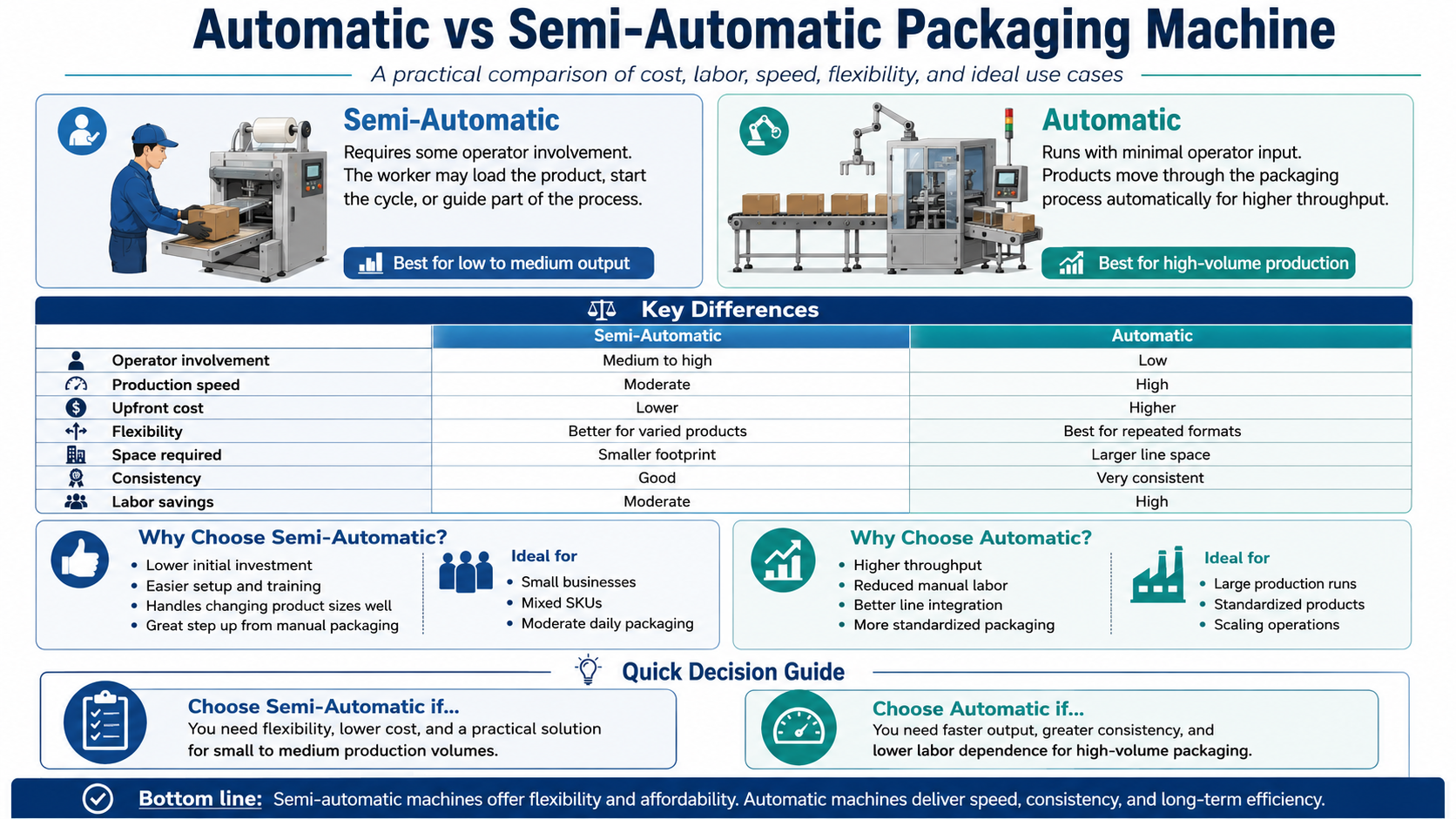
A semi automatic packaging machine handles part of the packaging process, but still requires an operator to load, position, start, guide, or remove the product.
In simple terms, the operator starts or assists the process, and the machine completes one or more key actions.
For example, with a semi automatic shrink wrap machine, the worker may place the product into the film, pull down the sealing bar, or press a button to start the sealing cycle. The machine then creates the seal, and in some systems, the product moves into a shrink tunnel or chamber for heat shrinking.
Semi automatic machines are commonly used for:
- Small and medium-sized production runs
- Businesses packaging different product sizes
- Companies moving away from manual packaging
- Operations that need better consistency but are not ready for a full packaging line
- Lower to moderate daily output
This type of machine is often a practical step between fully manual packaging and a fully automatic packaging line.
What Is a Fully Automatic Packaging Machine?
A fully automatic packaging machine is designed to complete the packaging process with minimal operator involvement.
In a fully automatic system, products may be fed into the machine by conveyor, sensors detect product position, sealing or strapping happens automatically, film or strap is cut automatically, and the finished package exits the machine without the operator handling every cycle.
Modern automation may include conveyors, sensors, robotics, vision systems, and software controls. NIST notes that manufacturing automation can include tools such as collaborative robots, industrial robots, and advanced sensing systems, and that these technologies have become more accessible even for smaller manufacturers in recent years.
Fully automatic packaging machines are usually used for:
- High-volume production
- Repetitive packaging formats
- Consistent product sizes
- End-of-line packaging systems
- Companies trying to reduce labor dependency
- Production lines where speed and consistency are critical
A fully automatic machine often requires more investment, more space, and more planning, but it can deliver stronger long-term efficiency when the production volume justifies it.
Automatic vs Semi Automatic Packaging Machine: Core Differences
The biggest difference between an automatic and semi automatic packaging machine is the level of human involvement.
A semi automatic system still depends on an operator for product loading, positioning, or cycle activation. A fully automatic system uses conveyors, sensors, and controls to move the product through the process with much less direct handling.
Here is a simple comparison:
| Factor | Semi Automatic Packaging Machine | Fully Automatic Packaging Machine |
|---|---|---|
| Operator involvement | Medium to high | Low |
| Upfront cost | Lower | Higher |
| Production speed | Moderate | High |
| Flexibility | Better for mixed products | Better for repeated formats |
| Space requirement | Usually smaller | Usually larger |
| Setup complexity | Easier | More complex |
| Best for | Small to medium operations | Medium to large operations |
| Labor savings | Moderate | High |
| ROI style | Lower risk, gradual improvement | Higher investment, stronger long-term payoff |
This is why the decision should not be based only on machine price. It should be based on your total packaging workflow.
When a Semi Automatic Packaging Machine Makes More Sense
A semi automatic packaging machine is often the better choice when your business is growing but not yet ready for full automation.
It gives you better speed and consistency than manual packaging without forcing you into the cost and complexity of a complete automatic line.
1. You Package Moderate Volumes
If your team packages a few hundred products per day, a semi automatic machine may already be a big improvement.
For example, semi automatic shrink wrap systems can reduce handwork by assisting with sealing, holding, or shrinking. Some chamber-style machines seal and shrink in one cycle, while L-bar sealer and shrink tunnel combinations can support higher daily output.
The key question is not only “How many products do we package today?” but also “How often is packaging slowing down shipping?”
2. Your Product Sizes Change Often
Semi automatic machines are often more forgiving when your products vary in size, shape, or packaging style.
If your business handles small batches, seasonal products, custom orders, or mixed SKUs, a semi automatic machine may be easier to adjust. Operators can reposition products manually and make quick changes without complex line programming.
3. You Have a Limited Budget
A semi automatic machine normally requires a lower upfront investment. This makes it attractive for startups, small factories, e-commerce warehouses, workshops, food producers, and businesses testing a new product line.
It also usually requires less installation work than a fully automatic system.
4. You Still Need Operator Judgment
Not every packaging process should be fully automated immediately. Some products need careful handling, visual checking, or flexible decision-making.
If the operator still plays an important quality-control role, semi automation can improve efficiency without removing the human element entirely.
When a Fully Automatic Packaging Machine Is the Better Choice
A fully automatic packaging machine becomes more attractive when manual or semi automatic work can no longer keep up with production demand.
At this stage, the cost of labor, inconsistency, delays, rework, and bottlenecks may be greater than the cost of automation.
1. You Need High Throughput
If your packaging station is holding back the rest of your production line, full automation may be the right move.
A fully automatic shrink wrap machine, strapping machine, case sealer, filling machine, or labeling system can work continuously at a stable speed. This is especially useful when your products are similar in size and packaging format.
Packaging productivity has become a major priority across the industry. PMMI’s 2025 operational readiness report, reported by Packaging World, found productivity ranked as the top priority among surveyed CPGs and industry suppliers, with cost and automation also ranking highly.
2. Labor Is Becoming Hard to Manage
If packaging depends heavily on manual work, your output may fluctuate based on staffing, training, fatigue, and shift changes.
A fully automatic machine can reduce repetitive manual tasks and allow workers to focus on supervision, quality control, material supply, maintenance checks, or other higher-value work.
3. You Need Consistent Packaging Quality
Automatic machines are especially useful when the final package must look highly consistent.
This matters for retail products, food packaging, pharmaceutical packaging, export cartons, branded consumer goods, and any product where poor packaging can affect customer trust.
A fully automatic system can help standardize sealing, wrapping, strapping, labeling, or filling results across long production runs.
4. You Want to Reduce Repetitive Motion
Packaging often includes repetitive motions such as lifting, bending, pulling film, taping cartons, loading products, or moving packages. OSHA explains that ergonomics focuses on fitting the job to the person, helping reduce muscle fatigue and the number and severity of work-related musculoskeletal disorders.
Automation does not remove every safety concern, but it can reduce some repetitive manual tasks when implemented properly.
Shrink Wrap Example: Semi Auto vs Automatic
Shrink wrapping is a good example because both semi automatic and automatic machines can produce a similar finished package, but the workflow is very different.
A semi automatic shrink wrap machine may require the operator to place the product into film, close the sealing bar, or push a button. Some systems use a magnetic hold-down so the operator does not need to keep holding the sealing bar during the cycle. Other machines combine sealing and shrinking in one chamber.
A fully automatic shrink wrap machine can feed products automatically, seal the film, move the package into the heat tunnel, and discharge the finished item with little operator handling.
The final wrapped product may look similar, but the production experience is not the same.
Semi automatic shrink wrapping is usually better when you need flexibility, smaller batch runs, and lower upfront cost. Automatic shrink wrapping is better when you need speed, repeatability, and less labor per package.
Strapping Machine Example: Semi Automatic vs Fully Automatic
The same logic applies to strapping machines.
A semi automatic strapping machine usually requires an operator to place the carton or bundle on the table, wrap the strap around the item, insert the strap into the slot, and start the cycle. The machine then tensions, seals, and cuts the strap.
A fully automatic strapping machine can be integrated with a conveyor line. Products move into the strapping area, sensors detect position, the strap cycle starts automatically, and the product exits the machine.
Semi automatic strapping machines are practical for lower or mixed-volume operations. Fully automatic strapping machines are more suitable for large volumes of similarly sized cartons, bundles, or packages.
Cost Is Not Just the Machine Price
When comparing automatic vs semi automatic packaging machine options, many buyers focus only on the purchase price. That is understandable, but it can lead to the wrong decision.
A machine with a lower price may still be expensive if it creates bottlenecks, requires too much labor, wastes film or strap, causes inconsistent packaging, or slows down shipping.
A better way to compare equipment is to look at total cost of ownership:
- Machine price
- Labor required per shift
- Output per hour
- Packaging material usage
- Maintenance needs
- Downtime risk
- Product damage rate
- Operator training
- Available floor space
- Future expansion plans
A semi automatic machine may offer the best ROI when volume is moderate. A fully automatic machine may offer the better ROI when labor savings, higher throughput, and consistency offset the higher initial investment.
How to Decide Which Packaging Machine You Need
Before choosing a machine, answer these questions honestly:
1. How many products do you package per day?
If your daily packaging volume is still modest, semi automatic equipment may be enough. If packaging runs all day and still cannot keep up, full automation becomes more attractive.
2. Are your products similar or highly varied?
Automatic systems work best with repeatable products and predictable packaging formats. Semi automatic machines are often better when product sizes change frequently.
3. Where is your bottleneck?
The problem may not be the entire packaging process. It may be sealing, labeling, strapping, carton closing, pallet wrapping, or product feeding. Identifying the bottleneck helps you avoid buying more machine than you need.
4. How much labor do you want to save?
If your goal is to reduce one repetitive task, semi automation may be enough. If your goal is to redesign the whole end-of-line process, a fully automatic system may make more sense.
5. Will your production grow soon?
If you expect rapid growth, it may be worth choosing equipment that can connect with conveyors, labeling systems, checkweighers, case sealers, or other machines later.
Best Choice for Small Businesses
For many small businesses, the best first step is a semi automatic packaging machine.
It improves speed and consistency without requiring a complete production line redesign. It also gives your team time to understand the packaging process before investing in full automation.
Semi automatic machines are especially useful for:
- E-commerce packing rooms
- Small food producers
- Cosmetic brands
- Hardware suppliers
- Printing and stationery products
- Small warehouses
- Low-to-medium-volume manufacturers
If your team is still handling everything manually, semi automation can feel like a major upgrade.
Best Choice for Growing Manufacturers
For growing manufacturers, the answer depends on whether packaging has become a serious bottleneck.
If orders are increasing, labor is stretched, and packaging output is limiting shipping capacity, a fully automatic packaging machine may be the better long-term investment.
Automation is especially useful when your operation has:
- Stable product dimensions
- Repetitive packaging requirements
- High daily output
- Multiple shifts
- Labor shortages
- Strict quality expectations
- Plans to integrate a complete packaging line
In this situation, paying more upfront can be justified by higher throughput, reduced manual work, and more predictable production.
Final Verdict: Automatic vs Semi Automatic Packaging Machine
The best choice depends on your production reality.
Choose a semi automatic packaging machine if you need flexibility, lower investment, easier setup, and better efficiency than manual packaging. It is a smart choice for small and medium-sized businesses, mixed product sizes, and moderate daily output.
Choose a fully automatic packaging machine if you need high speed, consistent output, reduced labor dependency, and long-term production efficiency. It is the stronger choice for larger operations, repetitive packaging formats, and companies ready to scale.
In short, semi automatic equipment helps you improve the packaging process. Fully automatic equipment helps you redesign it.
The right machine is not simply the most advanced one. It is the one that removes your real bottleneck, fits your production volume, and supports the next stage of your business.