Choosing between an automatic vs semi automatic labeling machine sounds simple at first. One is faster, one is cheaper — decision made, right?
Not exactly.
In real production, the better choice depends on your order volume, product shape, label size, available space, labor cost, budget, and how quickly your business may grow. A small skincare brand making short batches has very different needs from a beverage factory running thousands of bottles a day.
The good news is that both machine types can improve labeling accuracy, reduce manual work, and make your packaging look more professional. The key is knowing which one fits your current production stage — and which one will still make sense six months or two years from now.
What Is an Automatic Labeling Machine?
An automatic labeling machine is designed to apply labels continuously with minimal human intervention. In most cases, products are placed onto a conveyor, guided into position, detected by sensors, labeled, and then moved forward automatically.
This type of machine is commonly used in medium- to large-scale production lines. It can be connected with other packaging equipment, such as filling machines, capping machines, conveyors, turntables, coding machines, and carton packing systems.
Automatic labelers are especially useful when you need:
- High labeling speed
- Consistent label placement
- Lower labor dependence
- Stable output for large orders
- Integration with a full packaging line
For example, a fully automatic bottle labeling machine can be used for cosmetics, food, beverages, pharmaceuticals, daily chemicals, essential oils, and many other packaged products.
The biggest advantage is not only speed. It is consistency. When labels must be straight, centered, and repeatable across thousands of products, automatic equipment gives you far better control than hand labeling or small manual systems.
What Is a Semi Automatic Labeling Machine?
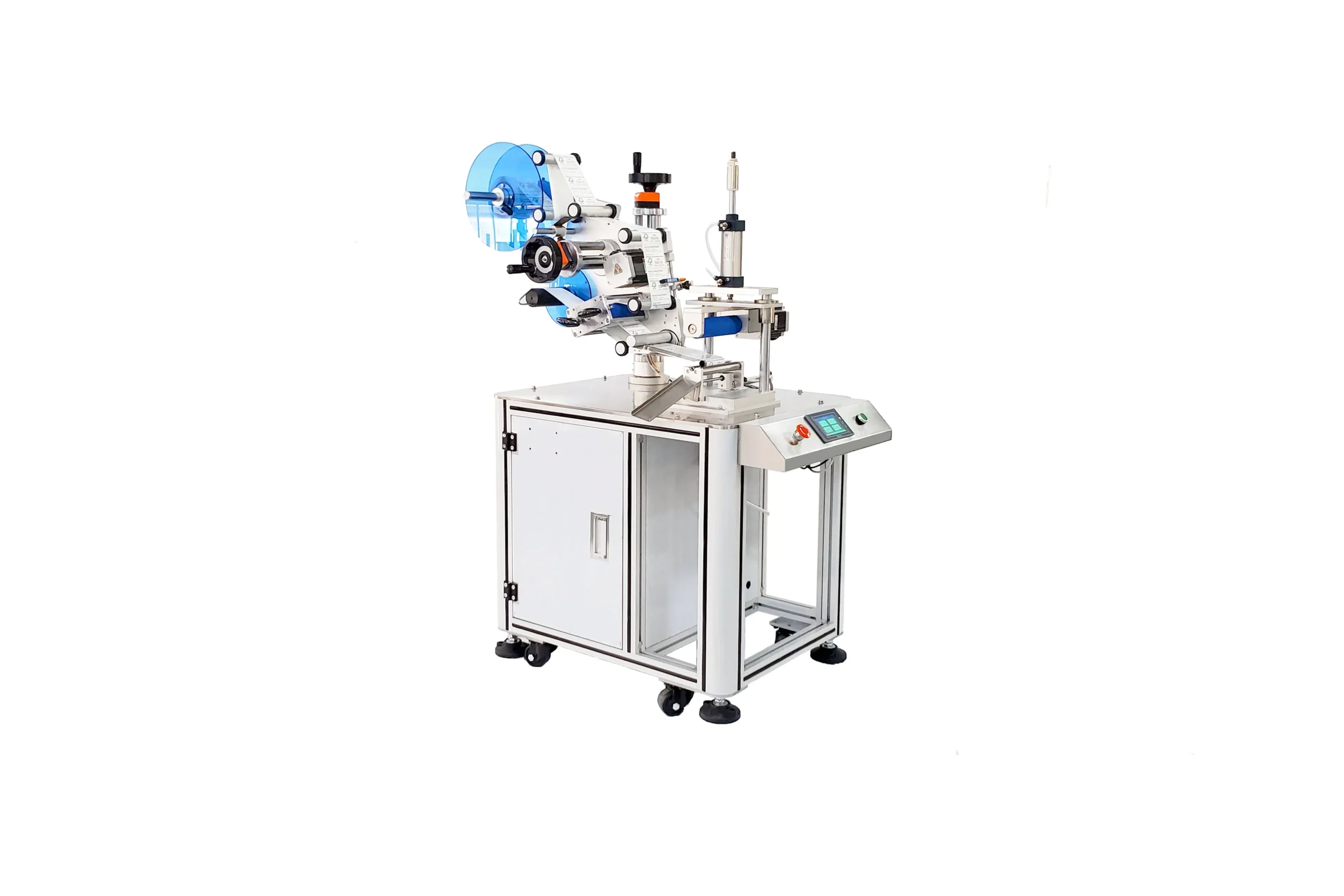
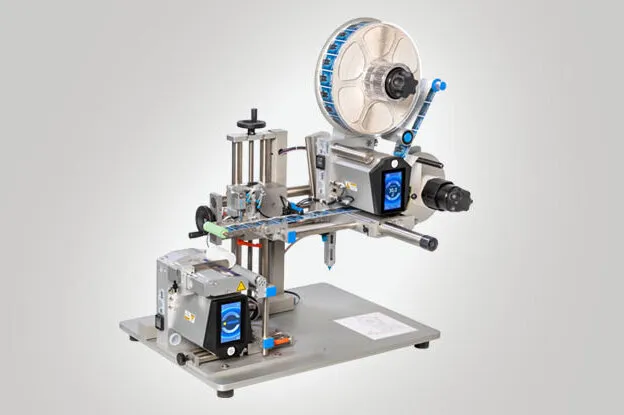
A semi automatic labeling machine is a partially automated labeler. The machine applies the label, but an operator usually needs to place the product onto the machine, align it, and activate the labeling cycle by using a button, switch, foot pedal, or sensor.
Semi automatic labelers are usually smaller, simpler, and more affordable than fully automatic systems. Many models can be placed on a tabletop, workbench, or small production station.
This makes them a practical option for:
- Startups
- Small businesses
- Low-volume production
- Small-batch products
- Custom orders
- Multiple SKUs
- Limited workshop space
- Businesses moving away from hand labeling
A semi automatic bottle labeling machine is often used for round bottles, jars, cans, boxes, tubes, cosmetic containers, supplement bottles, and other small to medium production needs.
It does not eliminate labor completely, but it makes labeling faster, cleaner, and more consistent than doing everything by hand.
Automatic vs Semi Automatic Labeling Machine: The Main Difference
The main difference between an automatic and semi automatic labeling machine is how much manual work is involved.
A semi automatic machine still needs an operator to load each product and often activate the labeling process. An automatic machine can move products through the labeling process continuously, usually with conveyor belts, sensors, guides, rollers, and positioning systems.
Here is a simple comparison:
| Factor | Semi Automatic Labeling Machine | Automatic Labeling Machine |
|---|---|---|
| Operation | Operator loads products manually | Products move through automatically |
| Speed | Slower, suitable for small batches | Faster, suitable for continuous production |
| Labor | Requires more operator involvement | Requires less manual labor |
| Cost | Lower upfront investment | Higher upfront investment |
| Space | Compact, often tabletop-sized | Larger, needs more floor space |
| Flexibility | Good for small runs and frequent changes | Better for stable, high-volume production |
| Maintenance | Easier and simpler | More technical and complex |
| Best For | Startups, small brands, limited production | Growing factories, large batches, production lines |
In short:
A semi automatic labeling machine is better when flexibility and lower cost matter most.
An automatic labeling machine is better when speed, consistency, and long-term efficiency matter most.
Production Speed and Efficiency
Speed is usually the first thing businesses compare.
A semi automatic labeler is much faster than hand labeling, but it still depends on the operator. The worker must place the product, activate the machine, remove the finished item, and repeat the process. This is fine for small batches, but it can become a bottleneck when daily orders increase.
An automatic labeling machine works continuously. Products can be lined up on a conveyor, detected by sensors, positioned correctly, and labeled one after another. This makes it much more suitable for high-volume production.
For example, if you only label a few hundred bottles per day, a semi automatic machine may be enough. But if you need to label thousands of products per shift, a fully automatic labeler will usually be the better investment.
Labeling Accuracy and Consistency
Label placement affects how customers see your product. A crooked label can make even a good product look cheap or careless.
Semi automatic machines can produce accurate labels, especially when the operator is skilled and the product shape is simple. However, because loading and alignment still involve human handling, small inconsistencies may happen.
Automatic labeling machines offer better repeatability. With sensors, guides, positioning belts, rollers, and adjustable control systems, they can apply labels in the same position again and again. This is especially important for:
- Barcode labels
- Pharmaceutical labels
- Cosmetic packaging
- Food and beverage products
- Front-and-back labels
- Transparent labels
- Products requiring strict brand presentation
If label accuracy is a major part of your quality control, automatic equipment has a clear advantage.
Cost: Upfront Investment vs Long-Term Savings
Cost is where many small businesses hesitate.
A semi automatic labeling machine usually costs much less than a fully automatic system. It is easier to buy, install, and start using. For businesses still testing the market, this lower risk can be very attractive.
Automatic machines cost more because they include more advanced components, such as conveyors, sensors, product positioning systems, PLC controls, motors, rollers, and sometimes multiple labeling heads.
However, the upfront price is only one part of the decision.
A semi automatic machine may save money at the beginning, but it still depends heavily on labor. If your production keeps growing, labor cost and slower output can become expensive over time.
An automatic labeling machine requires more initial investment, but it can reduce labor, increase output, reduce errors, and support larger orders. For stable production, the long-term return can be stronger.
A good way to think about it is this:
Choose semi automatic when you need to control early-stage cost.
Choose automatic when your production volume is high enough that labor and inefficiency are already costing you money.
Labor Requirements
Semi automatic machines still need an operator throughout the process. The machine applies the label, but the human worker is part of every cycle.
This is not always a bad thing. For short runs, customized products, or frequent SKU changes, operator control can actually be helpful. It allows more flexibility and faster adjustment.
Automatic machines need much less direct labor. After setup, the operator mainly monitors the machine, adjusts settings, replaces label rolls, checks quality, and handles occasional troubleshooting.
For companies facing rising labor costs or worker shortages, automatic labeling equipment can make a big difference.
Space and Factory Layout
Semi automatic labelers are usually compact. Many can fit on a table or small workbench, making them ideal for workshops, small factories, laboratories, and startup production rooms.
Automatic labeling machines are usually larger because they include conveyor systems and product handling components. They need more floor space and a more planned layout.
Before choosing a machine, consider:
- How much space do you have?
- Will the machine connect with existing equipment?
- Do you need room for operators?
- Is there space for product feeding and collection?
- Will your production line expand later?
For small spaces, semi automatic equipment is often easier to manage. For complete production lines, automatic machines are more efficient.
Flexibility for Different Products
If your business produces many product types in small quantities, flexibility matters.
Semi automatic labeling machines are often a good fit for small batches, custom packaging, seasonal products, and frequent changeovers. They are simpler to adjust and easier for operators to understand.
Automatic labeling machines can also handle different products, but adjustments may take more time. Some high-end systems can save settings for different containers, which makes changeovers faster. Still, automatic machines are usually most efficient when product sizes and labeling requirements are relatively stable.
For example:
A small essential oil brand with 20 bottle types may prefer semi automatic labeling.
A beverage company labeling the same bottle all day may prefer automatic labeling.
Maintenance and Technical Skill
Semi automatic machines are generally easier to maintain. Their structure is simpler, and basic troubleshooting is usually manageable for small teams.
Automatic machines require more preventive maintenance. They may involve conveyor alignment, sensor calibration, electrical systems, motors, belts, rollers, control panels, and more complex mechanical parts.
This does not mean automatic machines are difficult to use. A good supplier should provide training, manuals, technical support, and spare parts. But compared with semi automatic systems, they do require more technical attention.
When Should You Choose a Semi Automatic Labeling Machine?
A semi automatic labeling machine is usually the better choice when your business is still small, your order volume changes often, or you are moving from manual labeling to machine-assisted labeling.
It is especially suitable if:
- You have low to medium production volume
- Your budget is limited
- You label small batches
- You often change product types
- Your factory space is limited
- You do not need a full production line yet
- You want easier operation and maintenance
- You are testing new products or markets
For many small food brands, cosmetic startups, handmade product workshops, supplement brands, and niche beverage producers, semi automatic labeling offers the best balance between cost and efficiency.
When Should You Choose an Automatic Labeling Machine?
An automatic labeling machine is the better option when your production is stable, growing, or already running at high volume.
It is more suitable if:
- You label large quantities every day
- You need consistent label placement
- You want to reduce labor costs
- You have strict quality requirements
- You want to connect labeling with a production line
- You need higher output during peak seasons
- You plan to scale production soon
- You need front-and-back or multi-label application
For factories producing cosmetics, beverages, pharmaceuticals, food products, daily chemicals, or other high-volume packaged goods, automatic labeling equipment can improve both efficiency and packaging quality.
A Practical Buying Strategy: Start Small, Then Upgrade
Many businesses do not need to jump directly into a fully automatic system.
A phased investment strategy often works better.
You can start with a semi automatic labeling machine when your production is still small or unstable. This helps you reduce manual labeling, improve packaging quality, and avoid over-investing too early.
Later, when order volume becomes stable and labor becomes a bottleneck, you can upgrade to an automatic labeling machine.
This approach is especially useful for growing brands. It gives you flexibility at the beginning and scalability later.
Questions to Ask Before Buying
Before choosing between an automatic vs semi automatic labeling machine, ask these practical questions:
- How many products do I label per day or per hour?
- Will my production volume increase in the next 6–12 months?
- How many workers are currently involved in labeling?
- Are label errors causing waste or customer complaints?
- Do I use one product shape or many different shapes?
- Do I need one label, front-and-back labels, or multiple labels?
- How much space do I have for the machine?
- What is my budget for both equipment and labor?
- Do I need the labeler to connect with other packaging machines?
- How much technical maintenance can my team handle?
The answers will usually point you toward the right machine type.
Final Verdict: Automatic vs Semi Automatic Labeling Machine
There is no single best machine for every business.
A semi automatic labeling machine is ideal for small businesses, startups, short production runs, customized batches, and companies that need a lower-cost way to improve labeling efficiency.
An automatic labeling machine is ideal for growing factories, high-volume production, stable product lines, and businesses that need faster output, better consistency, and lower labor dependence.
The best choice is the one that matches your actual production needs — not just the most advanced machine or the cheapest machine.
For small and flexible operations, semi automatic is often the smarter first step.
For high-volume and scalable production, automatic labeling is usually the better long-term solution.
FAQ
What is the difference between an automatic and semi automatic labeling machine?
The main difference is the level of manual operation. A semi automatic labeling machine needs an operator to place products and often activate each labeling cycle. An automatic labeling machine can move, position, and label products continuously with much less human intervention.
Is a semi automatic labeling machine good for small businesses?
Yes. A semi automatic labeling machine is often ideal for small businesses because it is more affordable, compact, easy to operate, and flexible for small batches or multiple product types.
Is an automatic labeling machine worth the higher cost?
An automatic labeling machine is worth the investment when your production volume is high enough to justify faster output, reduced labor, fewer labeling errors, and better long-term efficiency.
Which labeling machine is better for bottles?
Both machine types can label bottles. A semi automatic bottle labeling machine is better for small batches, while an automatic bottle labeling machine is better for high-speed production lines and large daily output.
Can a semi automatic labeling machine apply accurate labels?
Yes. Semi automatic labelers can apply labels accurately, especially on simple container shapes. However, automatic machines usually provide better consistency for large batches because they use sensors, guides, and positioning systems.
Which machine is easier to maintain?
Semi automatic labeling machines are usually easier to maintain because they have a simpler structure. Automatic machines are more complex and may require regular calibration, preventive maintenance, and technical support.
When should I upgrade from semi automatic to automatic labeling?
You should consider upgrading when labeling becomes a production bottleneck, labor costs increase, order volume becomes stable, or label accuracy and output speed become more important for your business growth.