

A packaging conveyor system does more than move products from one machine to the next. In a real packaging line, conveyors control product flow, protect package quality, reduce manual handling, create buffers between machines, and help operators keep production running when one section slows down.
For beginners, the topic can feel confusing because “conveyor system” may refer to a simple belt conveyor, a full accumulation line, a case conveyor, a sanitary washdown conveyor, a puck handling system, or an integrated material handling layout connected to fillers, cappers, labelers, cartoners, case packers, and palletizing equipment.
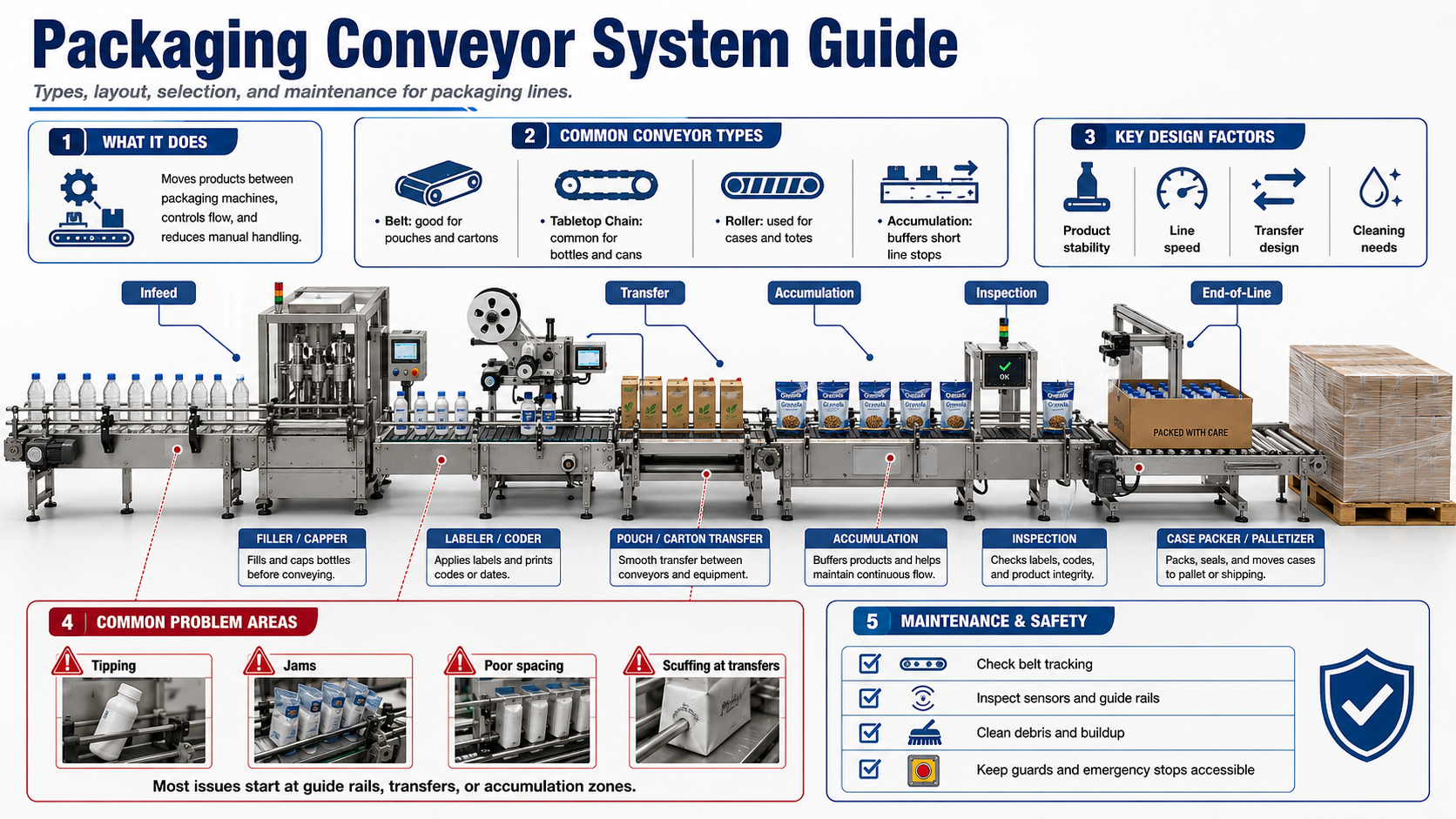
This packaging conveyor system guide explains the main conveyor types, where they are used, how to choose the right design, and what practical issues to check before installing or upgrading a packaging line.
What Is a Packaging Conveyor System?
A packaging conveyor system is a connected group of conveyors, transfers, guides, controls, sensors, and support structures that move products, containers, packages, or cases through a packaging process.
In packaging operations, conveyors may handle:
- Empty bottles, jars, cans, trays, pouches, cartons, or containers
- Filled and sealed primary packages
- Labeled products
- Bundled multipacks
- Corrugated cases
- Totes, bins, or secondary packaging materials
- Finished goods moving toward palletizing or warehousing
A basic conveyor may simply transport products from one point to another. A more advanced packaging conveyor system may include accumulation zones, inspection stations, reject lanes, merge sections, diverters, elevators, product orientation devices, and machine-to-machine controls.
Why Conveyors Matter in Packaging Lines
Conveyors are often treated as supporting equipment, but they have a direct effect on line performance. A packaging machine may be capable of high output, but the overall line will still suffer if product transfer is unstable, spacing is inconsistent, or downstream machines frequently starve or back up.
A well-designed packaging conveyor system helps with:
- Consistent product flow: Products arrive at each machine in the right orientation and spacing.
- Reduced manual handling: Operators spend less time carrying, sorting, or repositioning products.
- Better line balance: Accumulation zones absorb short stops between machines.
- Package protection: Correct belt type, guide rail setup, and transfer design reduce tipping, scuffing, crushing, and label damage.
- Safer operation: Guarding, emergency stops, and proper access reduce exposure to moving parts.
- Easier maintenance: Modular sections, accessible drives, and clean layouts make inspection and repair more manageable.
In practice, conveyor problems often appear as “machine problems.” For example, a labeler may seem unreliable when the real issue is inconsistent bottle spacing before the infeed. A case packer may show frequent jams because cases are entering slightly skewed. A checkweigher may reject good products because the conveyor transfer before it is unstable.
Main Types of Conveyors Used in Packaging
Different conveyors solve different handling problems. The right choice depends on the product, package shape, speed, environment, cleaning needs, and position in the line.
Belt Conveyors
Belt conveyors use a continuous belt running over pulleys to move products. They are common in packaging because they provide stable support and can handle many product shapes.
They are often used for:
- Pouches
- Trays
- Cartons
- Lightweight products
- Product inspection stations
- Manual packing areas
- Checkweigher and metal detector infeed or outfeed sections
Belt conveyors are useful when the product needs full bottom support. For example, a flexible pouch or small carton may not run well on rollers, but it can travel smoothly on a belt.
Common considerations include belt material, belt width, speed range, tracking, cleanability, and whether the belt surface should be smooth, textured, cleated, or food-grade.
Modular Plastic Belt Conveyors
Modular plastic belt conveyors use interlocking plastic belt modules. They are common in food, beverage, personal care, and other packaging environments where washdown, curves, or durability may be important.
They are often used for:
- Bottles and cans
- Wrapped food products
- Containers in wet or humid areas
- Lines with curved sections
- Washdown packaging environments
- Products that require strong, open, or easy-to-replace belting
Compared with a flat fabric belt, modular plastic belting can be easier to repair because damaged sections can often be replaced without changing the entire belt. It can also support curves and drainage depending on the design.
Tabletop Chain Conveyors
Tabletop chain conveyors, also called slat chain conveyors, are widely used for bottles, jars, cans, and rigid containers. They use a flat chain surface that supports containers as they move through filling, capping, labeling, coding, and packing areas.
They are often used for:
- Bottling lines
- Beverage packaging
- Pharmaceutical bottles
- Cosmetics containers
- Household chemical containers
- Food jars and cans
Tabletop chain conveyors work well when containers need to remain upright. Guide rails are important because small changes in rail position can affect container stability, spacing, and transfer behavior.
Roller Conveyors
Roller conveyors use a series of rollers to move items. They may be gravity-driven or powered.
They are often used for:
- Corrugated cases
- Totes
- Trays
- Secondary packaging
- End-of-line transport
- Warehouse connection points
Roller conveyors are usually better for rigid, flat-bottomed loads than for small or unstable primary packages. A sealed corrugated case may run well on rollers, while a small flexible pouch usually will not.
Chain Conveyors
Chain conveyors use one or more chains to move heavier loads. In packaging, they are more common in end-of-line and pallet handling applications than in delicate primary packaging areas.
They are often used for:
- Heavy cases
- Pallets
- Large containers
- Industrial packaging loads
- Transfer between palletizing and warehouse areas
Chain conveyors are durable, but they may not be suitable for fragile packages or products that need smooth continuous support.
Accumulation Conveyors
Accumulation conveyors temporarily hold products when one part of the packaging line slows down or stops. They help prevent every small stoppage from shutting down the entire line.
They are often used between:
- Filler and capper
- Capper and labeler
- Labeler and cartoner
- Flow wrapper and case packer
- Case sealer and palletizer
There are several accumulation styles, including low-pressure, zero-pressure, mass flow, rotary tables, bi-flow tables, and spiral accumulation systems.
For example, if a labeler stops briefly for a roll change, an accumulation conveyor can continue receiving capped bottles from upstream equipment for a limited time. This reduces the chance that the filler must stop immediately.
Incline, Decline, and Elevator Conveyors
Incline and decline conveyors move products between different heights. Elevator systems, spiral conveyors, and vertical lifts may be used where floor space is limited or where products must move between mezzanines, inspection platforms, or different machine elevations.
They are often used for:
- Feeding products into multihead weighers
- Moving cartons to overhead sections
- Connecting production floors to packing areas
- Transferring cases to palletizing systems
- Reducing the footprint of long conveyor runs
When using incline conveyors, product stability matters. Loose products, round containers, and smooth cartons may require cleats, sidewalls, friction surfaces, or controlled spacing.
Vacuum Conveyors
Vacuum conveyors use suction to hold lightweight products or packages against the belt. They are useful when products are unstable or need controlled handling.
They may be used for:
- Thin packs
- Empty cartons
- Flexible packaging
- Lightweight containers
- Printing or labeling applications
- Products that must be held in position during transfer
Vacuum conveyors can improve control, but they add complexity. The system must be designed around product porosity, weight, surface area, vacuum level, and cleaning requirements.
Puck Conveyors
Puck conveyors use carriers, or pucks, to hold products that are unstable, oddly shaped, or difficult to guide directly.
They are often used for:
- Small bottles
- Cosmetic containers
- Pharmaceutical containers
- Vials
- Tubes
- Tapered or non-round containers
Pucks help maintain product orientation and spacing. They are especially useful when containers are too unstable to move reliably on their own.
Conveyor Type Comparison for Packaging Lines
| Conveyor Type | Best For | Common Packaging Use | Main Advantage | Main Limitation |
|---|---|---|---|---|
| Belt conveyor | Small, light, or flexible products | Pouches, trays, cartons, inspection | Full product support | Belt tracking and cleaning must be managed |
| Modular plastic belt conveyor | Wet, curved, or washable lines | Food, beverage, containers | Durable and configurable | Can cost more than basic belt systems |
| Tabletop chain conveyor | Upright rigid containers | Bottles, jars, cans | Stable container handling | Requires careful guide rail setup |
| Roller conveyor | Flat-bottomed cases and totes | Case handling, end-of-line transport | Efficient for secondary packaging | Poor fit for small or flexible products |
| Chain conveyor | Heavy loads | Pallets, industrial packs | Strong and durable | Too aggressive for delicate packages |
| Accumulation conveyor | Buffering between machines | Filler-to-labeler, labeler-to-packer | Reduces line-wide stoppages | Requires correct sizing and controls |
| Incline/elevator conveyor | Height changes | Feeding, mezzanine transfer | Saves floor space | Product stability can be difficult |
| Vacuum conveyor | Lightweight unstable products | Cartons, flexible packs, labeling | Holds product position | Adds vacuum system complexity |
| Puck conveyor | Unstable shaped containers | Vials, tubes, cosmetics | Controls orientation | Requires puck management and changeover planning |
How a Packaging Conveyor System Fits Into a Complete Line
A conveyor system should be designed around the packaging process, not as an afterthought. Each conveyor section has a role.
Primary Packaging Area
This is where products are filled, sealed, wrapped, capped, or closed. Conveyors in this area often handle individual containers or packs.
Examples:
- Empty bottle conveyor feeding a liquid filler
- Filled bottle conveyor between filler and capper
- Pouch conveyor after a vertical form-fill-seal machine
- Tray conveyor feeding a sealing machine
- Product belt leading into a flow wrapper
At this stage, the conveyor must protect product quality and keep the product in the correct orientation.
Inspection and Coding Area
Packaging lines often include checkweighers, metal detectors, vision systems, barcode readers, date coders, and reject devices.
Conveyors in this area must provide stable product presentation. If products bounce, skew, or change spacing, inspection accuracy can suffer.
Examples:
- A short belt conveyor before a checkweigher
- A stable transfer into a metal detector
- A controlled spacing conveyor before a vision inspection system
- A reject lane for underweight or incorrectly labeled products
Secondary Packaging Area
Secondary packaging includes cartons, trays, multipacks, shrink bundles, and cases.
Conveyors may handle:
- Cartoned products
- Wrapped multipacks
- Case erector discharge
- Case packer infeed
- Case sealer discharge
- Print-and-apply labeler zones
In this area, conveyors often transition from primary package handling to case handling.
End-of-Line Area
End-of-line conveyors move sealed cases, trays, or pallets toward palletizing, stretch wrapping, or warehouse transfer.
Common equipment includes:
- Case conveyors
- Roller conveyors
- Merge conveyors
- Pallet conveyors
- Turntables
- Palletizer infeed conveyors
At this stage, load weight, carton quality, case spacing, and pallet handling become more important.
Key Design Factors When Choosing a Packaging Conveyor System
Product and Package Characteristics
Start with the product, not the conveyor catalog.
Important questions include:
- Is the product rigid, flexible, fragile, wet, dusty, or sticky?
- Is the bottom flat and stable?
- Can the product tip easily?
- Does it need to remain in a fixed orientation?
- Is the package open, filled, sealed, labeled, or uncased?
- What is the smallest and largest package size?
- What is the weight range?
- Are there multiple SKUs with frequent changeovers?
A small round cosmetic bottle may need guide rails or pucks. A flexible pouch may need full belt support. A heavy corrugated case may run well on powered rollers.
Line Speed and Throughput
Conveyor speed must support the required production rate, but faster is not always better. Excessive speed can cause tipping, scuffing, unstable transfers, and control problems.
Consider:
- Products per minute
- Cases per minute
- Required spacing between products
- Machine cycle times
- Changeover speed
- Accumulation time needed during short stops
- Operator access for inspection and packing
The goal is not simply to move products fast. The goal is to move them predictably.
Accumulation Requirements
Accumulation is one of the most important conveyor decisions in packaging line design.
A line with no accumulation may stop frequently because one machine’s small delay affects every upstream and downstream machine. Too much accumulation, however, can waste floor space, increase product contact, or make changeovers harder.
Ask:
- Which machine is the most likely bottleneck?
- How often do label roll changes, film roll changes, cap refills, or carton jams occur?
- How long should upstream machines continue running during a downstream pause?
- Are products allowed to touch?
- Can containers handle back pressure?
- Is zero-pressure accumulation needed?
- How will accumulated products restart without tipping or surging?
For fragile containers, decorated packages, or unstable bottles, accumulation must be designed carefully to avoid product damage.
Transfers Between Conveyors
Many packaging problems occur at transfer points. A product may run well on one conveyor but tip, rotate, or jam when crossing a gap.
Check:
- Gap between conveyor ends
- Product length relative to transfer gap
- Nose bar or small roller requirement
- Height alignment
- Speed matching
- Side guide continuity
- Dead plates or transfer plates
- Product stability during acceleration or deceleration
For small pouches, thin cartons, or lightweight trays, transfer design can be more important than the conveyor type itself.
Guide Rails and Product Control
Guide rails help keep products aligned, but poor rail setup can create friction, jams, scuffing, or tipping.
Good guide rail design considers:
- Container shape
- Label position
- Product center of gravity
- Rail contact points
- Changeover adjustment
- Tool-less repeatability
- Cleanability
- Operator access
For round bottles, guide rails may be relatively simple. For tapered containers, trigger bottles, oval bottles, or decorated packages, guide rail setup may require more testing.
Sanitation and Washdown Needs
Packaging lines for food, beverage, dairy, meat, seafood, pharmaceuticals, and personal care may require higher cleanability than dry industrial packaging lines.
Consider:
- Food-contact or non-food-contact use
- Wet washdown or dry wipe-down cleaning
- Chemical compatibility
- Belt material
- Frame design
- Drainage
- Open access for cleaning
- Avoidance of product traps
- Tool-less belt removal
- Hygienic bearing and motor placement
A conveyor used for sealed dry cartons does not need the same design as a conveyor handling exposed ready-to-eat food. Selecting the wrong sanitation level can either create cleaning risks or add unnecessary cost.
Floor Space and Line Layout
Conveyor systems consume valuable floor space. A good layout supports both product flow and people flow.
Review:
- Straight runs
- Curves
- Elevation changes
- Operator walkways
- Maintenance access
- Forklift routes
- Emergency exits
- Cleaning access
- Waste removal
- Packaging material supply routes
A compact layout may look efficient on a drawing but become difficult to operate if people cannot access key points safely.
Controls and Sensors
Modern packaging conveyor systems often rely on sensors, variable frequency drives, photoeyes, encoders, reject controls, and machine communication.
Controls may manage:
- Product spacing
- Start-stop sequencing
- Accumulation zones
- Jam detection
- Reject confirmation
- Machine starved or blocked signals
- Speed matching
- Emergency stop circuits
- Integration with upstream and downstream equipment
Controls should be specified early. Retrofitting controls after the mechanical layout is fixed can be costly and less effective.
Common Packaging Conveyor Layout Examples
Bottle Filling Line
A typical bottle packaging line may include:
- Unscrambler discharge conveyor
- Empty bottle conveyor to filler
- Filler-to-capper tabletop chain conveyor
- Capped bottle accumulation section
- Labeler infeed conveyor
- Inspection and reject conveyor
- Case packing infeed
- Case conveyor to sealer and palletizer
Key conveyor concerns include bottle stability, guide rail setup, accumulation pressure, and smooth transfers into the labeler.
Pouch Packaging Line
A pouch line may include:
- Discharge conveyor from form-fill-seal machine
- Incline conveyor to checkweigher
- Metal detector conveyor
- Reject conveyor
- Manual packing or cartoning conveyor
- Case conveyor after secondary packaging
Key concerns include pouch orientation, belt surface, transfer gaps, inspection stability, and reject accuracy.
Cartoning Line
A cartoning line may include:
- Product infeed conveyor
- Cartoner loading conveyor
- Carton discharge conveyor
- Checkweigher or vision inspection conveyor
- Case packing conveyor
- Case sealing and labeling conveyor
Key concerns include carton spacing, skew control, barcode readability, and case flow after secondary packaging.
End-of-Line Case Handling
An end-of-line case handling system may include:
- Case packer discharge
- Case sealer conveyor
- Print-and-apply labeler conveyor
- Merge conveyor
- Palletizer infeed conveyor
- Pallet conveyor or stretch wrapper connection
Key concerns include case weight, roller spacing, label placement, accumulation, palletizer timing, and safe access.
Common Conveyor Problems in Packaging Lines
Product Tipping
Possible causes:
- Conveyor speed too high
- Sudden speed changes
- Poor transfer design
- Incorrect guide rail height
- Product has a high center of gravity
- Accumulation pressure is too high
- Conveyor surface has too little or too much friction
Possible fixes:
- Reduce acceleration and deceleration
- Adjust guide rails
- Improve transfer support
- Add side belts or stabilizing rails
- Use pucks for unstable containers
- Review accumulation settings
Product Jams
Possible causes:
- Narrow guide rail setting
- Poorly aligned transfer plate
- Damaged belt or chain
- Excessive back pressure
- Product skew before machine infeed
- Sensor timing issue
- Mixed product sizes without proper changeover
Possible fixes:
- Inspect physical alignment
- Verify guide rail settings
- Check belt tracking and chain wear
- Confirm sensor placement
- Add repeatable changeover marks
- Review product spacing before the jam point
Inconsistent Product Spacing
Possible causes:
- Conveyor speed mismatch
- Irregular discharge from upstream machine
- Lack of metering conveyor
- Poor sensor feedback
- Accumulation release surges
- Product slipping on belt surface
Possible fixes:
- Add timing belt or metering section
- Adjust conveyor speed ratios
- Improve sensor logic
- Use indexing or servo control if needed
- Reduce uncontrolled accumulation release
Label Damage or Scuffing
Possible causes:
- Guide rails contacting the label area
- Excessive side pressure
- Rough conveyor surfaces
- Product rubbing during accumulation
- Poor transfer alignment
Possible fixes:
- Move guide rail contact points
- Use low-friction rail material
- Reduce accumulation pressure
- Add product spacing
- Review label cure time and package handling
Frequent Emergency Stops or Nuisance Stops
Possible causes:
- Poorly placed photoeyes
- Product reflection or transparency affecting sensors
- Loose guards or access doors
- Incorrect jam detection settings
- Operator workarounds due to poor access
Possible fixes:
- Review sensor type and placement
- Improve guarding design and access
- Adjust jam timers
- Train operators on proper clearing procedures
- Investigate the root cause rather than bypassing stops
Maintenance Checklist for Packaging Conveyor Systems
A conveyor maintenance program should be simple enough that operators and maintenance teams actually use it.
Daily Checks
- Look for unusual noise, vibration, or belt movement
- Check for product debris, broken packaging, or buildup
- Confirm guards are in place
- Check emergency stop access
- Watch transfers for tipping or hesitation
- Verify guide rails are secure
- Inspect visible belts, chains, and rollers
Weekly Checks
- Check belt tracking
- Inspect belt or chain wear
- Verify tension where applicable
- Check drive components
- Inspect bearings and rollers
- Confirm sensors are clean and aligned
- Review reject device function
- Check guide rail adjustment points
Monthly or Scheduled Checks
- Inspect motors, gearboxes, and drive assemblies
- Review control cabinet condition
- Check fasteners and frame alignment
- Inspect accumulation zones
- Confirm safety interlocks
- Review lubrication requirements
- Replace worn wear strips, rollers, belts, or chains as needed
- Document repeated issues by location
Good maintenance records help identify patterns. If the same transfer jams every week, replacing a belt may not solve the real problem. The root cause may be layout, timing, product variation, or guide rail setup.
Safety Considerations for Packaging Conveyors
Packaging conveyors include moving belts, chains, rollers, pulleys, sprockets, drives, and pinch points. Even a small conveyor can create serious hazards if it is unguarded or maintained improperly.
Important safety practices include:
- Keep guards in place during operation
- Protect accessible nip points and rotating parts
- Use emergency stop devices where required
- Do not climb, sit, stand, or ride on conveyors
- Stop and isolate energy before maintenance or jam clearing
- Train operators on safe cleaning and clearing procedures
- Keep walkways and access points clear
- Avoid bypassing interlocks or safety devices
- Design maintenance access so workers do not need unsafe workarounds
Safety should be considered during layout design, not only after installation. A conveyor line that blocks access, forces operators to reach across moving equipment, or makes cleaning difficult will encourage unsafe behavior.
How to Choose the Right Packaging Conveyor System
Step 1: Map the Packaging Process
List each machine and transfer point:
- Product feed
- Filling or wrapping
- Closing or sealing
- Coding
- Labeling
- Inspection
- Cartoning
- Case packing
- Palletizing
Identify where products change format, such as from loose product to pouch, bottle to carton, carton to case, or case to pallet.
Step 2: Define Product Handling Requirements
For each section, document:
- Package size range
- Package weight
- Product stability
- Required orientation
- Contact surfaces allowed
- Speed
- Cleaning requirements
- Accumulation rules
- Changeover frequency
This prevents overgeneralized conveyor selection.
Step 3: Identify Bottlenecks and Buffer Points
Look for machines that stop briefly but frequently. Common examples include labelers, cartoners, case packers, and inspection systems. These are often good locations for accumulation.
Step 4: Review Transfers and Machine Interfaces
Confirm conveyor height, infeed direction, discharge direction, product spacing, and control signals for every machine interface.
Many integration problems happen because one machine is specified correctly in isolation but poorly matched to the next machine.
Step 5: Plan Safety, Cleaning, and Access
Before finalizing the layout, check:
- Can operators reach normal adjustment points?
- Can maintenance access drives and sensors?
- Can cleaning teams reach product contact areas?
- Are guards practical and removable only when safe?
- Are emergency stops visible and accessible?
- Are walkways maintained?
A conveyor system should be easy to operate correctly.
Common Buying Mistakes
Choosing by Conveyor Type Instead of Product Behavior
Two products may look similar but behave differently. A full bottle, an empty bottle, and a tapered bottle may each require different handling even if their footprint is similar.
Ignoring Transfers
A conveyor may be well built but still fail at the transfer point. Small products, flexible packs, and unstable containers need transfer details reviewed carefully.
Underestimating Accumulation
Without enough buffering, minor downstream stops can reduce the performance of the entire line. But accumulation must match the product. Delicate labels, unstable containers, or soft packages may not tolerate pressure.
Overlooking Cleaning Requirements
A low-cost conveyor may become expensive if it takes too long to clean or traps product residue. For food and wet environments, cleanability should be part of the specification from the start.
Forgetting Changeover
A conveyor layout that works for one SKU may become inefficient when operators change package sizes several times per shift. Repeatable guide rail settings, quick-adjust components, and clear changeover procedures matter.
Treating Controls as an Afterthought
Sensors, drives, and machine communication are part of the conveyor system. Mechanical layout and controls should be designed together.
Practical Specification Checklist
Before requesting a conveyor quotation or planning an upgrade, prepare the following information:
- Product or package drawings
- Package dimensions and weight range
- Product photos or samples
- Required production speed
- Current pain points
- Upstream and downstream machine details
- Conveyor height requirements
- Available floor space
- Washdown or sanitation requirements
- Electrical requirements
- Accumulation expectations
- Inspection or reject requirements
- Changeover frequency
- Safety and guarding expectations
- Preferred layout drawing or line sketch
The more specific the information, the easier it is to evaluate whether a conveyor design is suitable.
FAQ
What is a packaging conveyor system?
A packaging conveyor system is a group of conveyors and related components used to move products, containers, cartons, cases, or pallets through a packaging line. It may include belts, chains, rollers, accumulation sections, transfers, sensors, controls, and safety devices.
What type of conveyor is best for packaging?
There is no single best conveyor for all packaging lines. Belt conveyors are useful for pouches and small products, tabletop chain conveyors are common for bottles and cans, roller conveyors are often used for cases, and accumulation conveyors help balance machine speeds. The best choice depends on product shape, weight, stability, speed, cleaning needs, and layout.
Why do packaging lines need accumulation conveyors?
Accumulation conveyors create a temporary buffer between machines. They allow part of the line to keep running during short downstream stops, such as label roll changes, case jams, or inspection interruptions. This can reduce unnecessary full-line stoppages when designed correctly.
What causes products to tip on a conveyor?
Product tipping can be caused by high speed, sudden acceleration, poor guide rail setup, unstable product shape, bad transfers, excessive accumulation pressure, or a conveyor surface that does not match the package. The fix depends on observing exactly where and when the tipping occurs.
Are belt conveyors suitable for food packaging?
Belt conveyors can be suitable for food packaging, but the design must match the application. Sealed food packages may need only basic cleanability, while exposed food or wet washdown environments may require sanitary design, food-contact materials, drainage, and easy access for cleaning.
How do I know if my conveyor system is causing machine jams?
Look at the product before it enters the machine. If products arrive skewed, too close together, tipped, bouncing, or inconsistently spaced, the conveyor system may be contributing to the jam. Many machine faults begin with poor infeed control.
What should be checked during conveyor maintenance?
Routine checks should include belt tracking, chain wear, roller condition, drive components, bearings, guide rails, sensors, guards, emergency stops, frame alignment, and buildup of debris or product residue. Repeated issues should be logged by conveyor section.
How important are conveyor transfers?
Transfers are critical. Many packaging conveyor problems happen when products move from one conveyor to another or into a machine. Transfer gap, height alignment, speed matching, guide rail continuity, and product stability all affect performance.
Can one conveyor system handle multiple package sizes?
Yes, but it must be designed for changeover. Adjustable guide rails, repeatable settings, suitable belt width, flexible sensors, and documented changeover procedures are important when one line handles multiple SKUs.
What is the difference between primary and secondary packaging conveyors?
Primary packaging conveyors handle individual products or containers, such as bottles, pouches, trays, or cartons. Secondary packaging conveyors handle grouped products, cases, trays, bundles, or totes. End-of-line conveyors may handle sealed cases or pallets.