
Packaging is one of the final steps in food production, but it is never just an afterthought. For many food brands, packaging is where product safety, shelf appeal, logistics, shelf life, and automation all come together.
The right packaging machines for food industry applications can help protect food from contamination, reduce manual labor, improve production speed, and keep products looking consistent on the shelf. Whether you are packing cookies, candy, chocolate, snacks, frozen food, vegetables, meat, sauces, powders, or ready-to-eat products, choosing the correct packaging equipment can make a major difference to your operation.
Food packaging has changed a lot over the past few decades. Walk through any grocery store and you will see resealable pouches, vacuum packs, cartons, trays, flow-wrapped snacks, eco-friendly containers, and beautifully designed retail packaging. Behind many of these packages is a carefully selected machine or complete packaging line.
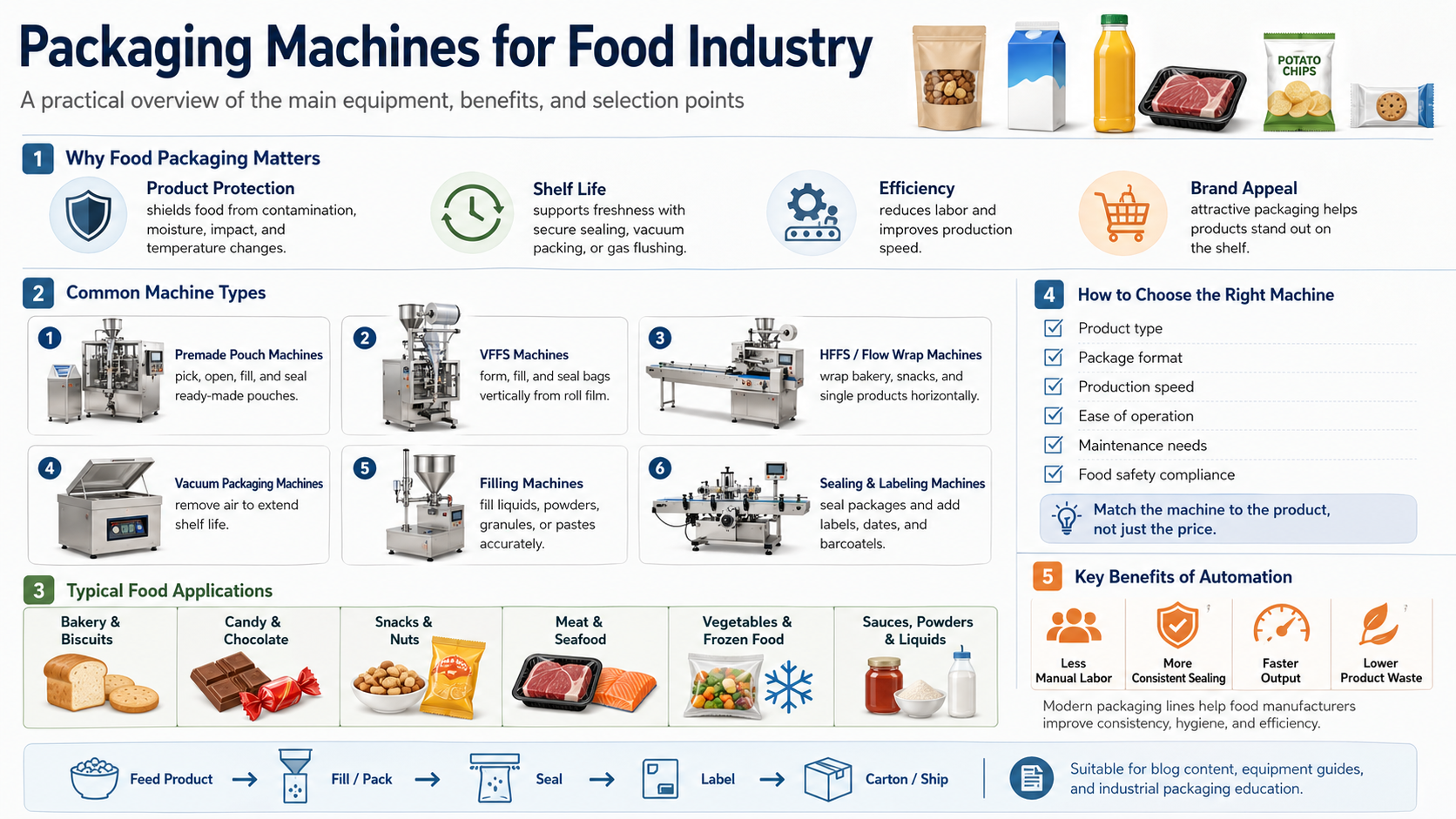
In this guide, we will look at what food packaging machines do, why they matter, the main types of machines available, and how to choose the right one for your food business.
Why Packaging Machines for Food Industry Applications Matter
Food packaging has several important jobs. It protects the product, helps preserve freshness, makes transportation easier, provides important information, and influences how customers see the brand.
For food manufacturers, the packaging stage is also time-sensitive. If your processing line is fast but your packaging line is slow, the entire production flow can be affected. A reliable food packaging machine helps keep production moving smoothly and reduces the risk of delays, errors, and product waste.
Good packaging equipment can help with:
- Product protection
- Faster packing speed
- Better sealing consistency
- Reduced labor costs
- Improved hygiene
- Better shelf presentation
- Easier transportation
- Longer shelf life
- More stable production output
This is especially important in the food industry, where product quality, cleanliness, and safety cannot be compromised.
What Do Food Packaging Machines Actually Do?
Food packaging machines are used after food has been processed, prepared, baked, mixed, cut, filled, or formed. Their job is to place food into suitable packaging and prepare it for storage, shipping, retail display, or direct sale.
Depending on the product and packaging style, a food packaging machine may perform one or more of the following functions:
- Feeding products into the machine
- Measuring or dosing food
- Filling bags, bottles, trays, jars, pouches, or cartons
- Sealing the package
- Vacuuming or gas flushing
- Wrapping or shrink wrapping
- Labeling
- Printing date codes or batch numbers
- Cartoning
- Case packing
- Sorting and conveying products
- Preparing products for palletizing or shipping
In a simple setup, a business may only need one machine, such as a sealing machine or vacuum packaging machine. In a larger factory, several machines may be connected into a complete automatic packaging line.
Food Packaging Protects the Product
The first purpose of packaging is protection. Food can be affected by temperature, bacteria, moisture, oxygen, pressure, vibration, impact, and poor handling during transport. Packaging creates a barrier between the product and the outside environment.
For example, cookies and crackers need protection from breakage and moisture. Meat may need vacuum packaging or modified atmosphere packaging to extend freshness. Powders require clean filling and strong seals to prevent leakage. Liquids need containers and caps that can withstand handling and transportation.
A suitable packaging machine helps ensure that the package is formed, filled, and sealed correctly. This reduces the chance of contamination, leakage, poor presentation, or product damage.
Food Packaging Supports Safety and Shelf Life
In the food industry, packaging is closely connected with hygiene and shelf life. A poor seal, weak material, or unsuitable packaging format can shorten product life or create safety concerns.
Some food products only need a basic bag or carton. Others require vacuum packaging, nitrogen flushing, modified atmosphere packaging, or high-barrier materials. The more sensitive the product is, the more carefully the packaging system should be selected.
For example:
- Meat and seafood often need vacuum or modified atmosphere packaging.
- Coffee, nuts, and snacks may use nitrogen flushing to reduce oxidation.
- Sauces and liquids require accurate filling and leak-proof sealing.
- Frozen food needs packaging that can withstand low temperatures.
- Bakery products need packaging that protects shape and texture.
This is why food suppliers should not choose a machine based only on price. The machine must match the product, the packaging material, and the safety requirements of the production environment.
Packaging Also Works as a Marketing Tool
Food packaging is not only functional. It also affects buying decisions.
A well-designed package can make a product look fresh, premium, convenient, or trustworthy. In many cases, customers judge the quality of food before they ever taste it. They look at the bag, box, label, color, shape, and overall presentation.
This is one reason many food brands choose premade pouches, zipper bags, stand-up bags, printed film, cartons, or custom-shaped packaging. These formats can help products stand out on supermarket shelves.
Convenience also matters. Customers often prefer packaging that is:
- Easy to open
- Easy to reseal
- Easy to store
- Easy to carry
- Clean and practical
- Suitable for repeated use
A food packaging machine should support both product protection and market presentation. If a package looks attractive but is difficult to seal properly, it may not be practical. If a package is technically safe but unattractive, it may not sell well. The best solution balances both sides.
Common Types of Packaging Machines for Food Industry Use
There are many different types of food packaging machines. The right choice depends on the food type, package format, production speed, and automation level.
Below are some of the most common options.
Premade Pouch Packaging Machines
A premade pouch packaging machine uses bags that have already been manufactured before the packing process. The machine automatically picks up the pouch, opens it, fills it, and seals it. Depending on the product, it may also include functions such as dust removal, nitrogen flushing, vacuum sealing, or date coding.
Premade pouch machines are popular because they allow brands to use more advanced packaging designs, such as:
- Stand-up pouches
- Zipper bags
- Resealable bags
- Spout pouches
- Shaped pouches
- Flat pouches
- High-quality printed bags
This type of packaging is especially useful for snacks, nuts, candy, dried fruit, frozen food, pet food, powder products, and some ready-to-eat foods.
The main advantage is presentation. Premade bags can look polished and retail-ready. The downside is cost. Both the machine and the packaging materials are usually more expensive than basic roll-film packaging.
Premade pouch machines are commonly available in rotary and horizontal designs. Both can be efficient, but the best option depends on the product, bag style, and required output.
Vertical Form Fill Seal Machines
A vertical form fill seal machine, often called a VFFS machine, is one of the most classic and widely used food packaging machines. It uses roll film to form a bag vertically, fill the product, and seal the package.
VFFS machines are commonly used for:
- Chips
- Nuts
- Candy
- Rice
- Grains
- Coffee
- Powdered food
- Frozen vegetables
- Small snacks
- Granular products
The biggest advantage of VFFS packaging is efficiency. Since the machine forms bags from roll film, packaging material costs can be lower than premade pouches. It is also suitable for high-volume production.
However, VFFS packaging may not offer the same premium shelf appearance as custom premade pouches. It is best for brands that need speed, consistency, and cost control.
Horizontal Form Fill Seal Machines
A horizontal form fill seal machine, or HFFS machine, uses roll film in a horizontal flow. It forms, fills, and seals the package while the product moves horizontally through the machine.
This type of machine is often used for larger individual items or products with a fixed shape, such as:
- Bread
- Biscuits
- Chocolate bars
- Waffles
- Cakes
- Bakery products
- Meat portions
- Frozen blocks
- Individually wrapped snacks
HFFS machines can be very fast, especially for single-piece products. They are widely used in bakery, confectionery, and snack production.
The limitation is that they are not suitable for every food type. Loose powders, liquids, or very irregular products may require another machine type.
Vacuum Packaging Machines
Vacuum packaging removes air from the package before sealing. This can help reduce oxidation, slow spoilage, and extend shelf life for certain food products.
Vacuum packaging machines are commonly used for:
- Meat
- Seafood
- Cheese
- Cooked food
- Ready meals
- Dried food
- Pickled products
- Fresh produce in some applications
There are several types of vacuum packaging machines, including chamber vacuum machines, continuous vacuum machines, automatic vacuum machines, semi-automatic machines, and vacuum systems designed for premade bags.
For food businesses that care strongly about shelf life, freshness, and product preservation, vacuum packaging can be a very practical choice.
A related method is modified atmosphere packaging, often called MAP. Instead of simply removing air, MAP replaces the air inside the package with a controlled gas mixture. This is common for fresh meat, prepared meals, bakery products, and fresh produce.
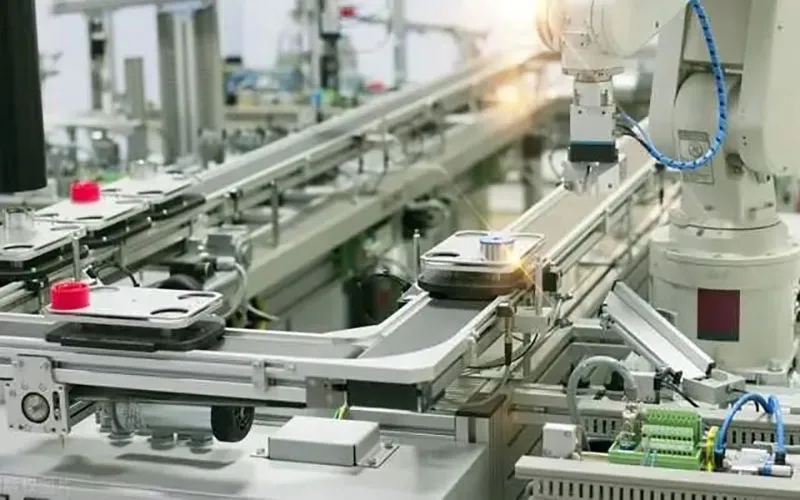
Filling Machines
Filling machines are used before or during the packaging process to place a measured amount of product into containers. They are widely used in both food and beverage production.
Common filling machine applications include:
- Sauces
- Oils
- Honey
- Juice
- Milk
- Yogurt
- Cream
- Paste products
- Powders
- Granules
- Seasonings
There are different filling systems depending on the product, such as volumetric fillers, piston fillers, gravity fillers, pump fillers, auger fillers, and weighing systems.
Choosing the wrong filling system can lead to inaccurate portions, messy packaging, leakage, or high product waste. For example, a thick sauce needs a different filling method from a free-flowing liquid or dry powder.
Sealing Machines
Sealing machines close bags, pouches, cups, trays, bottles, or containers. A strong and clean seal is essential in food packaging because it helps protect the product from leakage, contamination, moisture, and air exposure.
Common sealing equipment includes:
- Heat sealers
- Continuous band sealers
- Tray sealers
- Cup sealers
- Induction sealers
- Vacuum sealers
- Automatic bag sealing machines
A sealing machine may look simple, but seal quality is critical. In food packaging, a weak seal can lead to product returns, spoilage, poor customer experience, or safety concerns.
Cartoning and Case Packing Machines
Cartoning machines place products into boxes or cartons. Case packing machines place finished packages into shipping cases.
These machines are common in larger food production lines, especially for:
- Biscuits
- Cookies
- Chocolate
- Cereal bars
- Frozen food
- Bottled products
- Snack multipacks
- Retail display cartons
Automatic cartoning and case packing machines reduce manual labor and help improve consistency. They are especially useful when products need to be packed quickly for retail distribution.
Shrink Wrapping and Wrapping Machines
Shrink wrapping machines use film and heat to wrap products tightly. They are often used for bundled goods, trays, multipacks, bottles, and some retail food items.
Wrapping machines may also be used for products that need a protective outer layer or a clean retail finish.
Common applications include:
- Beverage multipacks
- Food trays
- Bakery items
- Frozen food packs
- Canned food bundles
- Retail display packs
Shrink wrapping is useful when products need to be grouped, protected, or made easier to transport.
Labeling, Coding, and Marking Machines
Food packaging usually needs labels and printed information. This may include:
- Product name
- Ingredients
- Nutrition facts
- Expiration date
- Production date
- Batch number
- Barcode
- Storage instructions
- Cooking instructions
Labeling machines apply labels to bottles, jars, cartons, bags, trays, and boxes. Coding and marking machines print important production information directly onto the package.
These machines are important for traceability, inventory control, retail sales, and regulatory compliance.
How to Choose the Right Food Packaging Machine
Choosing packaging equipment is not only about buying a machine that can “pack food.” Each food product has different requirements. A machine that works well for biscuits may be completely unsuitable for sauce, powder, frozen vegetables, or fresh meat.
Before choosing a machine, consider these factors carefully.
1. Product Type
Start with the food itself. Is it solid, liquid, powder, paste, granular, sticky, fragile, frozen, fresh, oily, or irregular in shape?
For example:
- Cookies need gentle handling.
- Meat may need vacuum packaging.
- Powder needs dust control.
- Liquids need accurate filling and leak-proof sealing.
- Chocolate may need temperature-sensitive handling.
- Vegetables may need breathable or fresh-keeping packaging.
The machine should match the physical characteristics of the product.
2. Packaging Format
Next, decide what kind of package you want to use.
Common food packaging formats include:
- Bags
- Pouches
- Boxes
- Cartons
- Bottles
- Jars
- Cans
- Trays
- Sachets
- Flow packs
- Vacuum bags
The packaging style affects machine selection, material cost, shelf appearance, and transportation efficiency.
3. Production Speed
Speed matters, especially if you have supply deadlines or high-volume production. A slow machine can become a bottleneck in the entire line.
However, faster is not always better. The machine should match your real production needs. A small food business may not need a fully automatic high-speed line at the beginning. A growing factory may need a machine that can scale with future demand.
4. Machine Price
Budget is always important. But the lowest-priced machine is not always the most economical option.
A cheaper machine may cost more later if it creates downtime, poor sealing, inconsistent packaging, high maintenance costs, or excessive labor requirements.
When comparing prices, look at the full cost of ownership, not only the purchase price.
5. Packaging Material Cost
Consumables can have a big impact on long-term costs. Premade pouches may look better but cost more. Roll film may be cheaper for high-volume production. Vacuum bags, trays, cartons, labels, and printed materials all add to the total operating cost.
A good packaging decision should consider both machine cost and packaging material cost.
6. Ease of Operation
A good machine should be easy to operate, adjust, clean, and maintain. Modular parts and quick-change systems can save time when switching between package sizes or product types.
This is especially useful for factories that produce several SKUs or frequently change packaging formats.
7. Maintenance and Repair
Every machine needs maintenance. Before buying, check whether the machine is easy to clean, inspect, repair, and service.
Ask questions such as:
- Are spare parts easy to get?
- Is the machine structure simple to access?
- Does the supplier provide technical support?
- Can operators handle basic adjustments?
- How much downtime is expected during maintenance?
In food production, downtime can be expensive. Reliable maintenance support matters.
8. Machine Size and Line Layout
Food factories often have limited space. Before choosing equipment, consider the machine footprint, operator access, conveyors, product flow, and future expansion.
A complete packaging line may include feeding, filling, sealing, labeling, cartoning, case packing, and palletizing. The layout should be planned carefully so materials and products move smoothly.
9. Food Safety Standards
Food packaging equipment should be suitable for hygienic production. Depending on the product and market, you may need food-grade contact parts, stainless steel construction, easy-clean design, dust control, or washdown features.
The machine should support safe production instead of becoming a contamination risk.
10. Automation Level
Food packaging machines can be manual, semi-automatic, or fully automatic.
Manual and semi-automatic machines are usually more affordable and suitable for small businesses or low-volume production. Fully automatic machines are better for larger factories that need speed, consistency, and lower labor dependence.
The best choice depends on your current production scale and growth plan.
Food Processing Machines vs. Food Packaging Machines
Food processing machines and food packaging machines are related, but they are not the same.
Food processing machines are used to prepare or process food. This can include cutting, mixing, stirring, pressing, baking, separating, cooking, forming, or blending.
Examples include:
- Ovens
- Mixers
- Cutting machines
- Pressing machines
- Dough sheeters
- Food slicers
- Dividing machines
Food packaging machines are used after the food has been processed. They package the finished product for storage, transportation, sale, or display.
Examples include:
- Filling machines
- Sealing machines
- Packing machines
- Wrapping machines
- Labeling machines
- Cartoning machines
- Vacuum packaging machines
In a modern food factory, both processing and packaging equipment are important. Processing affects the product itself. Packaging protects the finished product and prepares it for the market.
Building a Complete Food Packaging Line
Some businesses only need one machine. Others need a complete automated food packaging line.
A typical food packaging line may include:
- Product feeding system
- Filling or weighing machine
- Packaging machine
- Sealing machine
- Date coding machine
- Labeling machine
- Cartoning machine
- Case packing machine
- Conveyor system
- Palletizing system
For snacks, the line may include weighing, VFFS packaging, date coding, checkweighing, cartoning, and case packing.
For bottled sauces, the line may include bottle unscrambling, filling, capping, labeling, coding, shrink wrapping, and case packing.
For meat products, the line may include portioning, vacuum packaging, labeling, metal detection, and carton packing.
The important point is simple: the packaging line should be designed around the product, not the other way around.
Final Thoughts
Packaging is one of the most important stages in food production. It protects the product, supports food safety, improves shelf life, helps transportation, and shapes how customers see your brand.
The best packaging machines for food industry use are not always the most expensive or the fastest. The best machine is the one that fits your product, packaging format, production speed, budget, factory space, and safety requirements.
If you are packaging cookies, snacks, candy, chocolate, vegetables, meat, sauces, powders, or ready meals, take time to compare different machine types. A well-chosen packaging machine can make your production process more stable, efficient, and ready for long-term growth.
FAQ
What are packaging machines for food industry used for?
Packaging machines for food industry applications are used to fill, seal, wrap, label, carton, or prepare food products for storage, transport, and retail sale. They help protect food, improve efficiency, reduce labor, and support consistent packaging quality.
What is the best packaging machine for food products?
There is no single best machine for every food product. Snacks may use vertical form fill seal machines, bakery items may use horizontal flow wrapping machines, meat may need vacuum packaging, and sauces may need filling and sealing machines. The best choice depends on the product type, package format, and production volume.
What is a premade pouch packaging machine?
A premade pouch packaging machine uses ready-made bags or pouches. It automatically picks up the pouch, opens it, fills it, and seals it. It is often used for snacks, nuts, frozen food, powders, candy, and products that need attractive retail packaging.
What is the difference between VFFS and HFFS machines?
A VFFS machine forms, fills, and seals bags vertically, making it suitable for snacks, powders, grains, and small loose products. An HFFS machine packages products horizontally and is often used for bread, chocolate bars, biscuits, bakery products, and single-piece food items.
Why is vacuum packaging used for food?
Vacuum packaging removes air from the package before sealing. This can help reduce oxidation, slow spoilage, and extend shelf life for products such as meat, seafood, cheese, cooked food, and dried food.
How do I choose a food packaging machine?
Consider the product type, packaging format, production speed, machine price, packaging material cost, ease of use, machine size, maintenance needs, automation level, and food safety requirements. The machine should match the product and the packaging goal.
Are automatic food packaging machines suitable for small businesses?
Automatic machines can be useful for growing businesses, but small businesses may start with semi-automatic equipment if production volume is limited. The right choice depends on budget, labor cost, production demand, and future growth plans.
Why is sealing quality important in food packaging?
Sealing quality affects freshness, leakage prevention, contamination control, and shelf life. A weak or inconsistent seal can lead to spoiled products, damaged packaging, customer complaints, and product waste.